- Creating a compensation plan that wins top talent
- What is a compensation plan?
- Why your company needs a compensation plan
- The components of a compensation plan
- Foundation of a compensation plan
- How to create a compensation plan
- Phase 1: Define your compensation philosophy and job architecture
- Phase 2: Benchmark pay and establish your option pool
- Phase 3: Make competitive offers and manage performance
- Compensation plan example
- Best practices for managing your compensation plan
- Maintain fairness and compliance
- Communicate total rewards with confidence
- Review and adapt at every stage
- The tools that makes compensation planning simple
- Frequently asked questions about compensation plans
- How often should I review my startup's compensation plan?
- How do I explain equity to my first hires?
- Should my compensation plan be different for remote employees?
- Do I need a formal compensation plan if I only have a few employees?
- How does compensation planning differ for an LLC?
- When should a startup introduce performance bonuses?
- How do you balance cash and equity in an offer?
- Download our guide to building an effective compensation plan
What is a compensation plan?
A compensation plan is a structured framework that outlines how your company rewards employees for their work. It includes all forms of employee compensation, such as base salary, bonuses, equity, and benefits—a concept the IRS supports by defining gross income to include wages as well as other forms of compensation like fringe benefits and stock options. An effective compensation plan not only sets the value of what you’re paying, but also defines roles and levels and outlines how performance will be evaluated. Ideally, it’s part of a total rewards plan, which documents your compensation plan plus the benefits package you offer.
For you as a founder, your employee compensation plan is your official playbook for building your company, with formal plans often stating their purpose is to attract, retain, and motivate the talent you need. Your compensation plan should be a tool that aligns your team’s efforts with your business objectives, rather than an administrative checklist. It defines how you will pay your employees and what behaviors and outcomes you are rewarding. A well-designed comp plan provides a clear, consistent, and fair approach to employee pay that helps you build a strong and motivated team from day one.
Why your company needs a compensation plan
As a founder, you're juggling many tasks, and creating a formal compensation plan might seem like an activity you can put off. However, in a volatile startup environment, establishing a people and compensation plan early is one of the most strategic decisions you can make for your company's future. An official compensation plan cultivates pay equity and transparency, maintains strong company culture, and helps retain top talent. It’s your secret weapon for competing against established companies that may have deeper pockets and more recognizable brand names.
The stakes for employee retention are high, with data showing considerable employee turnover: The median job tenure for startup employees is 2 years, and there is roughly a 50% chance an employee will no longer be with the company after 3 years.
A well-defined compensation plan demonstrates professionalism to investors, showing them you are serious about building a sustainable and scalable business. More importantly, it creates a fair and transparent foundation for your team from the very beginning. Pay equity is simply compensating employees equally for performing the same or similar role according to factors like experience and job performance. Without a compensation plan, pay equity can be difficult to track and manage, especially for early-stage companies. A fair work environment increases employee performance and reduces turnover, according to a Gartner survey. By implementing a compensation program early, founders and CEOs can attract the best employees and reduce turnover.
This proactive approach helps prevent the kind of confusion and feelings of inequity around pay rates that can demotivate employees and create internal friction, as the inability to retain staff can be an enormous impediment to core operations. It sets a precedent for how you value your people.
A strong compensation plan gives your startup several superpowers:
Attract top talent: You can make compelling offers to candidates you might not otherwise be able to afford. By leading with the potential for significant equity upside, you appeal to ambitious individuals who are motivated by building something and sharing in its success through equity. While working for a startup is a gamble, the reward for success most often comes from company equity. For many talented people, the allure of equity—the potential for a 10x or 100x return—represents a rare economic opportunity that motivates them to join a growing company.
Create an ownership culture: When you make employees owners, you align their incentives with the company's long-term success. Instead of just renting their time, they have a real stake in the outcome, which fosters a culture of commitment, accountability, and shared purpose.
Manage your burn rate: A structured comp plan leads to predictable compensation budgeting. This helps you extend your runway, manage cash flow with greater confidence, and plan your growth without unexpected payroll spikes that can put your company at risk.
Build investor confidence: A formal compensation plan shows investors that you are a serious, organized founder. It demonstrates that you manage the company’s most valuable resources—its cash and its equity—in a professional and strategic manner, which gives them confidence in your ability to lead.

The components of a compensation plan
A modern compensation package has three main pillars that work together to create a compelling and holistic offer: cash, benefits, and equity. As a founder, you need to understand how to balance these types of compensation to attract the right talent for your team, especially when you can't always compete on cash alone. Each piece plays a unique role in how an employee perceives the value of working for your company.
Cash (salary and bonuses): This is direct compensation consisting of a fixed base pay for financial stability and variable, non-guaranteed payments tied to specific goals. It is the most straightforward part of a package, though early-stage startups often manage these costs strictly through geographic adjustments to conserve cash.
Benefits (benefits and perks): This is indirect compensation in the form of non-cash benefits, such as health insurance, paid time off (PTO), and retirement plans, designed to enhance employee wellness and job satisfaction. They serve as a vital tool for building company culture and can be the deciding factor for candidates when cash or equity offers are otherwise similar.
Equity (your competitive edge): This is equity that grants employees ownership in the company, aligning their personal financial interests with the organization's long-term success. Often provided through stock options or restricted stock units (RSU), it typically involves a vesting period to incentivize retention and allow startups to attract high-tier talent they might not be able to afford with cash alone.
Foundation of a compensation plan
A compensation plan is built on four pillars: compensation philosophy, job architecture, performance management, and incentives.
Compensation philosophy: Your company’s overall position about employee compensation. Your compensation philosophy should align with your business strategy to hire, retain, and reward top talent.
Job architecture: How you define roles and leveling. Also called job leveling or job structure, this refers to the hierarchy of jobs within your company.
Performance management: Guidelines for performance evaluations. This helps managers track employees’ work so they can receive ongoing feedback and advance their career development.
Incentives: How you reward high-performing employees for their work. Incentives like bonuses, and equity refreshes, encourage employee performance and stimulate productivity.
Creating or updating any compensation program starts with a clear philosophy. Knowing what your company values makes it easier to make decisions that match those values. Knowing why you’re making those decisions will make sure the entire planning process goes smoothly.

How to create a compensation plan
Building your first compensation plan is a practical, step-by-step process that sets your company up for scalable growth. For a founder, the goal is to get this right from the start to make hiring and retaining talent a core strength, not a constant challenge. The process should feel manageable and strategic, not overwhelming.
Phase 1: Define your compensation philosophy and job architecture
Your first step is to create a compensation philosophy, which is a set of guiding principles for all your pay decisions. This philosophy should be a direct reflection of your company's values and overall business strategy. To define it, ask yourself key questions: Will you pay at, above, or below the market rate for cash salaries? How transparent will you be about pay with your team? How central is equity to your offers?
Next, establish a simple job architecture. This process of job leveling organizes roles into tiers, such as Junior, Mid-level, and Senior, based on skills and responsibilities. This framework creates a clear path for career progression for your employees and ensures you can make fair and consistent pay decisions as your team grows. It’s the internal structure that brings your philosophy to life.
Phase 2: Benchmark pay and establish your option pool
A compensation philosophy is useless without data. Salary benchmarking is the process of researching what other companies are paying for similar roles in your industry and location. In a competitive job market, relying on generic, outdated market trends and salary surveys can put you at a significant disadvantage. For specialized roles, the market moves quickly; for example, median AI/ML salaries for new hires at smaller startups rose by 9.1% in the 18 months between January 2024 and June 2025.
As Darcy McKay, SVP, HR and client services at Rippling, explains during Carta’s Elevate Your Compensation Strategy webinar, it's best to use a mix of inputs. These can include external data sources, real-time market data from your recruiting team, and conversations with senior-level candidates.
This is where headcount planning, real-time industry benchmarks, and startup-specific compensation data become invaluable. Software like Carta Total Compensation provides salary and equity benchmarks from thousands of other startups, helping you create a truly competitive compensation plan. At this stage, you should also work with your board and legal counsel to create an option pool, which is a portion of company equity reserved specifically for new hires.
Phase 3: Make competitive offers and manage performance
With your philosophy and data in hand, you can now combine salary and equity to create a compelling total compensation package. It's important to communicate the full value of your offer, as the potential of equity can be a powerful motivator that sets you apart. For example, the team at Dynasty uses Carta Total Compensation to show candidates the full picture, which has been instrumental in helping them build a strong, motivated team.
Tools that generate a total rewards statement can visually break down the value of an offer, including base salary, benefits, and the potential upside of equity. This clarity makes it easier for top candidates to understand the offer letter and say yes. Once a hire accepts, their equity grant can be issued and managed directly on equity management software, ensuring a smooth and professional onboarding experience.
Compensation plan example
Now that you know the structure of a compensation plan, let’s put it into action. Using Carta Total Comp, you can create your company’s total rewards system. Our software accounts for all of the aspects mentioned above, including salary targets based on geography and cost of living, salary bands, bonuses structures, and equity grant schedules, as well as employee benefits.
Here’s an example of a compensation plan for a (hypothetical) $150 million Series D company that used Carta Total Comp to create its compensation plan:
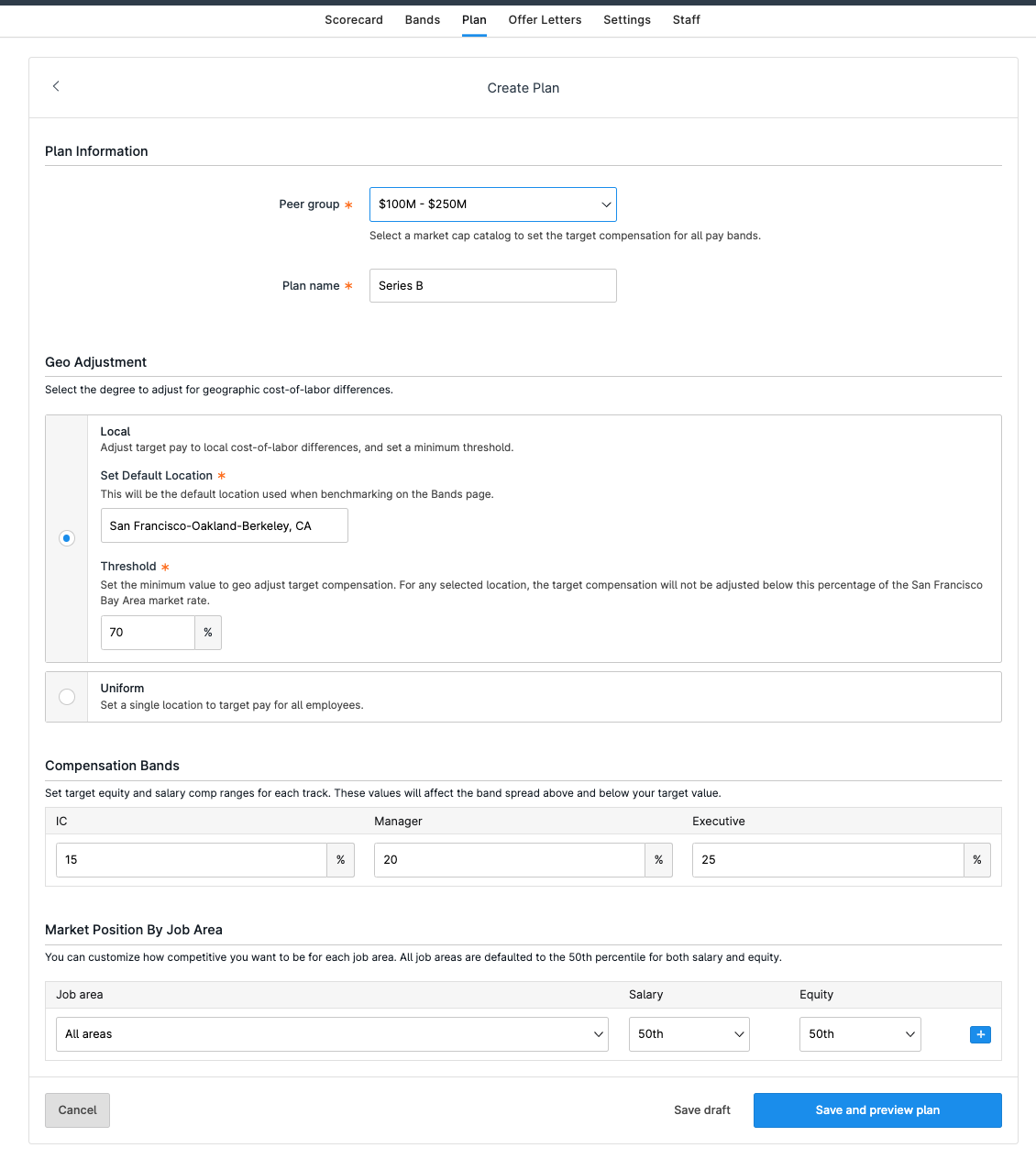
Meetly’s HR manager set the peer group used to benchmark compensation for all pay ranges (the total amount allocated for compensation) to between $100 million and $250 million and set the geographical location to the local San Francisco-Oakland-Berkeley, CA, area. They were also able to set compensation band widths for individual contributors (ICs), managers, and executives.
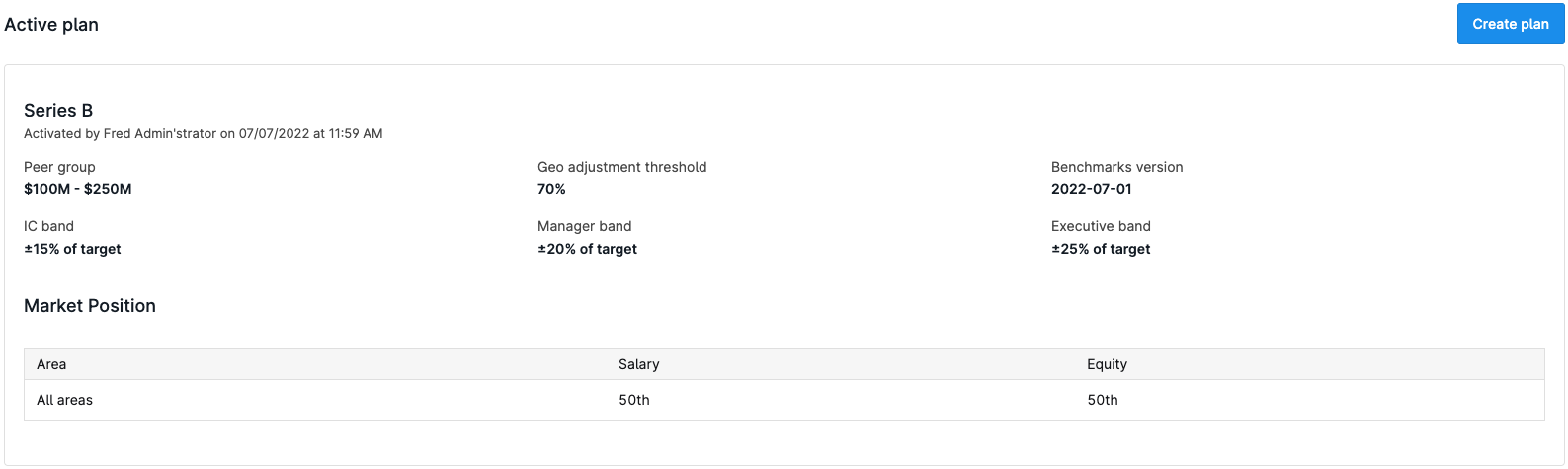
Above you can see a customized compensation plan for Meetly. It also shows how the company targets compensation versus the overall market for the roles, using Carta’s benchmarks.
By inputting some basic information, you can create a total rewards compensation plan that accounts for salary, bonus, equity, and benefits. Carta Total Comp uses data from over 120,000 employees across the entire Carta’s customer base to make compensation recommendations that can help your company attract and retain talent.
Schedule a demo to see how Carta Total Comp can work for your company.

Best practices for managing your compensation plan
Creating your compensation plan is the first step, but managing it effectively is what ensures long-term success and team alignment. A compensation plan is a living document that should evolve as your company grows, the market changes, and your business goals shift. Following these best practices will help you maintain a fair, competitive, and compliant program.
Maintain fairness and compliance
A structured compensation plan is your best defense against pay inequity and a step toward pay transparency, and with a rising demand for pay equity from candidates, it's also a critical tool for building trust and attracting top talent. It creates a defensible, consistent logic for why people are paid what they are, which reduces legal risk and, just as importantly, builds trust with your team. Without a clear framework, it’s easy for inequity to take root. The startup equity gap is a clear example: White men alone received 43.4% of issued equity, compared to 23% for white women—and racial diversity among new hires has continued to decline through 2024.
This is where your compensation plan connects directly to your core equity management. True equity management requires a single source of truth for ownership, which is your cap table software. It also depends on compliant option pricing through regular 409A valuations and adherence to ASC 718, which are the bedrock of any fair and legally sound employee equity program.
Communicate total rewards with confidence
One of the most common challenges for founders is helping candidates and employees see the full value of an equity-heavy offer. Cash is easy to understand, but the potential of equity can feel abstract and confusing without a startup equity calculator. Clear, simple equity education is key to making your offers compelling and ensuring your team feels valued.
This is where a tool like Carta Total Compensation's total rewards statements can be transformative. These visual, easy-to-understand documents show the complete value of an offer—salary, bonus, and the potential future value of equity—all in one place. For companies like Dynasty, this clarity has been instrumental in building a strong, motivated team by helping everyone “understand the full value of their compensation.”
Review and adapt at every stage
You should treat your compensation plan as a living document that grows with your company. It's essential to conduct a compensation review at least once a year, as pay packages have become more generous overall in recent years, and refreshing your benchmarks ensures you don't fall behind the market. This ensures your compensation remains competitive and aligned with your company's evolving financial position and strategic goals.
This proactive approach prevents your pay from falling behind the market, which can lead to retention issues that may require an equity refresh grant to resolve. It also allows you to adjust your strategy as your company matures and your ability to offer more competitive cash salaries increases, ensuring your plan always reflects your current reality.

The tools that makes compensation planning simple
Choosing the right tool for the job is the final step in setting up your compensation process. As a founder, you can choose between manual spreadsheets and a modern, integrated platform. While spreadsheets might seem easy and free at first, they quickly become a liability as your company and team grow.
Manual compensation planning presents many challenges for a busy founder. The guesswork, the messy spreadsheets, the constant risk of inequity, and the sheer administrative burden can be overwhelming. Decisions around equity, like whether to use monthly or annual vesting schedules, have significant downstream effects on the administrative workload. For employers, monthly vesting can create more complexity because administrators and other workers must spend more time managing and updating cap tables and other financial systems. A dedicated, integrated equity management software removes these challenges and replaces them with a professional, streamlined process that saves you time and gives you confidence.
Manual spreadsheets | Integrated compensation software |
Relies on stale, public data | Uses real-time private market benchmarks |
High risk of errors and inconsistency | Ensures fairness with structured salary ranges |
Difficult to explain equity value | Clearly communicates total rewards |
Disconnected from your cap table | Aligns compensation with ownership |
Carta provides a single, integrated platform for founders and HR professionals covering cap table management, 409A valuations, compensation benchmarking, and communication with Carta Total Compensation.
Request a demo to get started today.
Frequently asked questions about compensation plans
How often should I review my startup's compensation plan?
You should conduct a compensation review at least once a year and after any major company event, like a new funding round, to ensure it remains competitive and aligned with your organization’s goals.
How do I explain equity to my first hires?
Explain equity to early employees by focusing on the concept of ownership and shared success, using simple analogies and being transparent about both the potential rewards and the risks involved.
Should my compensation plan be different for remote employees?
You can use salary bands to either adjust pay based on an employee's location or pay everyone the same for the same role; choose the approach that best fits your company's compensation philosophy.
Do I need a formal compensation plan if I only have a few employees?
Yes, establishing a hiring plan and fair compensation strategy from your very first hire sets a professional foundation for growth and helps you avoid complex and costly problems down the road.
How does compensation planning differ for an LLC?
While the strategic principles are the same, LLCs typically issue profits interest instead of stock options. These have unique tax and tracking requirements that specialized equity incentive plans are designed to manage.
When should a startup introduce performance bonuses?
Early startup employees should be cautious with cash bonuses, as they are most effective for roles with directly measurable performance metrics, such as sales roles. To avoid them becoming an entitlement, they should always be tied to clear, ambitious goals.
How do you balance cash and equity in an offer?
The balance shifts with company maturity. Very early-stage companies lean heavily on startup equity to conserve cash and offer significant upside, while later-stage companies can offer more competitive cash salaries while still providing meaningful equity.
Download our guide to building an effective compensation plan
Learn how to strategically plan and implement a data-driven compensation strategy to attract and retain talent, manage financial resources, and align your company’s goals with employee incentives.

DISCLOSURE: This communication is on behalf of eShares, Inc. dba Carta, Inc. ("Carta"). This communication is for informational purposes only, and contains general information only. Carta is not, by means of this communication, rendering accounting, business, financial, investment, legal, tax, or other professional advice or services. This publication is not a substitute for such professional advice or services nor should it be used as a basis for any decision or action that may affect your business or interests. Before making any decision or taking any action that may affect your business or interests, you should consult a qualified professional advisor. This communication is not intended as a recommendation, offer or solicitation for the purchase or sale of any security. Carta does not assume any liability for reliance on the information provided herein. © 2026 Carta. All rights reserved. Reproduction prohibited.