Tax season arrives at the same time every year. Your K-1 doesn't.
As an LP in a VC fund, you know the drill: You wait on your K-1, your accountant waits on you, and the April 15 individual tax filing deadline often turns into an extension that buys you more time to file your return. If you've been an LP long enough, this feels like a fact of life rather than something you can influence.
But there’s a structural reason behind it—and a structural way to improve it. To see it, you need to understand what's actually happening between January and whenever your K-1 finally arrives.
Where the delay actually comes from
Your K-1 isn’t delayed only because tax preparation is complicated (though it is). A major driver is how fund administration and tax preparation are typically structured as two separate services, managed by two separate teams, sharing data only once a year.
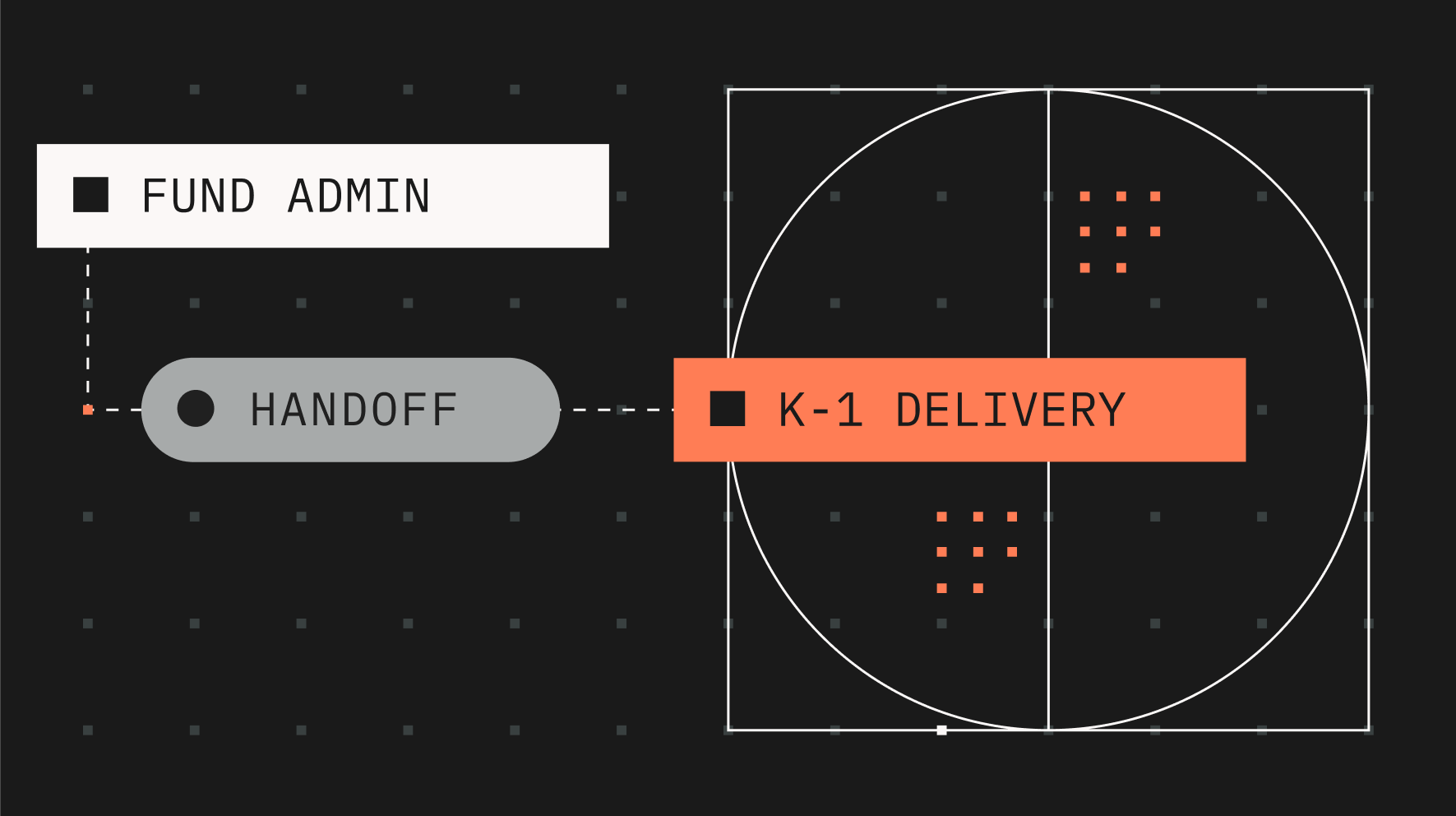
Here's the standard workflow: The fund's administrator closes the books after the fiscal year ends. That takes 30 to 45 days after December 31 for most calendar-year funds. Once the books are finalized, the fund admin exports the financial data and sends it to a separate tax provider—a different firm entirely. That tax provider reviews the data, prepares a Form 1065 partnership return, and produces the Schedule K-1s for each LP.
Every step in this process is sequential. Nothing moves until the previous step is complete. The tax provider doesn't start until they have the fund admin's export. You don't receive your K-1 until both are done.
In practice, this timeline often extends well past the original March 15 partnership return deadline for calendar‑year funds. Many VC funds with separate providers file extensions, which can push final K-1 delivery to September or even later. If the fund’s fiscal year ended on December 31, you might not receive your K-1 until nine months after year‑end.
What that means for your own tax filing
You generally can't accurately complete your own tax filing (individual, trust, or entity, depending on how you’re invested) until you have your K-1. Your K-1 reports your share of the fund's income, losses, deductions, and credits for the year—information the IRS requires you to include.
If you're invested in more than one fund, you're waiting on multiple K-1s, any one of which can delay your filing. If you're a family office or fund of funds with downstream reporting obligations, your own investors are waiting on you. The delay compounds.
The most common response is to file an extension on your return—often moving an individual filer’s deadline to October 15. That’s a perfectly standard fix, but it’s still a workaround for a workflow problem you didn’t create and can’t control. Your fund manager’s choice of service providers directly affects your tax calendar and how long you’re left waiting.
What changes when fund admin and tax are on the same platform
A large part of the timeline problem has a structural cause and a structural solution. When fund administration and tax preparation run on the same platform, the sequential handoff disappears. The tax team has direct access to the fund's general ledger, investment schedule, and capital account statements from day one, not after a year-end export.
Carta Fund Tax is built on the same underlying data as Carta Fund Administration. Because there's no data handoff between two separate firms, K-1 preparation can begin earlier and move faster.
For you as an LP, this means two things.
Earlier delivery. When a fund manager uses an integrated platform, returns can go out before—not after—extension season for funds that aren’t waiting on lower‑tier or look‑through K‑1s. In the most recent tax year, Carta’s Fund Tax team delivered K‑1s to tens of thousands of LPs ahead of the original March 15 partnership deadline in those cases.
Access in one place. If the fund you’re invested in uses Carta Fund Administration, your K‑1s are available in the same portal where you receive your capital call notices and distribution statements. No separate email delivery service. No password-protected PDF arriving in a zip file. Your tax documents appear in the same place you already go to manage the fund relationship, organized by year and entity.
What you can do while you wait
If your K‑1 is arriving after March 15 this year and your fund doesn’t use Carta, your practical options are limited. You can file an extension using Form 4868 to push an individual filing deadline to October 15. You can ask the fund manager for a timeline and a status update. You can note the pattern when you're evaluating your next LP commitment.
Extensions are a standard part of fund tax for now. What’s not inevitable is being in the dark about when your K‑1 will arrive, or having to wait until late summer for it. The funds that consistently deliver K-1s on time—before the original deadline—are typically the ones that have eliminated the handoff between fund administration and tax preparation entirely.
If you're invested in a fund that uses Carta Fund Administration, you can access your K-1s and all other tax documents directly through the Carta LP Portal. The fund manager can grant you access if you don't already have it.
If you're evaluating a new fund commitment, it's a fair question to ask: When did LPs in your existing funds receive their K-1s last year? The answer tells you more about their operational setup than their investment thesis.
Already a Carta LP? Access your K-1s and tax documents in the Carta investor portal. Sign in or request access →
Are you a fund manager? See how Carta Fund Tax eliminates the handoff that delays K-1 delivery. Learn more →

DISCLOSURE: This communication is on behalf of eShares, Inc. dba Carta, Inc. ("Carta"). This communication is for informational purposes only, and contains general information only. Carta is not, by means of this communication, rendering accounting, business, financial, investment, legal, tax, or other professional advice or services. This publication is not a substitute for such professional advice or services nor should it be used as a basis for any decision or action that may affect your business or interests. Before making any decision or taking any action that may affect your business or interests, you should consult a qualified professional advisor. This communication is not intended as a recommendation, offer or solicitation for the purchase or sale of any security. Carta does not assume any liability for reliance on the information provided herein. © 2026 Carta. All rights reserved. Reproduction prohibited.