As a private equity fund manager, you can’t do your job without accurate, timely, and traceable valuations for your portfolio companies.
Having the best available valuations data is a critical part of providing financial reporting to your LPs and regulators. It can be integral in other ways, too, such as accurately reflecting complex capital structures or exit scenario planning.
Wrangling all the information that goes into a valuation, however, can be an inefficient, time-consuming task. Data from cap tables, waterfall models, company financial reports, and portfolio analytics is often scattered across different systems, spreadsheets, and software providers. This data must be manually collected and analyzed. Numbers might be out of date or in disagreement. Any discrepancies must be reconciled, and fast.
For deal teams and valuation associates, this process can feel Sisyphean. The moment one manual reporting cycle is completed, the next one is ready to begin.
The inefficiencies of a traditional valuation process can have serious implications. Juggling data from various internal sources and third-party providers might lead to crossed wires or unforced errors. LPs might raise questions, or look in other directions. Attractive opportunities might be missed. Or your deal teams and middle office might just waste a lot of time churning through outdated, manual processes when there is a better, simpler way.
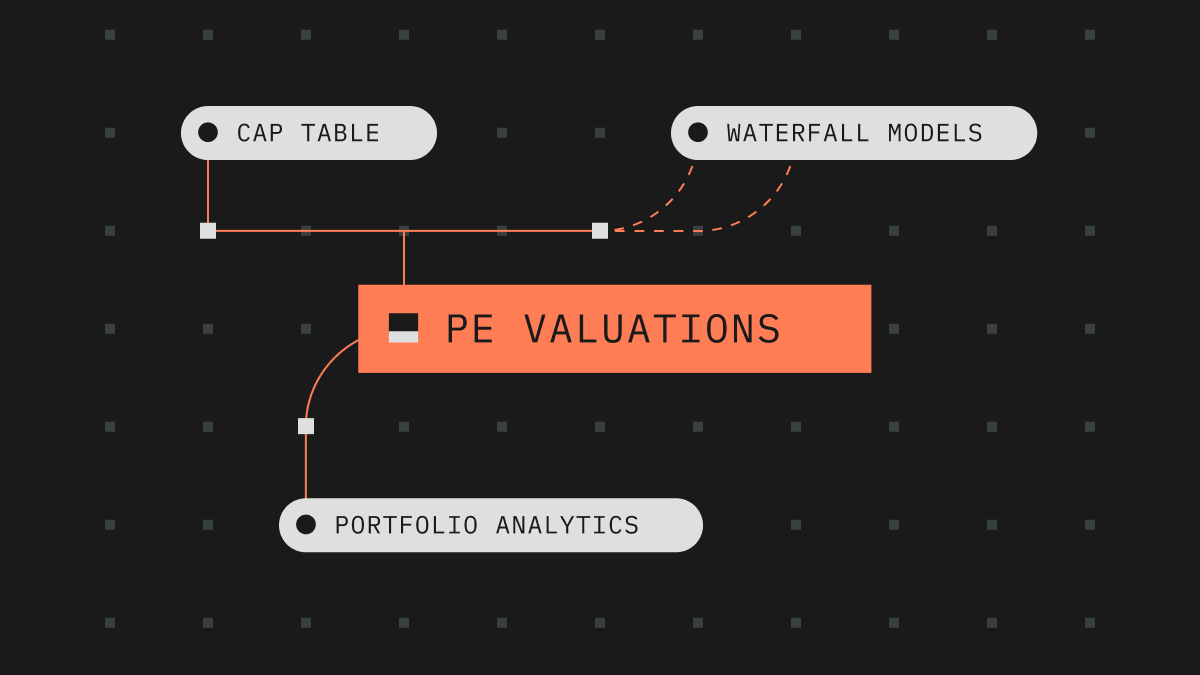
When your valuation process is managed in the same place as your cap tables, waterfall models, tax documentation, fund reporting, portfolio analytics, and LP communications, everything is connected. Everything is automated. Everything is under your control. A network ERP for private capital can provide better insights with more clarity in less time, freeing you and your team to spend more time on the most important, rewarding, and profitable parts of managing a fund.
A connected ecosystem for fund management can improve your PE fund’s valuation process in three primary ways.
1. Data collection and integration
Many PE firms work with a roster of different third parties or build their own internal systems to manage portfolio company cap tables, waterfall models, and portfolio analytics. When a firm’s finance team is running a valuation process, they must coordinate and reconcile data from these disconnected systems.
There are lots of ways it can go wrong. A change in ownership structure from a recent investment wasn’t properly reflected in the cap table. Three of your portfolio companies are using three different pieces of software to update their KPIs. Six versions of the waterfall model are floating around in various confusingly named spreadsheets, and the only person who knows which one is correct is out of the office for the week.
Your valuations associate planned to spend two hours determining the proper valuation to report for one of your portfolio companies. Instead, it takes all day.
Having a single source of truth for all of your fund and portfolio company financials can eliminate these concerns. Everything is housed in one system. Cap tables and waterfalls are automated and connected, to each other and to your valuations tool. No more reconciling disparate sources of data. When your LPs or auditors ask where a valuation came from, you can easily show them the audit trail.
Efficiency in collecting and integrating data only grows more important as valuations cycle grow more frequent. Traditionally, private equity firms provided quarterly valuations updates to their LPs. But that quarterly scramble is increasingly becoming a monthly one. Firms that are pursuing retail investment through private wealth channels must now typically update their valuations every month, to align with the reporting standards of brokerages that are connecting their clients to fund managers.
The PE industry’s ongoing expansion is introducing new demands on valuations reporting. A connected ERP system can help you keep pace.
2. Calculation and allocation
Once the data is collected, the work of determining the proper valuations for your portfolio companies can begin. There are a few widely accepted ways of valuing private companies, as outlined by ASC 820. In PE, the most common methods are a market-based approach and an income-based approach, which typically relies on a discounted cash flow (DCF) model.
Your deal team and valuations associates are familiar with these methods and are comfortable with different approaches. They know the right public comparables and the valuation multiples from recent transactions. But without connected systems, the quarterly valuation sprint too frequently turns into a monthlong ordeal of juggling different versions and spreadsheets to make sure that all information and models are accurate and up to date.
When your valuation tool is connected to your cap tables, waterfall models, and all the other relevant data, that timeline can be slashed. Instead of multiple hours, updating a company’s valuation might take 30 minutes. And you can easily shift between different valuation methodologies and models to fit your needs.
Linking your valuations to portfolio company waterfall models can also help with potential liquidity planning, allowing you to see how value will be distributed across the cap table. The latest valuations may inform your scenario modeling. Want to know what the difference between a 3x exit and a 5x exit means for all of a company’s shareholders? When your valuations are connected to your waterfall, the answer is at your fingertips.
This ability to better visualize value creation and potential allocations can be particularly useful at scale, where complexities tend to increase. PE firms might have various co-investments with LPs across different assets. Instead of investing directly in an asset, a firm might own a holding company that owns the asset. When there are changes to the valuation or economics of a platform, a connected system can help you track the impact across different entities.
When it comes to calculating portfolio valuations, PE firms don’t need to reinvent the wheel. But they can make existing processes more efficient.
3. Automated updates
In a connected system, once portfolio valuations are updated, they’re used to automatically update the Schedule of Investments and the entire downstream reporting system. Valuation exports are attached directly to the journal entry, making valuations easy to review and to defend to any auditors or LPs.
If the software you use for fund administration is separate from the software you use for valuations, there’s a lot of required communication back and forth between systems about the value of each holding. The emails, phone calls, and instant messages can stack up, eating into your time and making it more difficult to track every step of the valuation process.
When these systems are connected, communication between them is automatic and seamless. Information rolls over smoothly, and the chance for errors is greatly reduced.
Automating this process can free up your middle office—and reduce the amount of middle-office help that a fund requires. PE firms can operate more leanly, limiting the amount of time and capital they spend on administrative tasks.
When your auditors come calling, having automated updates throughout your reporting system makes their job easier. You can trace and check your financial statements with the push of a button, creating a clearly defined chain of custody for your valuations and all the rest of your most important information.
There are lots of tools out there designed to help PE firms manage the finances of their portfolio companies more effectively. Tools for collecting documents and data. Tools for fund admin. Tools for updating valuations.
But most of these tools have a problem. They’re siloed and disconnected. There’s not one source of truth. Data that’s updated in one place remains unchanged in another. Documents and systems aren’t talking to each other. As a PE fund manager, this can leave you in the dark.
You’ve probably already started down the road of using software to improve your fund operations. It’s time to take the next step—time to consolidate all of your disparate tools into a single, connected system that helps you manage your valuations and every other aspect of fund management in the most efficient way possible.

DISCLOSURE: This communication is on behalf of eShares, Inc. dba Carta, Inc. ("Carta"). This communication is for informational purposes only, and contains general information only. Carta is not, by means of this communication, rendering accounting, business, financial, investment, legal, tax, or other professional advice or services. This publication is not a substitute for such professional advice or services nor should it be used as a basis for any decision or action that may affect your business or interests. Before making any decision or taking any action that may affect your business or interests, you should consult a qualified professional advisor. This communication is not intended as a recommendation, offer or solicitation for the purchase or sale of any security. Carta does not assume any liability for reliance on the information provided herein. © 2026 Carta. All rights reserved. Reproduction prohibited.