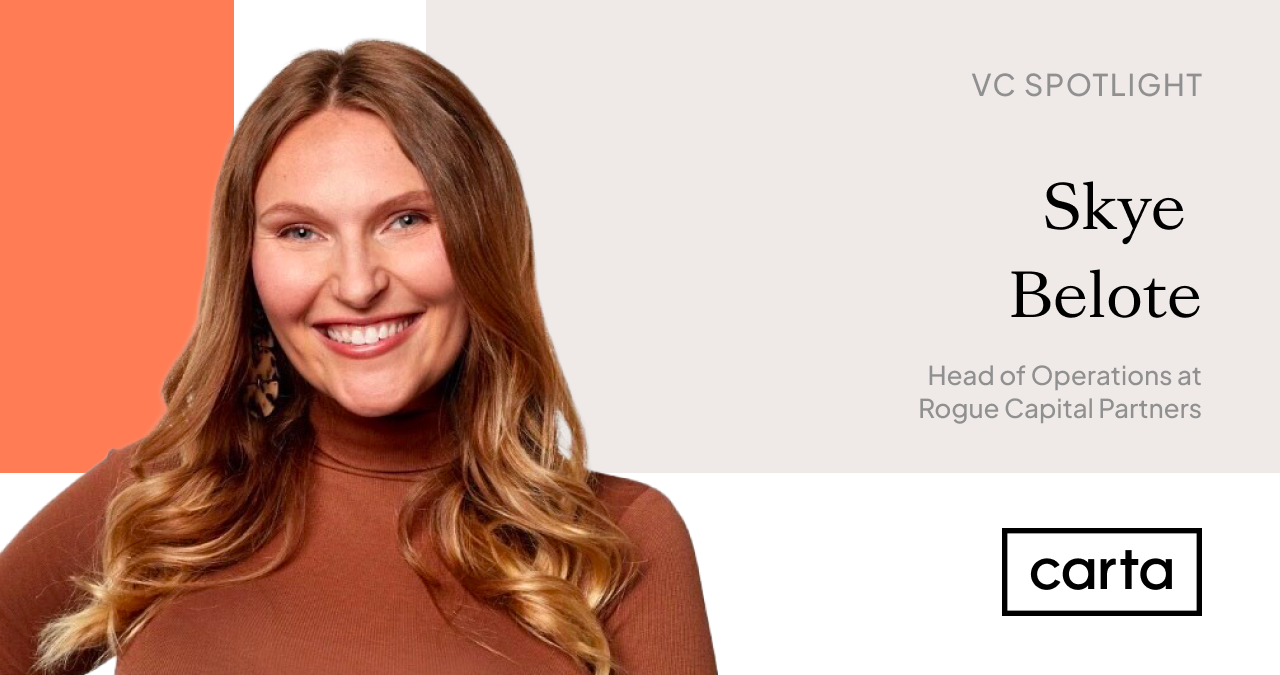
Skye Belote is head of operations at Rogue Capital Partners. The women-led firm was founded in 2010, and invests in deep technology with a $60M fund. Skye joined Rogue after years working at startups, venture firms, and a hedge fund. Her path began with an executive assistant position at a startup, during what she thought would be a gap year before medical school, but she fell in love with the dynamic world of Silicon Valley.
We sat down with Skye to hear more about her path, what excites her about venture operations, and the advice that has shaped her career.
CARTA: Tell us about your path to venture and what led you to Rogue.
SKYE BELOTE: I have a pretty interesting, non-linear, way I got here. I married my high school sweetheart, and we wanted to try something new, to get out of Connecticut. So we came out to California after he got a job at Stanford. I was taking a year off before medical school, and pretty much took the first position I was offered, which ended up being a job at a startup. I had no idea about the startup world back then, since I’d been so focused on pre-med.
I started as an executive assistant, right when this company was raising a Series A. That first company is how I got connected with Pear VC. I ended up working at Pear for a bit, then at another Pear portfolio company. That was a really valuable experience—to get to see both sides of the VC-startup relationship.
Then after some time in consulting, I worked at a hedge fund, running operations, which was really, really wild. It was probably the most intense aspect of my career, but it gave me a wealth of knowledge on financial operations. I could probably work at any type of financial firm now.
When I came back to venture, I had a much more eclectic knowledge of different sorts of fund structures, and financial operations generally.
So that led me to where I am today—Rogue. It’s a $60 million deep technology fund. It’s me and the managing director, and I run fund operations, all of back and middle office. Once we decide that we're doing a deal, I help with the negotiations, ensuring that we have the capital, and getting everything across the finish line. Plus, I do everything behind the scenes, soup to nuts, like tax, audit, working with legal, working with the fund administrators, answering any LP questions, and so on.
I’d love to dig into that moment at your first startup. Was med school still in the back of your mind? When did you know you wanted to switch course more permanently, rather than a gap year?
I’d say I truly fell in love with the startup world about three weeks into that first job. It’s when I first started to feel like I was bringing value to the table. I remember thinking, “I don’t know anything about this, but I’m somehow doing a good job.”
Then I thought: I think I can do this, and I love what I’m doing. I loved that the career opportunities felt limitless. There was such a sense of uncapped potential.
With fund ops, you can really make what you want out of it. Whether your goal one day is to open your own fund or become an expert in your exact trade and do it for a bunch of funds, there’s ample opportunity to build the career you want. I'm a Gemini, so I love to have my hands in lots of different things, and I love that with venture you wear so many different hats.
I would never have learned that if I hadn’t stumbled into that first job. I quite honestly didn't understand what venture capital was until I got to Silicon Valley. That first experience opened my eyes to different opportunities and possibilities, and redefined what my career path might look like.
Has there been a mentor in your life who has guided your career?
There has been. He was probably the first person that believed in me and my skills, and recognized my potential. He saw that even before I did. When I would produce something, I was always nervous to show anyone. But this mentor told me, “This is quite literally excellent. You shouldn't be nervous to bring anything to the table.” He really helped build my confidence, and shape how I thought about career growth.
I met him when I was between my first stint in venture and my hedge fund work. This helped me pave a new way for my career, from being more of an executive assistant to really thinking through what it would look like for my trajectory to become the CFO or CCO or even COO of a venture capital fund.
He also helped me understand a little bit more of the landscape and what kinds of skills are very valuable, like compliance, and how I can build those skills to continuously be a valuable asset. So I owe a lot of that to him and I'm very thankful for his partnership and his continued believing in me.
Is there advice you would share with someone just starting their career in venture operations?
I would say go with the flow. Things will always change at the drop of a hat, especially when you're working in early stage venture or startups. You need to be malleable, especially in these operating roles where sometimes you might have to plug a hole for marketing, or hiring, and you have no idea about it, but there’s no one else to do the work.
I’ve found that being able to produce, produce quickly, and be flexible are the most important traits. Your job is not to know everything. Your job is to figure out how to just complete what you need to. At the beginning of my career, I would take it upon myself a lot to become an expert in this or an expert in that, but it really is just being able to synthesize and source data and being able to get that output to whoever needs it, whether it's yourself or your manager.
Rogue invests in deep technology—tell us more about what that means.
When we approach potential investments, we are really looking forward to a protopian future. And that's a little bit different from Utopia. It's more of what is genuinely achievable and how we can continuously progress as a society. So in our deep technology portfolio, we don't just have robotics and energy companies, which are fantastic, but we also have culture, gaming, and art.
We're backing technology that we genuinely feel will shape a better tomorrow. And it's such an incredible initiative to be part of. I think that helps me do my best work because incredible companies, the founders, the initiatives and everything that they're working on is super dear to my heart.
You’ve mentioned that you wear a lot of hats in venture ops. How do you manage your day-to-day?
Because I manage all of the day-to-day, I've created my own system, which I’ve brought with me to each place I’ve worked, and improved each time. I rely on Asana for project management—it’s my go-to for everything. I have large initiatives that I set and then continuously monitor that through Asana as I chip away at them. So whether that's enhancing our modeling, tracking our budget and seeing where we can cut unnecessary expenses, or how we can speed up our audit process, I’ll track it there.
That's some of the day-to-day work that I do when an investment isn't present. But if it is, then it's typically calls with lawyers and emailing and ensuring that we are as quick as possible.
In my role, I obviously rely super heavily on Carta, making sure that all our cap tables for portfolio companies are organized, and when it’s time for a capital call, that everything is in order so that when we’re making an investment, we’re ready to start rocking and rolling right away.
How does Carta help you in your role?
I could not do my job without Carta. Especially being a small team at our fund, Carta is my backbone, it is my source of truth.
If I ever don't know what's going on, someone at Carta does. Any question, big or small, you all answer. I've tried so many different fund administration softwares, and nothing rivals Carta for the level of depth and thoughtfulness put into the product.
And each year, there are more features I use. I’m now doing our fund’s taxes in partnership with Carta. I love the Carta Carry App. I was one of the first users on it I think, and I love to be able to access whatever I need, wherever I am. And then I’m excited about the data I can leverage because of Fund Forecasting. Everything about Carta is so technology-forward and innovative. I’m a big fan.
DISCLOSURE: This communication is on behalf of eShares, Inc. dba Carta, Inc. ("Carta"). This communication is for informational purposes only, and contains general information only. Carta is not, by means of this communication, rendering accounting, business, financial, investment, legal, tax, or other professional advice or services. This publication is not a substitute for such professional advice or services nor should it be used as a basis for any decision or action that may affect your business or interests. Before making any decision or taking any action that may affect your business or interests, you should consult a qualified professional advisor. This communication is not intended as a recommendation, offer or solicitation for the purchase or sale of any security. Carta does not assume any liability for reliance on the information provided herein. © 2026 Carta. All rights reserved. Reproduction prohibited.