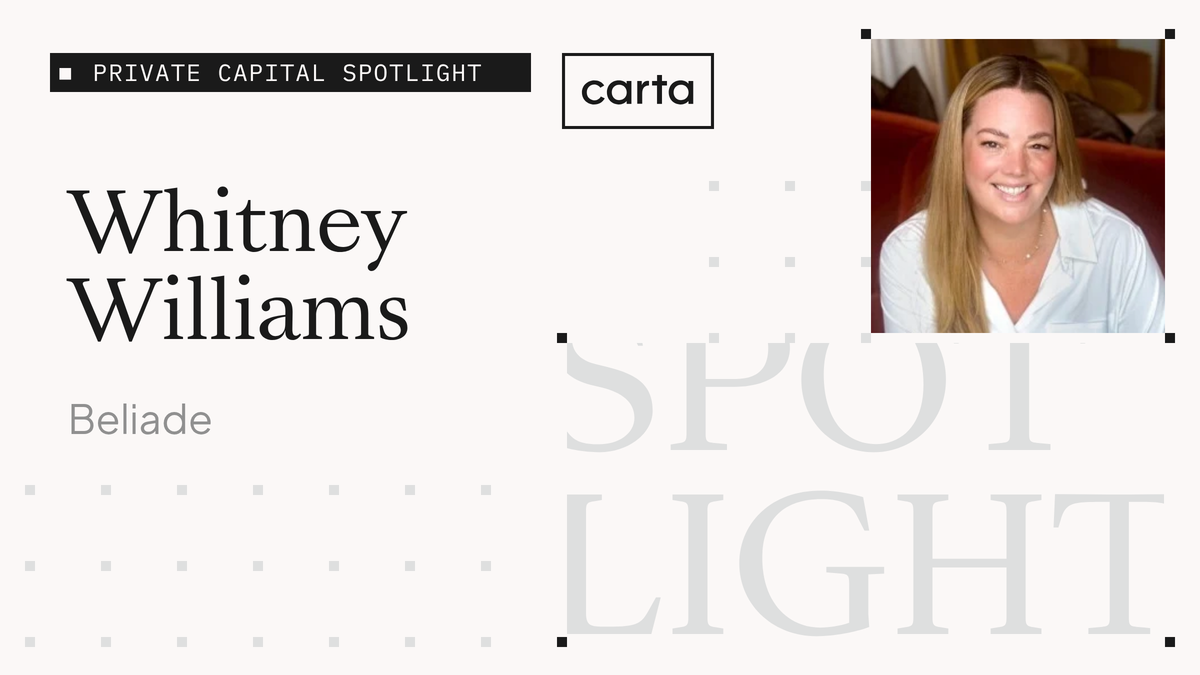
Whitney Williams is the CFO at Beliade, an early-stage venture capital firm based in Nashville and New York that invests in brands including Van Leeuwen ice cream, Rhone Apparel, Kosas cosmetics, and Hill House Home.
We sat down with Whitney to talk about charting a career from big four accounting to private equity and consumer venture capital, investing in the Southeast, and the mentors and advice that shaped her career.
CARTA: Tell us about your career path. What led you to study accounting at the University of Tennessee? And then to PwC and beyond?
WHITNEY WILLIAMS: I grew up in East Tennessee, in a town called Kingsport. I always knew I wanted to attend the University of Tennessee since I was little going to football games. My dad owned his own CPA firm, so I was familiar with accounting. I ended up changing majors from mass communications to accounting thanks to advice from my dad. He told me: You can major in accounting and end up doing a lot of different things, but it’s a great financial background. And that has proved very true in my career.
So I went to UT, majored in accounting, then got my master’s, which led me to big four accounting (at PwC in Atlanta), where I was doing tax compliance for large corporations.
I had a friend in another PwC group, Investment Management and Real Estate. In Atlanta, that group did a lot of overflow tax work from the New York office. I switched into that group which was my first exposure to investment management: hedge funds and private equity. The hedge fund world, derivatives, shorts, swaps…it didn’t come naturally to me. But understanding a real estate asset did.
Then someone from our group moved to New York, called me, and said, there’s a group called Tishman Speyer. They’re a big owner-operator-developer headquartered in New York, and they’re looking for somebody who has accounting experience to work in their tax transactions group.
So you moved to New York?
I did. I spent five years at Tishman, where I really cut my teeth in private equity. That job exposed me to a different asset class – real estate. I covered great assets like Rockefeller Center, the Chrysler Building, some really cool stuff in Brazil and other places.
It was a great group of people: They taught me how to review partnership agreements, lease agreements, private placement memorandums, offering memorandums, and so on. Really everything within the lifecycle of a real estate asset in the fund and joint venture context.
Then I went to Och Ziff (now Sculptor Capital) in New York as their real estate tax advisor. The real estate they handled was different: It was everything from casinos to senior living to marinas and ski resorts.
As all this was happening, a dear friend of mine, Martin Dolfi, was starting what was then M3 Ventures and evolved into Beliade. We’d known each other for over 30 years; we grew up together and graduated high school together. When he first started Beliade, I was a small investor in that first friends and family fund, so I was staying updated on what was happening and how it was growing while I was still at Och Ziff.
But then in 2019, I joined Martin. The conversation started casually. It wasn’t, “Hey, I need you to come work for me,” but more a sit down and “Help me think through my day, what I’m doing, and how to triage.” And I said, “You’re spending way too much time on audits, tax returns, quarterly compliance, investor communications, et cetera. You need to be fundraising and hunting for new deals, and you need to bring in somebody to run everything else.” So a few months later I joined him.
What excited you about Beliade?
It’s exciting to me to be at a firm that invests in consumer brands with a health and wellness focus. I can leverage my experience in how funds and investments work, but it’s a different asset. I liked that it wasn’t amorphous, some technology that I didn’t totally understand, like some early stage software investing. Consumer, like real estate, is a tangible thing.
Like just about everyone, I’m a consumer of consumer brands. I’ve always loved to go to the grocery store, I love to go to the mall, I love to be in Sephora. Investing in a real, tangible product excites me.
And consumer spending is a big market – it’s 70 percent of US GDP. From the time you wake up until the time you go to bed, you’ve made so many decisions that day about what toothpaste and shampoo you use and what apparel you wear. What you put in your body and on your body. It’s all consumer branded products that you’re choosing.
What are the main differences across the variety of private market assets you’ve worked with throughout your career?
When buying an existing piece of real estate, it’s very quantifiable. What are the rents going to be? What are the capital expenditures going to be there? The underwriting model is about the building and the tenants and how it’s already set up. But in real estate development, it was more visionary: “Here’s what could be created.” There’s a different risk profile there. You don’t know: Is this going to work out? Are tenants going to come in here? Are you going to get the foot traffic you think that you’re going to have?
So real estate development was much more akin to early-stage seed investing. At Beliade, we invest about 12 months into the life of a company. So something’s working, something’s resonating. But there’s a lot of unknowns. That product is going to iterate a number of times.
So we’re also looking for: What’s the founder like? Are they going to be around in three years? Because things are hard at the beginning.
That’s very different from what I did before; there were these very complex underwriting models and all these assumptions driven off of data along with tax structuring. That was very quantitative. My work at Beliade is much more qualitative.
Were there certain mentors throughout your career that shaped your journey?
Definitely. At Tishman, Gregg Larson and Jay Soave taught me so much. They spent a lot of time teaching how to read through various agreements and that’s a time consuming and tedious process to undertake with someone junior and less experienced. I’d already been reading the tax code, but not transaction documents. During those five years they spent a lot of time explaining things, like, here’s how you write effective memos that are going to end up at Investment Committee, or here’s how you distill facts that are going to go to our outside counsel. It was almost like going to school again!
And I think it’s important to have peer mentors that aren’t necessarily in your same industry but are career professionals that you can bounce ideas off of as you’re navigating your path. Whether that was a career move in NYC or my decision to come back to Nashville. I feel fortunate to have a great group of these peer mentors and friends in people like Val Shapiro and Katie Dugan. Sometimes mentors are at your workplace and in the nitty-gritty, but it’s also so helpful to have someone who’s not in the same day-to-day as you who can sense check and can give that outside perspective and help you think about your career long-term.
Speaking of your move to Nashville: What is it like investing in and working with founders outside of the coastal center of startup activity in Silicon Valley and New York?
My response now is totally different than the answer I would’ve given in 2017 when I moved here. Then, everyone said, “Why would you leave New York?” But Nashville was coming back home for me.
After 2020, everyone has moved around so much, and Nashville is so central. You can get to 75% of the country in a two-hour flight. That proximity makes it easy for me. For example, I was in Austin this week meeting with prospective investors and a portfolio company; I’m in Dallas next week doing the same.
Plus, the city has grown a lot in the last ten years. There’s a growing private equity and venture capital industry here. Nashville, beyond music, is a major healthcare town, and then recently, Oracle announced they’re building their headquarters here, Amazon has an operations hub here and many more companies are choosing to relocate headquarters or a portion of their operations here.
That gives the city a sort of credibility, which means you're attracting more talent. There are favorable benefits for founders, because it’s more affordable to live here than some of the coastal cities coupled with there is no state income tax. Trade organizations like the Greater Nashville Private Capital Association and our economic development council for the state of Tennessee have done a tremendous job amplifying the area and attracting companies and talent here. The ecosystem here is really growing, and we’ve been glad to see that in the Carta geographic data.
DISCLOSURE: This communication is on behalf of eShares, Inc. dba Carta, Inc. ("Carta"). This communication is for informational purposes only, and contains general information only. Carta is not, by means of this communication, rendering accounting, business, financial, investment, legal, tax, or other professional advice or services. This publication is not a substitute for such professional advice or services nor should it be used as a basis for any decision or action that may affect your business or interests. Before making any decision or taking any action that may affect your business or interests, you should consult a qualified professional advisor. This communication is not intended as a recommendation, offer or solicitation for the purchase or sale of any security. Carta does not assume any liability for reliance on the information provided herein. © 2026 Carta. All rights reserved. Reproduction prohibited.