Startup salaries are moving up and to the right. Across all ranks and all roles, the average salary for new hires at startups in June 2025 was 5.8% higher than it was roughly three years ago, back in April 2022.
Much of this growth in the compensation market has occurred in just the past year and a half. The average startup salary has now increased by nearly 5% since January 2024, reversing a trend of salary declines that extended through much of 2023.
Which employees are seeing the biggest gains? Between April 2024 and June 2025, the average salary for new hires in legal job functions increased by 10%, climbing to $183,000. The product, design, and marketing job functions have seen significant salary gains of their own. As of June, product is now tied with engineering as the function with the highest average new-hire salary, at $189,000.
And what about AI? Depending on the size of the company, the median salary for new AI/ML engineering hires rose by somewhere between 5.4% and 9.1% between January 2024 and June 2025.
These AI/ML salaries have been rising most quickly at younger companies: Among startups valued between $1 million and $10 million, the median salary for new AI/ML engineers is up 9.1% over the past year and a half, while the 90th percentile salary is up 9.5%.
H1 2025 key takeaways
Startup job movement continues to slow: Compared to the same period a year ago, companies on Carta logged fewer new hires, fewer job departures, and fewer layoffs during the first half of 2025. Changing jobs is considerably less common among startup employees today than it was during the hectic market that emerged in 2021 and 2022.
Hardware startups keep hiring: In the hardware sector, startups combined to make 1.3 new hires for every job departure they experienced during H1 2025. That’s the highest rate of headcount growth for any major startup sector so far this year, followed by medical devices (1.2 hires per departure).
New hires tilt toward engineering and sales: Over the past several years, engineering and sales roles have begun to make up a larger percentage of all new hires made by startups on Carta, while the frequency of new hires in operations has been in decline. In H1, about 29.7% of all new hires were in engineering, and another 16.6% were in sales.
Hiring & headcount
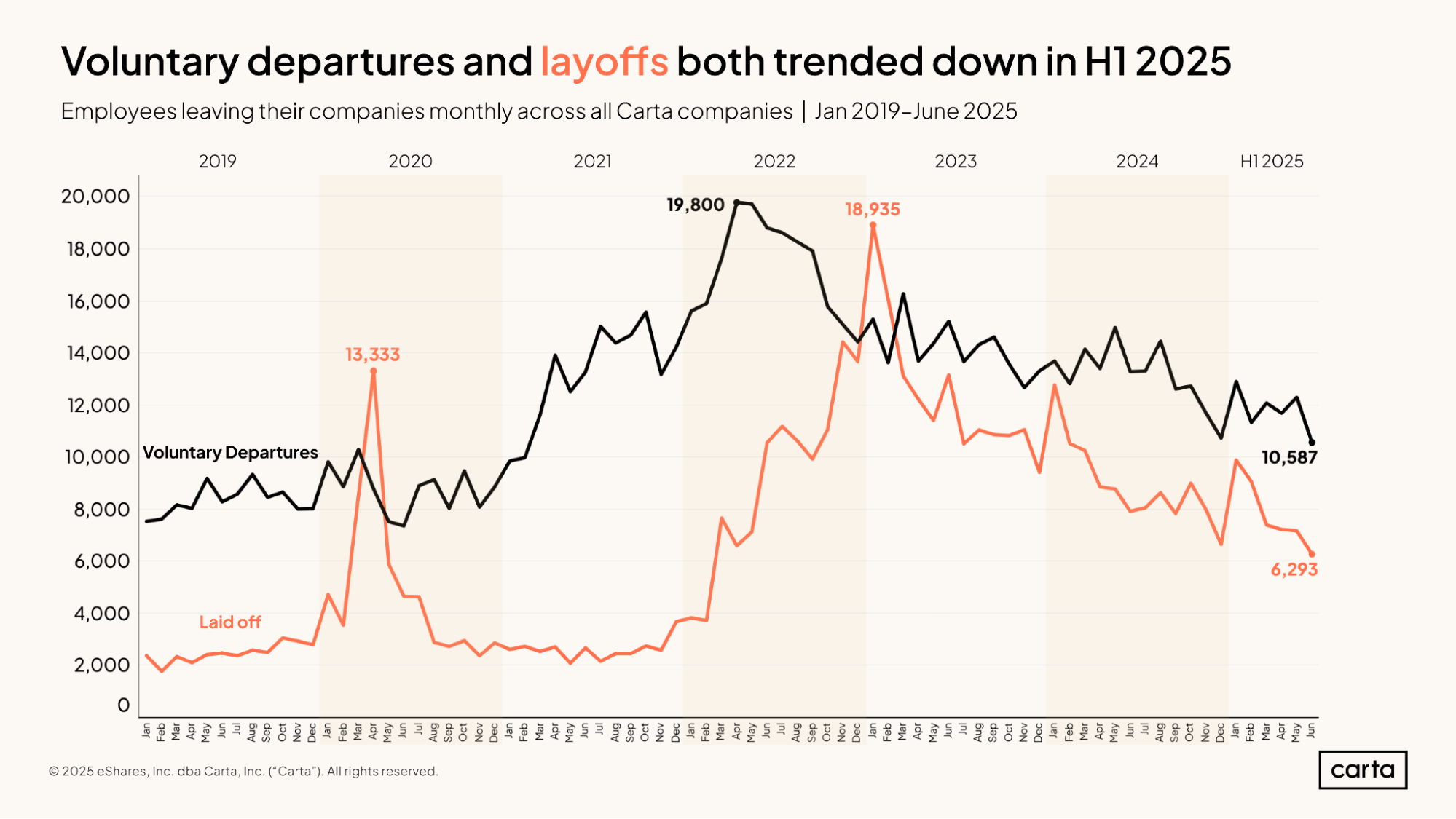
In June, companies on Carta combined to see 10,587 employees leave their roles by choice, while another 6,293 employees were laid off. Both of these figures will likely continue to rise in the weeks to come as more employee movement is logged on the platform. From a macro perspective, however, both figures continue a trend of reduced job movement among startup employees that has been underway for well over two years.
Compared to the recent peak of voluntary job departures that occurred in April 2022, the most recent month’s numbers are down 47%. Layoffs have fallen off even more sharply, with June’s results representing a 67% decline from the highs of January 2023.
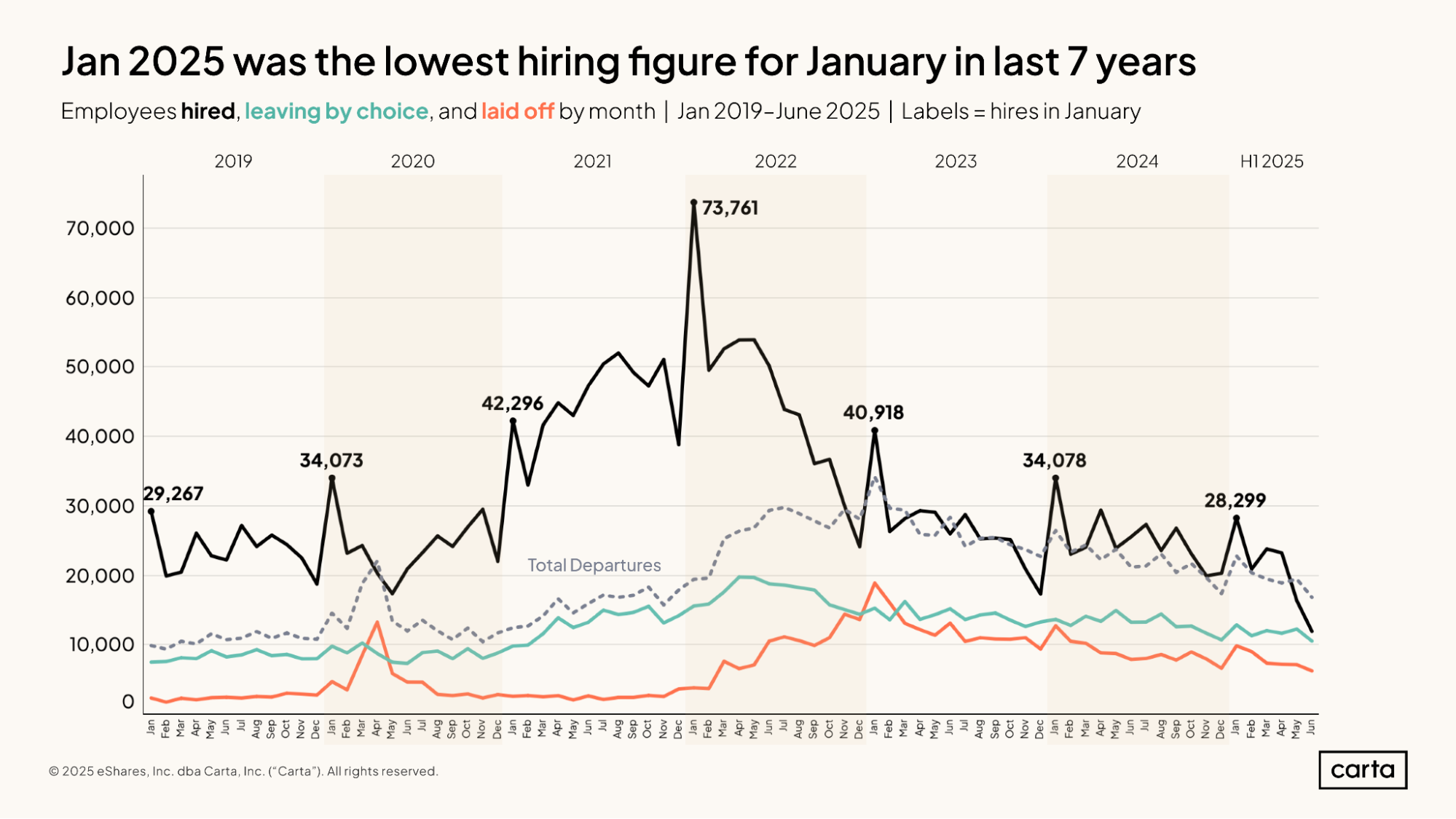
An ongoing trend of startups making fewer new hires has continued during the first half of 2025. In January, which is typically the busiest month for hiring, startups brought on 28,299 new workers, a 17% decline from January 2024. Hiring has now declined in three straight Januaries, falling off 62% from a recent high point of 73,761 new hires in January 2022.
For most of the past two and a half years, the total number of new hires by companies on Carta has tracked relatively closely with the total number of job departures. Both numbers have been generally trending down since a surge in job movement that occurred during the post-pandemic market of 2022 and 2023.
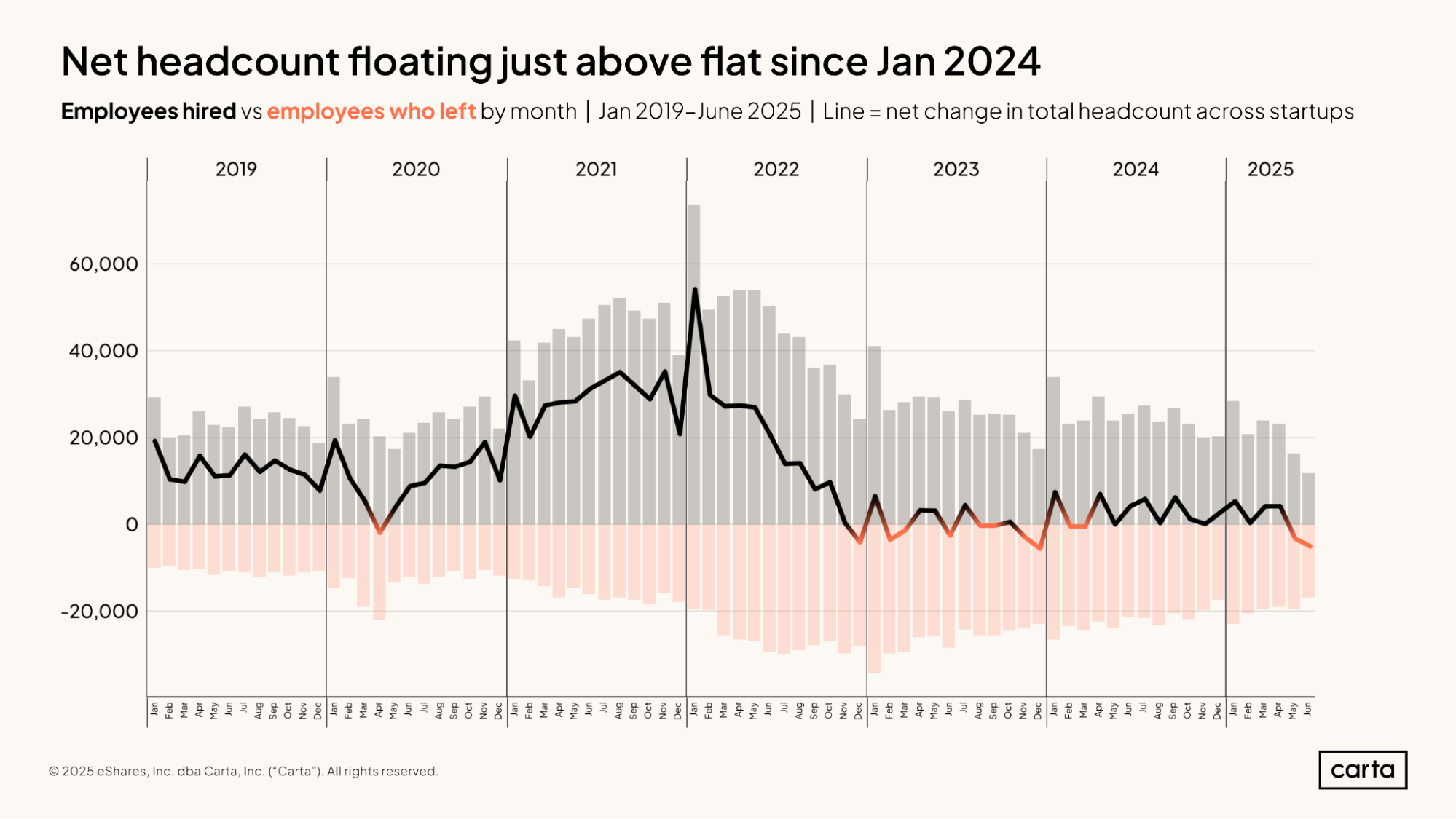
From the start of 2019 through the end of 2022, there were typically more new employees hired by companies on Carta each month than there were job departures. During 2021 and the first half of 2022, hiring sometimes outpaced departures by a rate of more than 25,000 employees per month.
Since the start of 2023, however, the job market has changed, with monthly net headcounts typically hovering closer to zero. After expanding rapidly for many years, the startup employment market has begun to grow at a much slower rate.
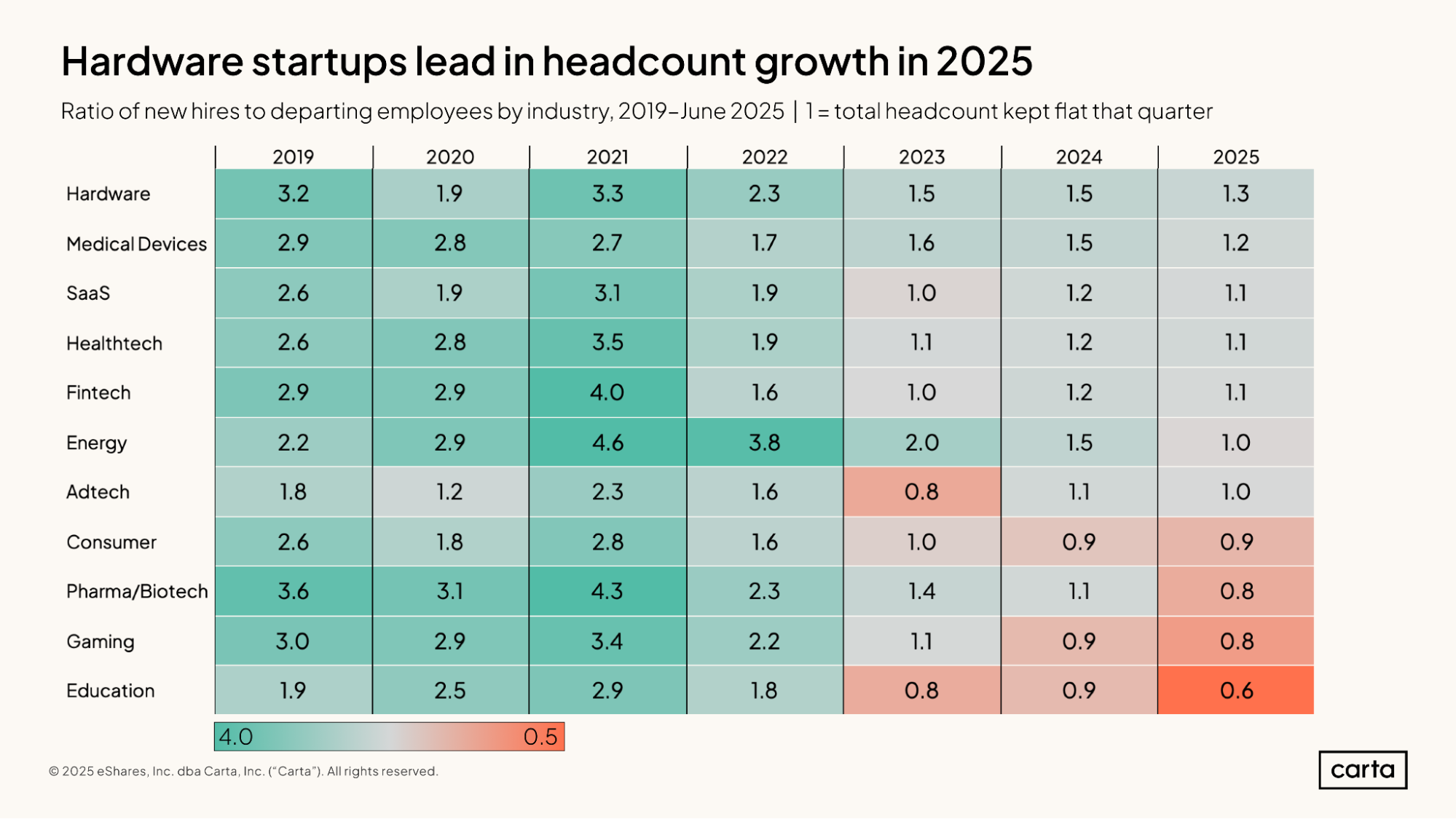
In 2025 so far, startups across the hardware sector have made 1.3 new hires for every one employee who has left their role. This is the highest ratio of hires to departures in any sector this year—but it’s also the lowest ratio of hires to departures within the hardware sector in the past seven years. In every sector, the ratio of hires to departures was lower in the first half of 2025 than in any full year from 2019 through 2022.
Headcount is shrinking the fastest in the education sector, where there were 0.6 new hires for every departure in H1 2025. This marks the third straight year that net headcount in education has been in decline. Net headcount is also dropping in consumer, pharma/biotech, and gaming.
Download the full report
Our complete State of Startup Compensation report includes 20 new charts showing how trends in salary and equity are shifting across the startup ecosystem. These charts and accompanying analysis illuminate how startups and founders are thinking about compensation amid an ever-changing environment, with key insights including:
Industries that are seeing the biggest changes in hiring and comp
Headcount changes based on company sector and company stage
How startup salaries compare across major U.S. metro areas
The job functions experiencing the fastest hiring growth
Changes in the size of employee stock option pools by company stage
The rate at which employees are choosing to exercise their vested options
And much more from Carta’s pre-eminent startups database


DISCLOSURE: This communication is on behalf of eShares, Inc. dba Carta, Inc. ("Carta"). This communication is for informational purposes only, and contains general information only. Carta is not, by means of this communication, rendering accounting, business, financial, investment, legal, tax, or other professional advice or services. This publication is not a substitute for such professional advice or services nor should it be used as a basis for any decision or action that may affect your business or interests. Before making any decision or taking any action that may affect your business or interests, you should consult a qualified professional advisor. This communication is not intended as a recommendation, offer or solicitation for the purchase or sale of any security. Carta does not assume any liability for reliance on the information provided herein. © 2026 Carta. All rights reserved. Reproduction prohibited.