
The San Francisco Area is by far the busiest hub for venture capital funding in the U.S. In fact, in terms of capital raised, it was busier in 2025 than the next seven biggest VC markets combined.
Startups on Carta that are headquartered in the Bay Area combined to bring in $39.92 billion in total funding over the course of last year, accounting for 41.3% of the national total—enough to easily nab the top spot in the overall ranking of U.S. startup ecosystems in 2025. The Bay Area’s fundraising footprint is nearly three times larger than that of New York, which ranks second in the startup ecosystem rankings for 2025, with 14% of capital raised.
Los Angeles checks in at third on the list, with 8.3% of all capital raised, and Boston is fourth, at 6.6%. No other market in the U.S. claimed more than 4% of venture dollars raised in the U.S. last year.
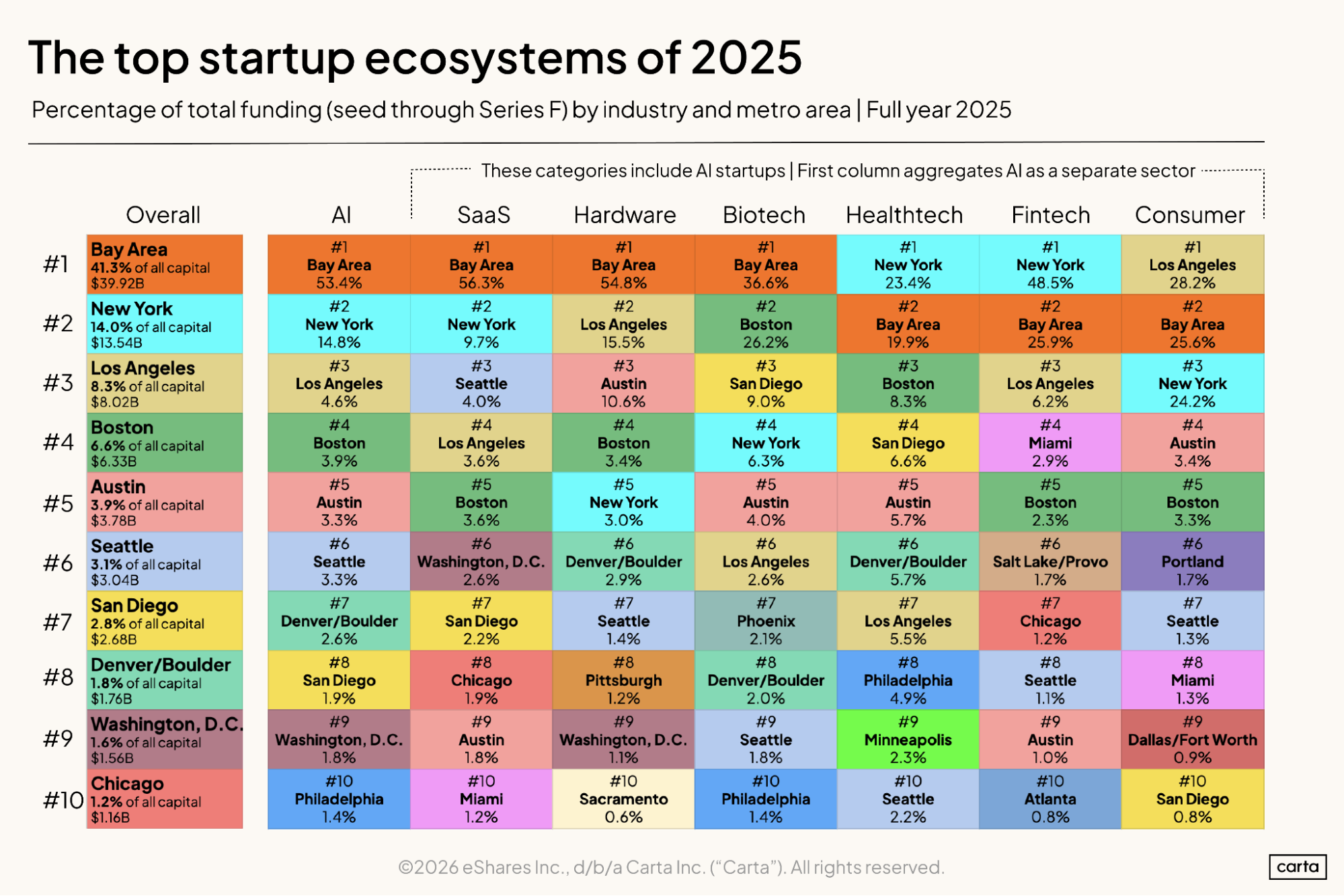
The Bay Area was at the top of the national leaderboard for fundraising in AI—the hottest sector in all of venture capital last year—with 53.4% of all cash raised. The Bay was also home to a majority of all fundraising in SaaS (56.3%) and hardware (54.8%), and it was the top-ranked metro for biotech, too.
(Note that there is overlap between AI and the other sectors shown in the above chart. For example, funding raised by a startup making AI-powered SaaS products is included in the tally for both the AI sector and for SaaS.)
If the Bay Area wasn’t the most lucrative market for fundraising in a particular industry last year, then it was close to it. In each of the healthtech, fintech, and consumer sectors, the Bay Area ranked second among all U.S. metros.
The wide spectrum of popular industries within a single startup ecosystem is rare. Most other metros near the top of these rankings have certain strengths and weaknesses—industries where startups thrive at raising capital, and other industries where major funding rounds are less common.
In addition to the Bay Area, five other metros ranked in the top 10 of last year’s ecosystem rankings in each of the seven industries listed in the above chart (AI, SaaS, hardware, biotech, healthtech, fintech, and consumer). For each of these other five top U.S. startup ecosystems, where do their particular strengths and weaknesses lie?
New York
New York City is the nation’s runaway winner in the race for fintech funding. Startups on Carta based in the New York metro combined to raise more than $3.1 billion in new capital during 2025, accounting for 48.5% of all fintech dollars raised. That was almost double the amount of the Bay Area, which ranked second, with 25.9% of fintech dollars raised.
New York has long been the center of the wider financial industry within the U.S., serving as the home to Wall Street and many of the country’s largest banks and other financial institutions. This dominance carries over into the realm of finance upstarts.
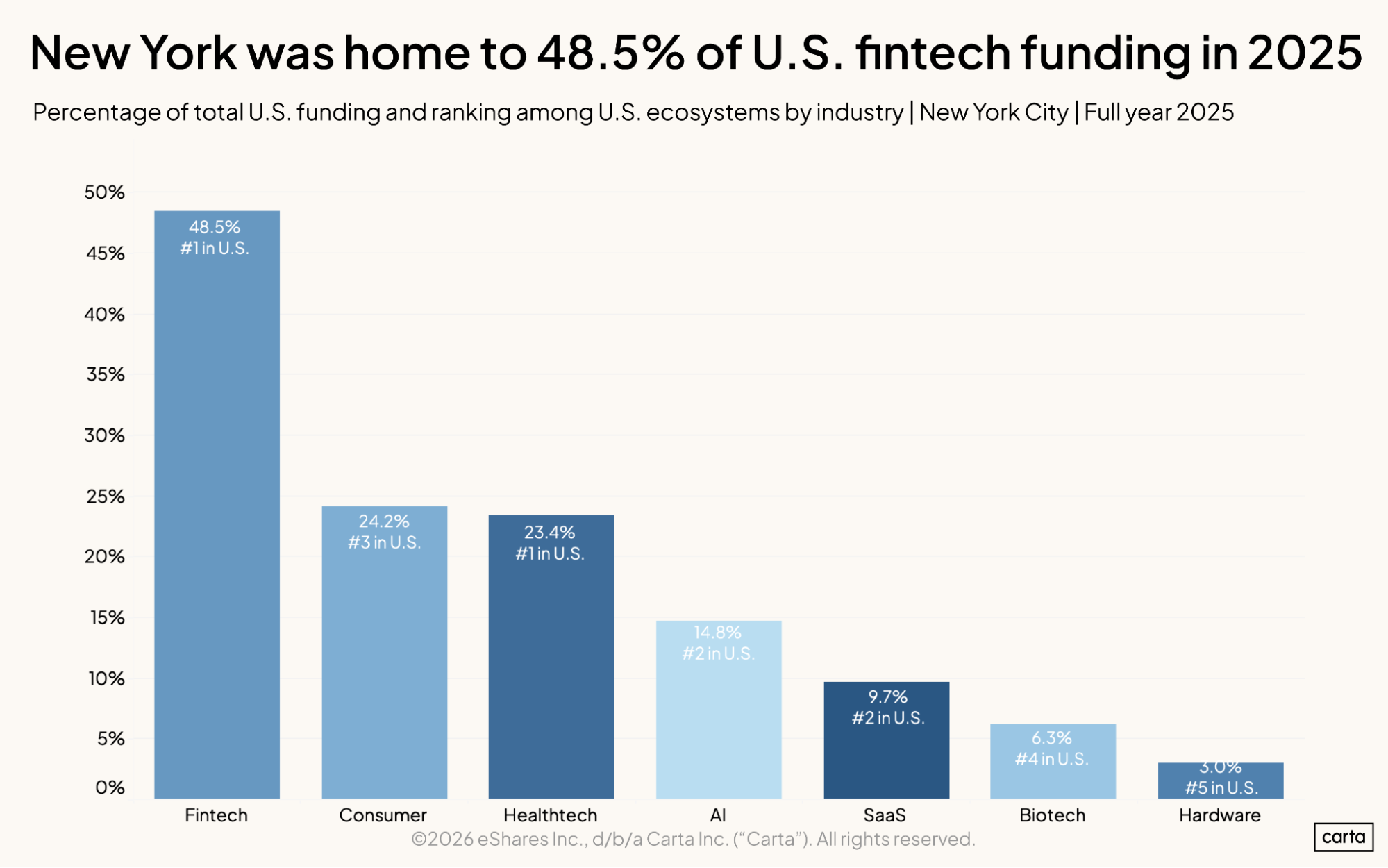
The Big Apple is no slouch for fundraising in other sectors, either. It was the top-ranked ecosystem last year for healthtech funding, with 23.4% of cash raised, and ranked second in both AI and SaaS. Among the industries surveyed here, New York has the smallest footprint in hardware, with just 3% of total funding.
Los Angeles
Either the Bay Area or New York was the top metro for venture fundraising in six of these seven popular startup industries. The lone interloper in this duopoly is Los Angeles, which seized the top spot in the consumer sector, with 28.2% of cash raised.
The Los Angeles ecosystem is also well represented within the hardware industry, where it was responsible for 15.5% of total fundraising last year, placing second among all U.S. markets. To at least some degree, this ranking may reflect Los Angeles’s centrality in the booming market for defense tech.
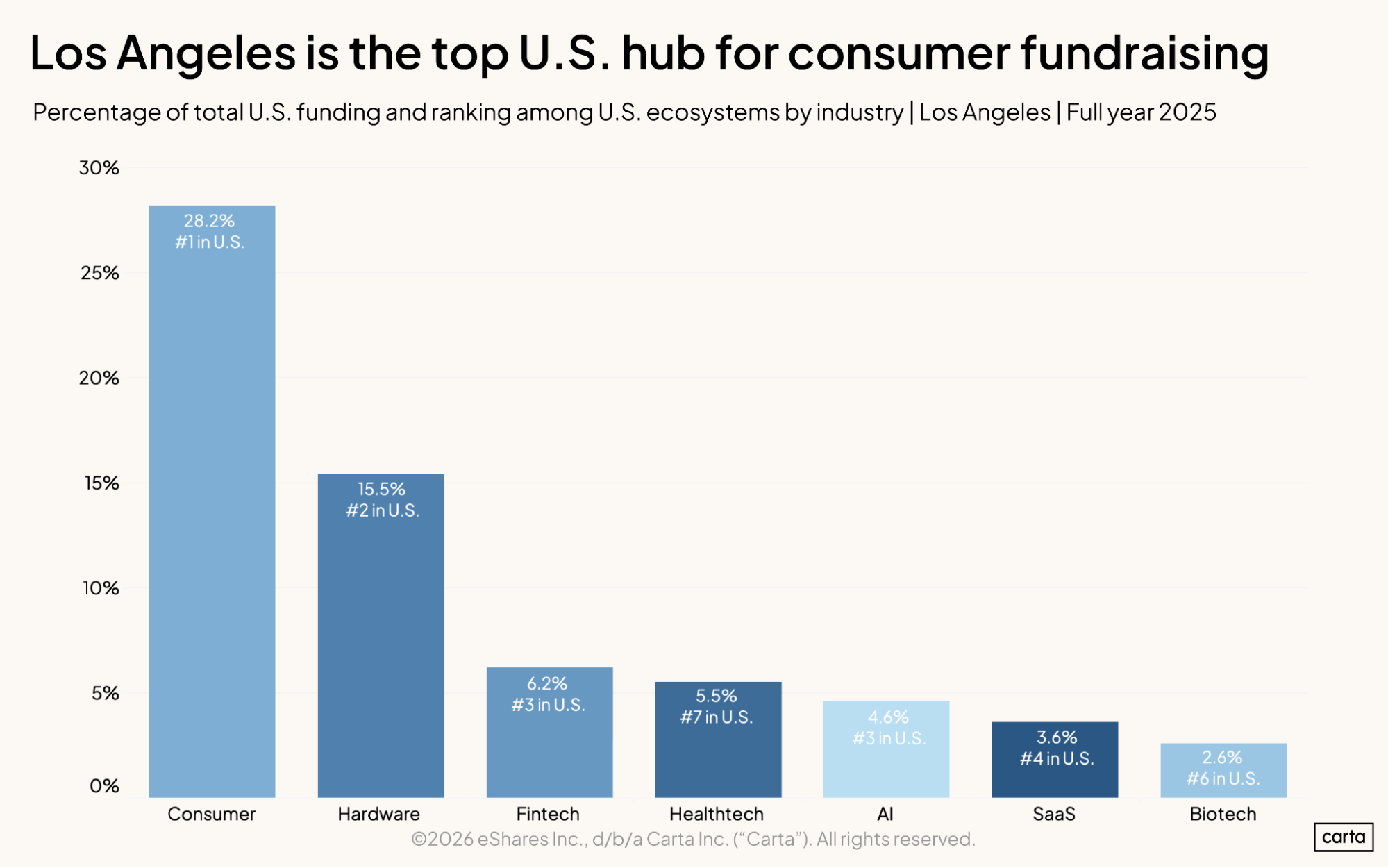
Conversely, the region plays a comparatively lesser role in the landscape of healthcare startups. Companies based in the Los Angeles metro raised just 2.6% of last year’s total biotech funding, ranking sixth among startup ecosystems, and 5.5% of healthtech funding, ranking seventh.
Boston
Boston has historically been synonymous with the biotech industry. That identification remains in place today. Startups based in the Boston metro area combined to bring in 26.2% of all venture dollars raised within biotech last year, finishing second among all U.S. markets.
Biotech was the only sector where at least 10% of cash raised went to startups from Boston. But Beantown still plays a significant role in most other common startup industries: In fact, it was one of only three metro areas (along with the Bay Area and New York) to rank in the top five for cash raised last year in all seven of the industries included in this analysis.
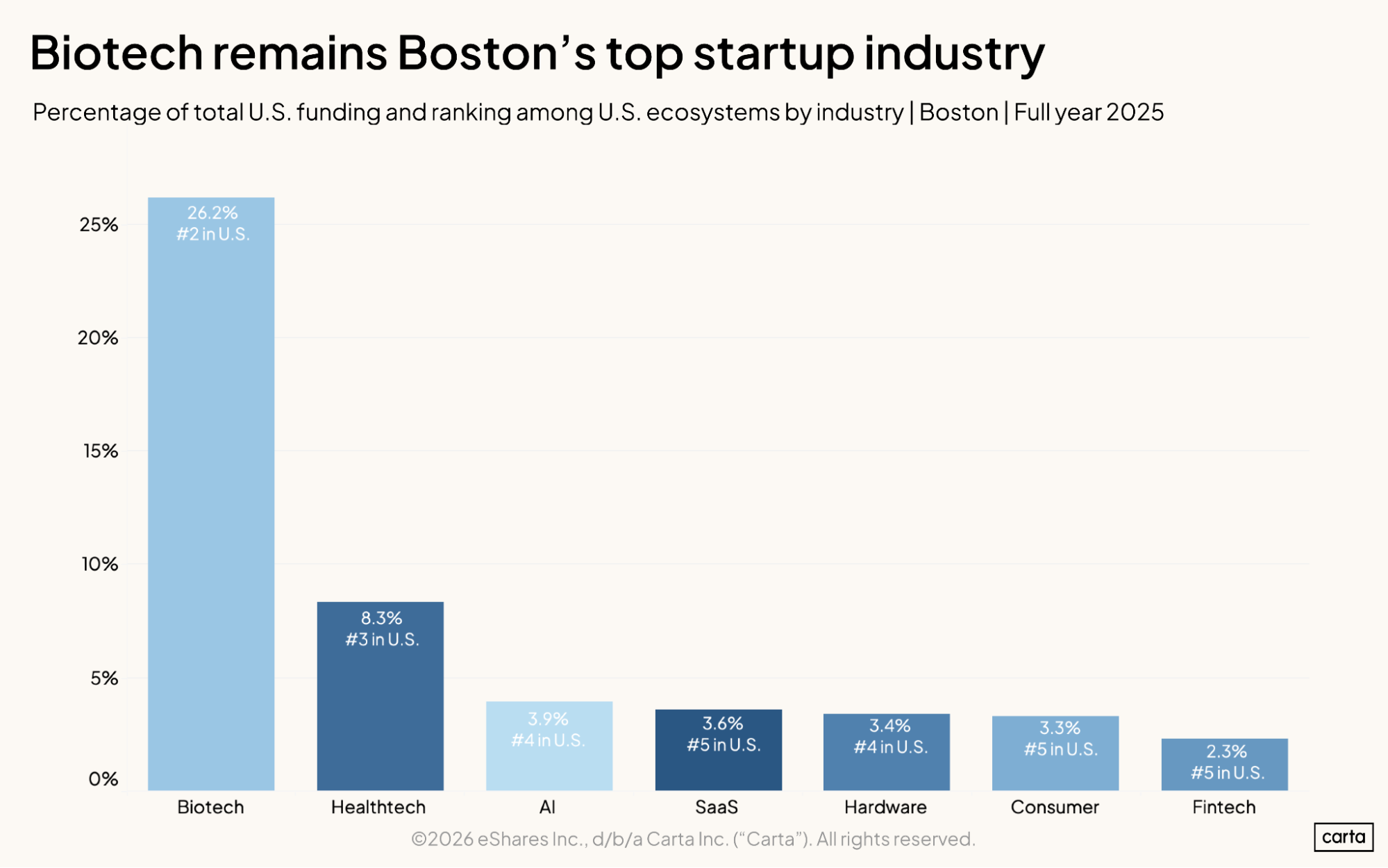
Healthtech was the industry where Boston claimed the next-highest share of fundraising, with 8.3%, ranking third among U.S. ecosystems. The Boston metro finished with somewhere between 3% and 4% of all cash raised last year in each of the AI, SaaS, hardware, and consumer sectors.
Austin
Austin ranked fifth in the overall startup ecosystem rankings last year, with 3.9% of total capital raised. The Texas capital punched above its weight in the hardware, where it was home to 10.6% of capital raised—finishing third among all metro areas, Austin’s highest placement in any industry.
Austin is also relatively strong in the consumer sector, where it ranked fourth in last year’s fundraising leaderboard, and in healthcare, ranking fifth in both biotech and healthtech. The healthtech sector is more geographically diverse than most other common startup industries: Startups from Austin were responsible for 5.7% of cash raised last year, but that was only good for fifth place. (By comparison, a 5.7% share would have ranked third among all metros in SaaS.)
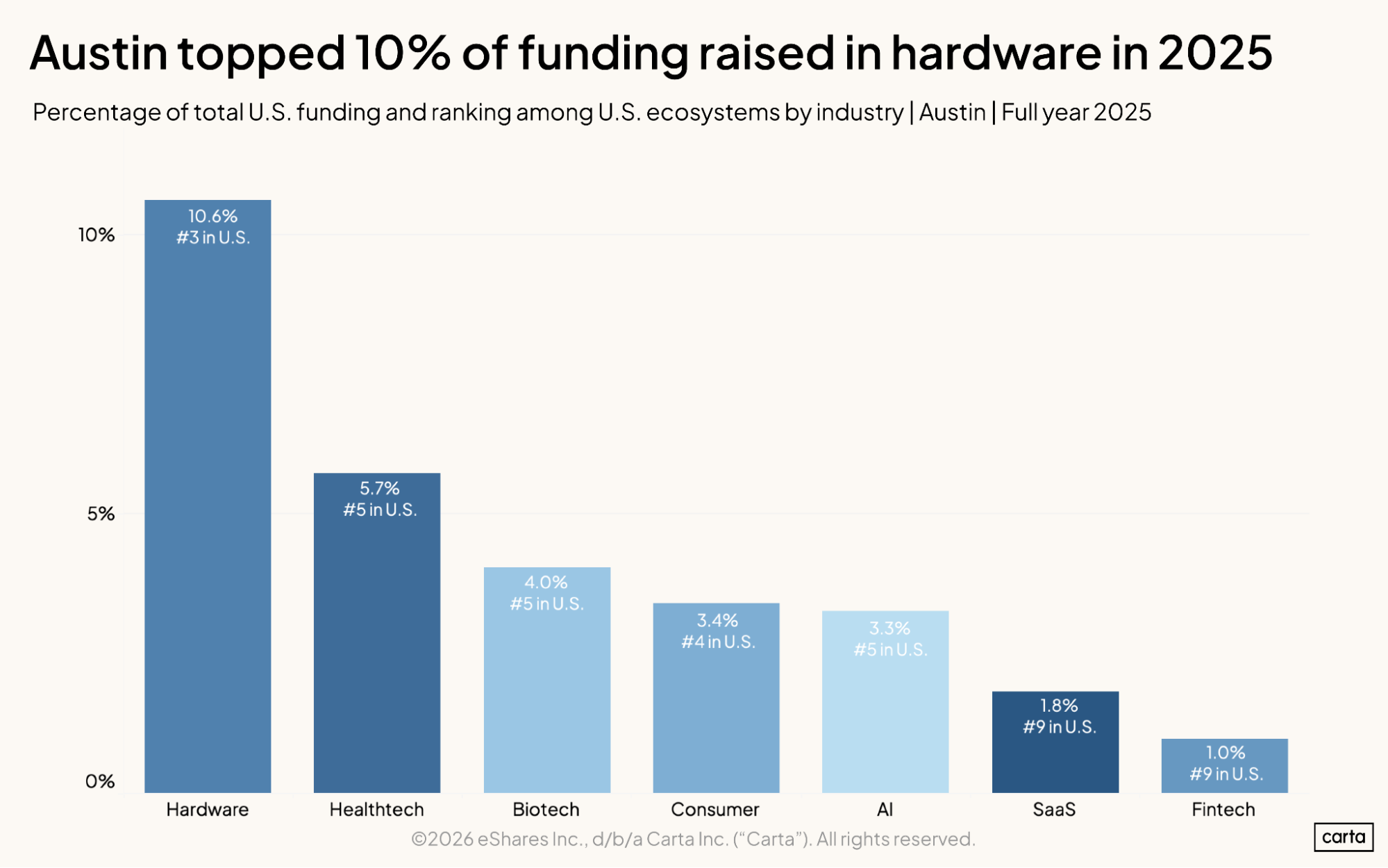
The Austin metro checks in at number five on the list of dollars raised by AI startups last year, with 3.3% of funding. But it ranks ninth in both SaaS and fintech, two sectors that are undergoing wholesale transformations amid the age of AI.
Seattle
With a 3.1% share of total capital raised, Seattle placed sixth among all U.S. ecosystems last year in venture fundraising. This was aided by a third-place finish on the rankings for SaaS funding, with a 4% share of dollars raised, behind only the Bay Area and New York. As the headquarters of Microsoft and Amazon, the Seattle metro has both a long history of software innovation and a deep roster of well-funded potential software investors.
In each of the other six sectors included here, Seattle landed somewhere between sixth and 10th on last year’s rankings. This includes a sixth-place finish in AI, closely behind Austin, and seventh-place rankings in both hardware and consumer.
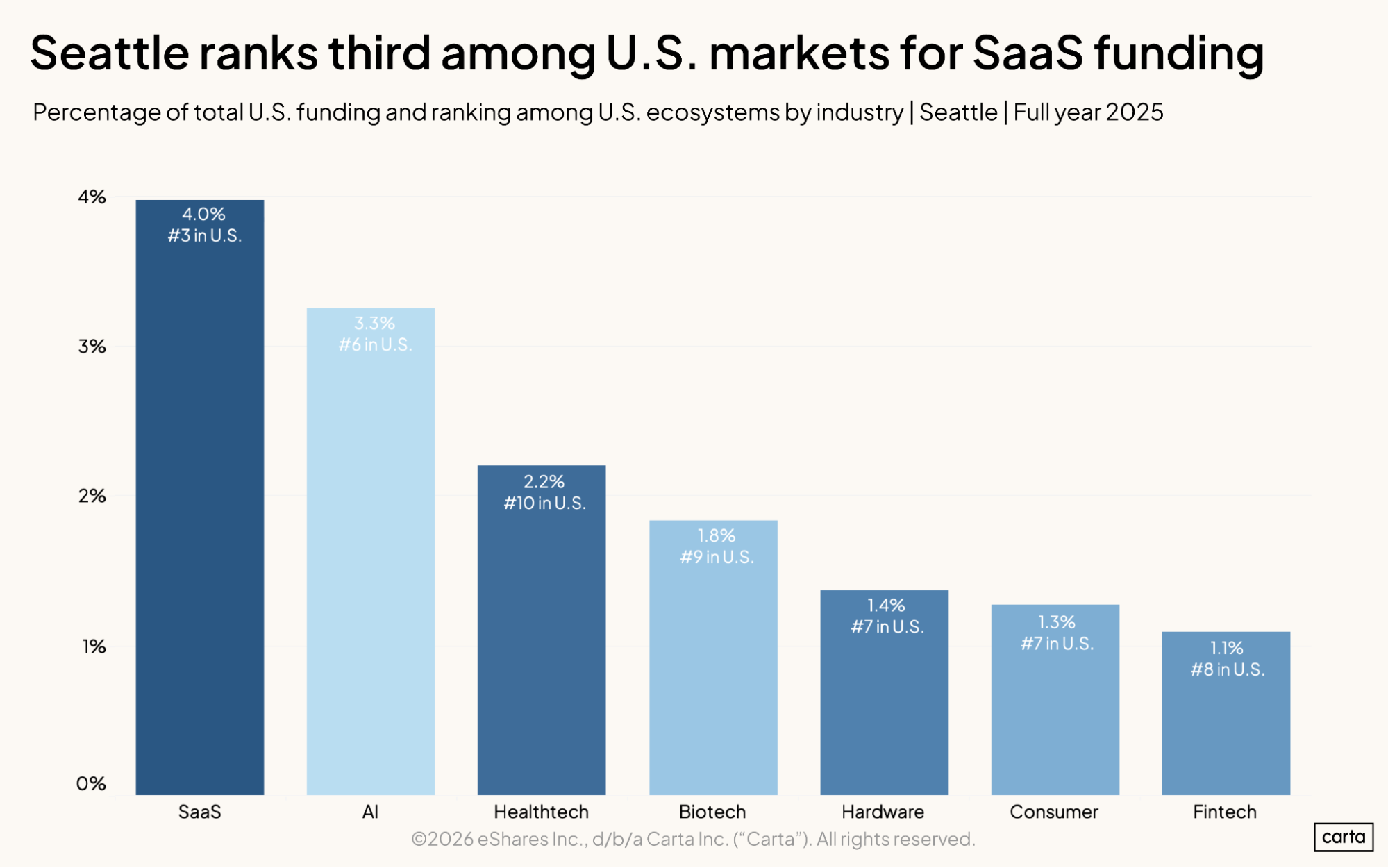
The Emerald City may not be a juggernaut in any single sector, but it can claim a significant presence in most major startup industries.
Subscribe to the Data Minute newsletter

DISCLOSURE: This communication is on behalf of eShares, Inc. dba Carta, Inc. ("Carta"). This communication is for informational purposes only, and contains general information only. Carta is not, by means of this communication, rendering accounting, business, financial, investment, legal, tax, or other professional advice or services. This publication is not a substitute for such professional advice or services nor should it be used as a basis for any decision or action that may affect your business or interests. Before making any decision or taking any action that may affect your business or interests, you should consult a qualified professional advisor. This communication is not intended as a recommendation, offer or solicitation for the purchase or sale of any security. Carta does not assume any liability for reliance on the information provided herein. © 2026 Carta. All rights reserved. Reproduction prohibited.