In 2025, many conversations around venture capital fund management have eventually circled back to the same topic: the growing liquidity needs of LPs.
In the early 2020s, VCs rode the back of a bull market to raise record-breaking sums of capital from LPs. Then, the market for IPOs and other venture-backed exits largely dried up. With fewer exits, there were fewer opportunities to return cash to LPs. This meant LPs had less capital to invest in new VC funds, which in turn meant that VCs had less money to invest in new startups. Deal activity declined. The typical cycles of the startup ecosystem were slowing down, because LPs weren’t getting the returns they expected.
In Q2, VCs seemed to get the message.
The percentage of venture funds on Carta that have begun to return capital to their LPs jumped noticeably in Q2 for every vintage from 2017 through 2023, as investors demonstrated a new urgency around generating DPI. Among funds raised in 2017, some 85% have started to generate DPI. Among funds raised in 2019, some 53% have begun returning capital to LPs, including 8% of funds in the vintage that did so for the first time in Q2.
Noticeably, some of the most recent cohorts of funds on Carta are adapting most aggressively. In the 2023 vintage, about 15% of funds had begun generating DPI after six quarters of management. That’s a higher percentage than any other vintage from 2017 through 2022 at that same six-quarter threshold.
For the LPs who have been eagerly awaiting liquidity—and for any other investors or founders interested in greasing the skids for more VC dealmaking—this Q2 increase in DPI is a welcome sign.
Highlights
Key performance metrics are on the rise: Median net TVPI increased at every fund vintage from 2017 to 2023 in Q2. In other words, the value of the typical venture fund inched up. For the 2017 vintage, median TVPI rose to 1.95x. Net IRRs also mostly trended up in Q2, with the median for the 2017 vintage climbing to 13.5%.
Average LP check sizes have grown: Among VC funds with between $1 million and $10 million in commitments that were raised from 2018 to 2021, the average LP check size was $127,000. Among funds of that same size that were raised more recently, from 2022 through 2025, average check size rose to $165,000. This same trend of larger checks from 2022 on holds true for funds up to $100 million in size.
Dry powder is drying up: Most VC funds raised prior to 2021 have little dry powder remaining. Funds in the 2020 vintage, for instance, have just 11% of their total committed capital still available to invest. More recent funds are also deploying capital quickly. Funds in the 2023 vintage have 42% of their cash in reserve, while 33% of capital from the 2022 vintage remains as dry powder.
Fund details
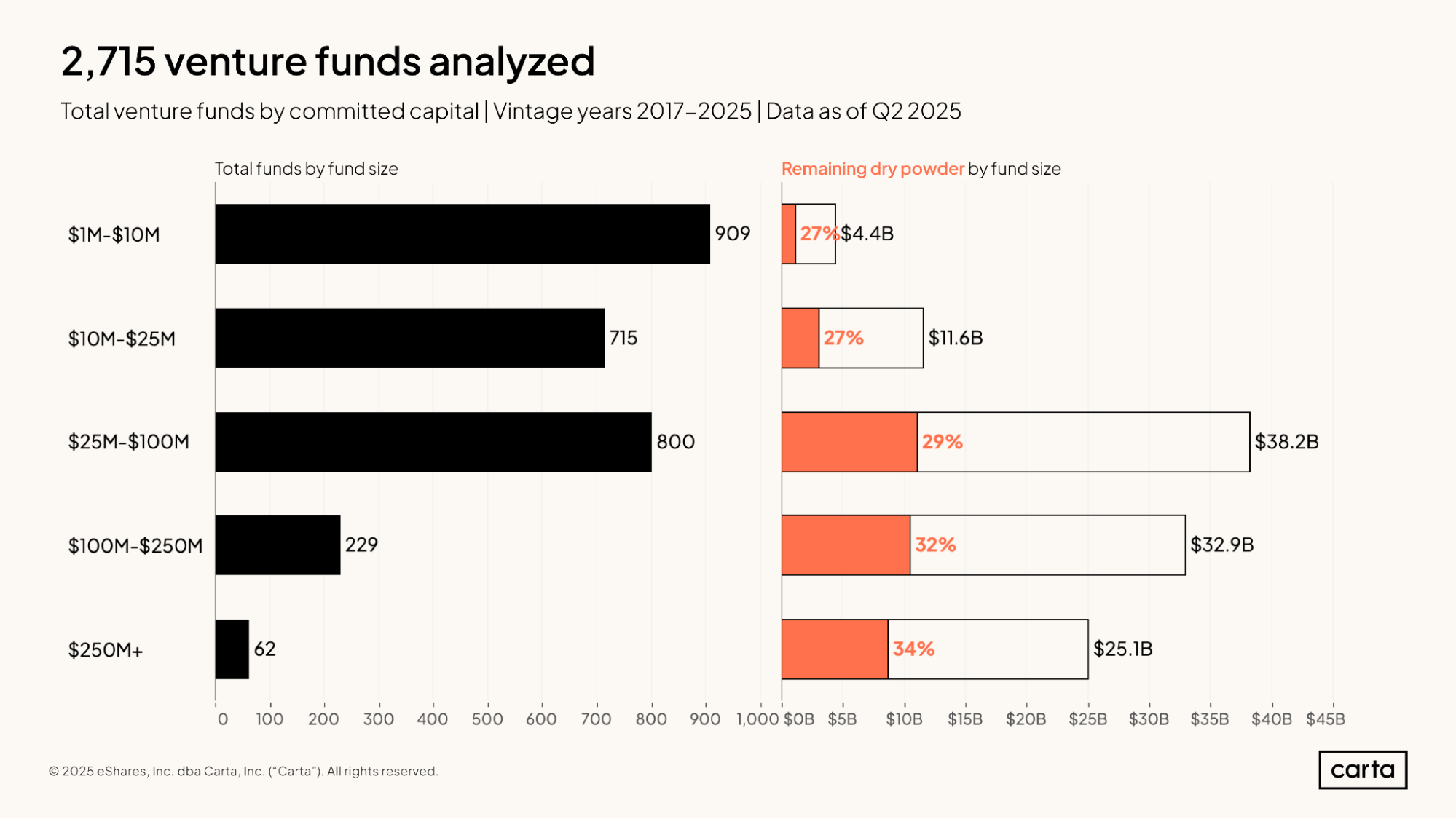
This report includes data from 2,715 venture funds with vintage years ranging from 2017 through 2025. Across all fund sizes, these vehicles combined to raise about $112.2 billion in capital commitments. Some $38.2 billion of this capital (about 34% of the total) is managed by funds between $25 million and $100 million in size, while another $32.9 billion (29% of the total) was raised by funds between $100 million and $250 million.
In each of the five size intervals shown here, somewhere between 27% and 34% of all committed capital remains uninvested and ready to deploy. The largest venture funds—those with more than $250 million in commitments—have the highest portion of remaining dry powder, at 34%.
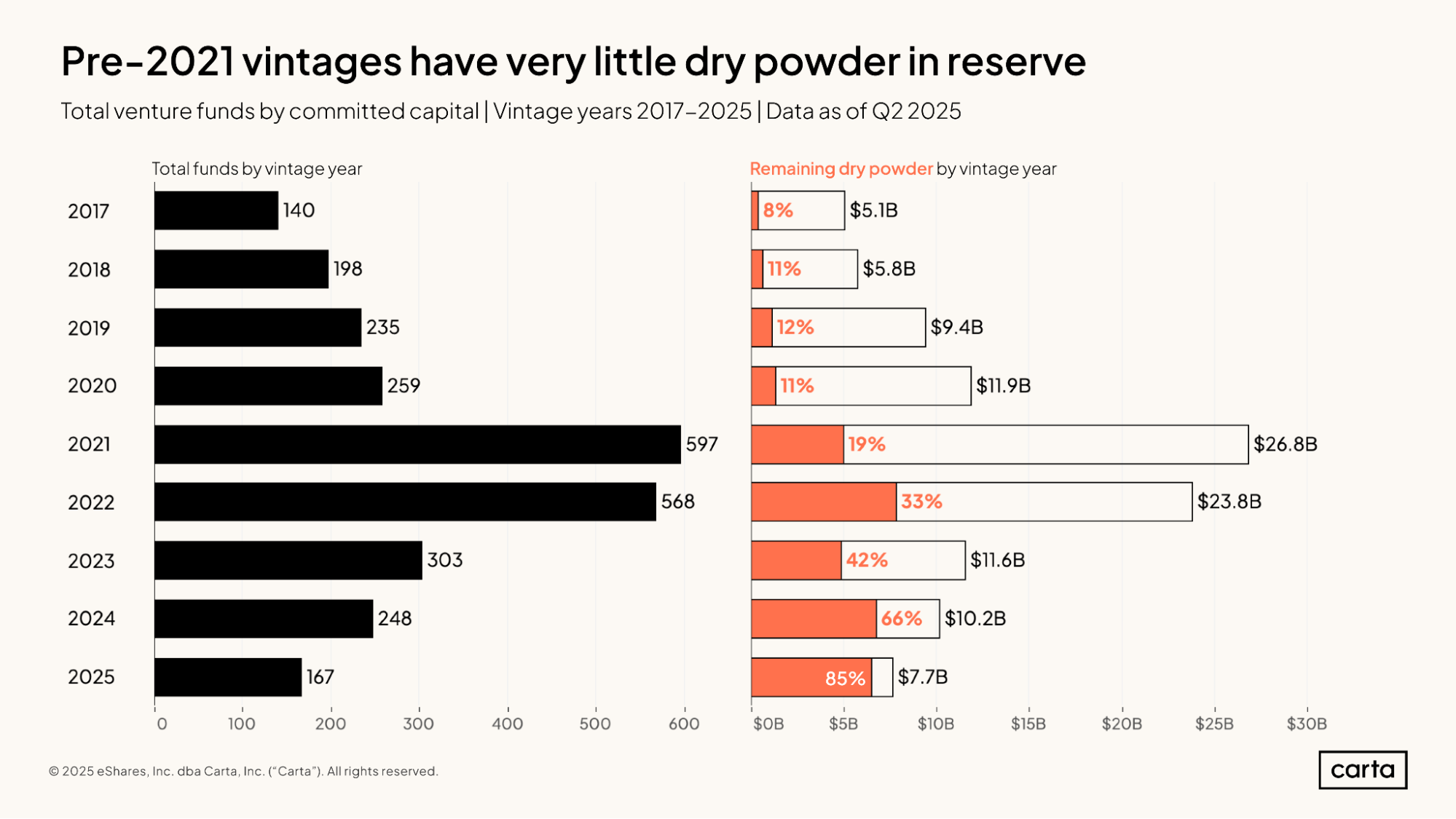
As a whole, venture funds that were raised prior to 2021 have now invested roughly 90% of their available capital. In the 2020 vintage, just 11% of committed capital across all funds remains as uninvested dry powder. This rate of dry powder is similar for the 2019, 2018, and 2017 vintages.
More recent vintages have more dry powder still in reserve. But venture funds tend to invest their capital on relatively rapid timelines. For instance, the two-year-old funds from the 2023 vintage have already deployed 58% of their committed capital, or about $6.7 billion, with the other 42% remaining as dry powder. Funds from the 2025 vintage have already put 15% of their committed capital to work.
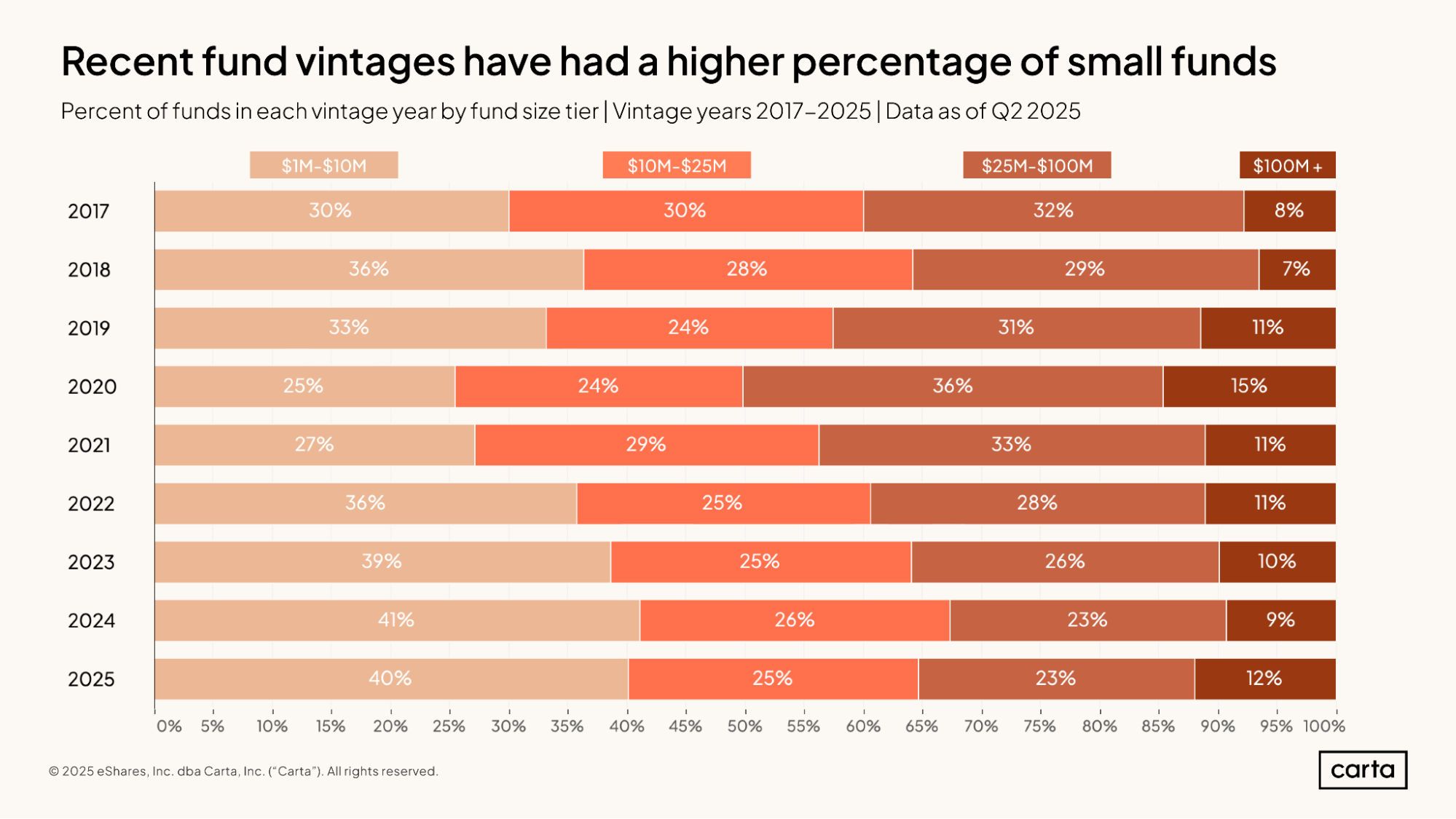
In both the 2024 and 2025 vintages, at least 40% of all closed funds on Carta had between $1 million and $10 million in committed capital. That percentage has increased markedly over the past five years, rising from 25% in 2020. At least in part, this shift in the market is due to the growing presence of solo GPs and other emerging managers, who are more likely than established managers to raise smaller funds.
In the first half of 2025, however, there was also a slight uptick in the frequency of the largest VC funds: Some 12% of vehicles closed during H1 had at least $100 million in commitments, on pace for the highest annual figure since 2020.
As both the smallest and largest funds have grown more common, mid-sized vehicles have felt the squeeze. Just 48% of funds closed in 2025 were between $10 million and $100 million in size, the smallest percentage in at least the past nine years.
Full report available: Start reading now for free
See our complete VC Fund Performance report, with 25 additional charts and best-in-class data on fund performance including IRR, TVPI, DPI, and more.



DISCLOSURE: This communication is on behalf of eShares, Inc. dba Carta, Inc. ("Carta"). This communication is for informational purposes only, and contains general information only. Carta is not, by means of this communication, rendering accounting, business, financial, investment, legal, tax, or other professional advice or services. This publication is not a substitute for such professional advice or services nor should it be used as a basis for any decision or action that may affect your business or interests. Before making any decision or taking any action that may affect your business or interests, you should consult a qualified professional advisor. This communication is not intended as a recommendation, offer or solicitation for the purchase or sale of any security. Carta does not assume any liability for reliance on the information provided herein. © 2026 Carta. All rights reserved. Reproduction prohibited.