
- Equity in business: A founder's perspective
- What is equity in business?
- What are the types of equity?
- Common shares
- Preferred shares
- Employee equity
- Convertible instruments
- Types of equity in an LLC
- Types of interests
- Vesting
- How does equity turn into cash?
- Merger and acquisition (M&A)
- Initial public offering (IPO)
- Secondary market transactions
- How to calculate your equity’s value
- Why does equity matter for your startup?
- Equity in public markets vs. private markets
- The ownership economy
- Managing your equity with confidence
- Frequently asked questions about equity
Owning equity in a company means you have an ownership stake. A wide range of people and entities can own equity in a company, including the company’s founders, investors, employees, advisors, and consultants.
You might have heard the term equity used in other contexts, like home equity, but the concept is the same—it’s your ownership stake. As a founder, you will use a few specific types of equity to build and grow your company, often creating compensation packages that are a strategic blend of cash and equity to attract top talent.
The greatest advantage of this kind of shared ownership is that it can align equity holders with the overall prosperity of a business: If the value of the company increases, so does the financial stake held by equity owners.
Equity can also provide a path to wealth for wage earners through the outsized returns that could come from long-term equity ownership, especially in early- and growth-stage private companies. In this article, you’ll learn the basics of business equity ownership.
What is equity in business?
In the simplest terms, equity in business is ownership. In a private company, equity represents the total ownership divided among the people who have a stake in it, including founders, employees, and investors. This ownership gives them a claim on the company's future profits and assets, and it's important for all holders to understand the resulting taxes on equity, including capital gains.
You may see equity called “shareholders’ equity” (public companies) or “owners’ equity” (private companies). In each case the definition is the same: Equity is the portion of ownership shareholders have in a company.
You can think of business equity using a basic accounting formula: Assets - Liabilities = Equity. If a company were to sell all of its assets and pay off all of its debts, the value that remains is the equity. This is the core meaning of equity and represents the net worth of the business.
While a textbook definition of equity comes from the accounting formula of total assets minus total liabilities, this doesn't capture the full picture for a startup. The true value of a company’s equity isn't just what’s on the balance sheet today, but what the company could be worth in the future.
This future potential is what makes equity so compelling: It represents a stake in the upside you and your team are working to create. Understanding how equity works, the principles of equity management, and how to use this powerful asset are some of the most important skills a business owner can develop.
For a founder, equity is the most powerful tool you have to build your company, serving as the currency you use to raise money, attract a great team, and align everyone around a shared vision. It's how you reward the people who take a risk on your vision before there's any revenue or profit to show for it.
For employees, the ability to own equity can be an incentive to join a company, stay at the company for longer, and feel more invested in the company’s success. Many businesses, including most startups, include equity as part of their overall compensation to employees.
What are the types of equity?
The two main types of equity issued by private companies are shares of common stock and preferred stock. Both types offer different benefits to shareholders. In general, shares of common stock are issued to founders and employees, while shares of preferred stock are issued to investors.

Common shares
Common shares, or shares of common stock, are generally issued to a company’s early founders and its employees. It represents a direct ownership stake and is granted with certain rights, such as voting rights, which allows holders to have a say in company decisions. This type of equity is the foundation of your company's ownership structure.
When the company files its Articles of Incorporation, it specifies how many shares it is creating. The company then determines how those shares will be divided if there are co-founders and how many shares will remain unissued and available to be issued to other early contributors to the company, such as advisors, consultants, or early employees. As you hire your first employees, you may also grant them common stock or options to buy common stock. If they receive restricted stock subject to vesting, they may have the option to file an 83(b) election to potentially save on taxes.
Founders can amend their Articles of Incorporation to create more shares. This usually occurs as a company grows, often in conjunction with raising money from investors. With more shares available, companies can award equity in the form of stock grants or stock options to more employees. These forms of equity compensation offer an incentive for employees to join the company.
The major disadvantage of common shares versus preferred shares is that they receive a lower preference if there is a liquidity event—common shareholders generally only receive a payout after preferred shareholders have received at least their initial investment back.
Preferred shares
Preferred shares, or preferred stock, is a type of equity issued primarily to investors (such as venture capitalists or angel investors) when they invest in a company’s funding round, known as equity financing. Preferred shares come with specific rights that common stock doesn't have, such as a liquidation preference. A liquidation preference gives investors their money back first in an exit scenario, like an acquisition, before common stockholders receive anything.
These additional rights are why people call it "preferred." Investors take on significant financial risk, and these preferences are designed to protect their investment. Understanding the terms of preferred stock is critical when you negotiate a funding round.
Employee equity
Companies can issue several different types of equity to employees depending on the company’s compensation philosophy, fundraising stage, or option pool. Issuing equity to employees can create a possibility of profit if the company’s share price grows over time. Like all investments, however, gains are never guaranteed, and shares can become worthless if the company fails, reaches insolvency, or otherwise never reaches a liquidity event, like an IPO or a merger with another company.
Restricted stock award (RSA) | Incentive stock option (ISO) | Non-qualified stock option (NSO) | Restricted stock unit (RSU) | |
When to issue | Before raising outside funds | After fundraising | After fundraising | When your company reaches a stable valuation |
Stock options
A stock option is a type of equity compensation that allows an employee to buy a set number of company shares at a fixed price (known as the strike price, or exercise price). Stock options aren’t actual shares of stock, only the right to buy them. You’re never required to exercise a stock option.
Companies generally distribute options from an option pool, which is a reserved set of shares from which equity can be issued to service providers in the future. Those people could include advisors, consultants, and independent contractors, as well as employees.
The two types of employee stock options in the United States are incentive stock options (ISOs) and non-qualified stock options (NSOs). Both enable equity ownership and are offered to service providers depending on different factors. ISOs and NSOs mainly differ in how and when they’re taxed—ISOs could qualify for favorable tax treatment.
Incentive stock options (ISOs): ISOs are the most common type of security issued to employees in the U.S. ISOs can only be issued to employees and not to other service providers. Unlike NSOs, you usually don’t have to pay taxes when you exercise ISOs (except for the alternative minimum tax, if applicable). ISOs sometimes qualify for a lower tax rate if you meet certain requirements.
Non-qualified stock options (NSOs): Non-qualified stock options do not qualify for favorable tax treatment for the employee. For NSOs you pay taxes both when you exercise the option (purchase shares) and when you sell those shares.
Other types of equity awards
Other types of equity awards like restricted stock awards (RSAs) and restricted stock units (RSUs) are two examples of equity alternatives to stock options. Companies usually switch to RSUs as they grow larger to reduce share dilution and to make the awards attractive and affordable to employees.
While stock options offer you the “option” to buy shares at a fixed price, RSAs and RSUs are grants of stock subject to certain conditions. Although recipients sometimes pay nothing up front for these types of equity awards, they don’t take full ownership of the stock until their award fully vests.
→ Learn more about RSUs vs. options.
Restricted stock units (RSUs): A restricted stock unit is a promise to give you shares of a company’s stock (or the cash equivalent) on a future date—as soon as you meet certain conditions. These conditions are the “restrictions” placed on the award, and the process of meeting the conditions is called vesting. With RSUs, you are usually only responsible for paying the applicable taxes when you receive the shares. Larger, later-stage companies more commonly issue RSUs.
Restricted stock awards (RSAs): RSAs are equity awards that are acquired upon grant, and are usually subject to vesting conditions. If the shares do not vest, the company has the right to repurchase the unvested shares when the service provider leaves the company. Very early-stage companies issue RSAs before raising substantial funding—when the fair market value (FMV) of common stock is low—to help recipients avoid a large tax burden.
→ Learn more about RSAs vs. RSUs

Convertible instruments
Convertible instruments, such as Simple Agreements for Future Equity (SAFEs) and convertible notes, are tools used in early-stage fundraising. The conversion of these instruments, which results in share dilution for existing owners, typically happens during a priced funding round where preferred stock is issued. A SAFE is one of the most common convertible instruments founders use in their earliest funding rounds because they are simpler and faster than issuing preferred stock. They allow you to secure capital without having to set a formal valuation for the company, deferring that complex conversation until a later stage.
Types of equity in an LLC
While the C-corporation is the most common entity type for venture-backed companies, it's important to know that less than 10 percent of all U.S. small businesses are organized this way, with many others choosing to form as a limited liability company (LLC). LLCs use a different business structure than corporations. They are legally structured as partnerships, with different tax and employment implications. LLCs may set up an LLC equity compensation plan, to detail how the company shares ownership with employees and consultants. An LLC’s equity incentive plan is different from those that corporations use to offer equity to their employees. Corporations generally issue shares of stock, stock options or RSUs, but LLC equity can come in many forms, known as interests.
Types of interests
Profits interests: Profits interests units (PIUs) or incentive unit plans offer employees future profits from the company, either from a sale or from yearly distributions. PIUs require a threshold or hurdle valuation to establish what the business is worth on the date of grant, and the recipient is able to participate in any proceeds from the growth of the company from that point forward.
Membership interests: Membership interests, also called membership units or capital interests, are another form of equity for LLCs. Membership interests owners have the same financial privileges as other members do and may also have voting rights. This type of equity has value as soon as it’s granted.
Phantom equity: Phantom equity or synthetic equity awards recipients the right to future value, typically in the form of a cash payment when the company reaches a milestone. Phantom equity is not outright ownership (as the name “phantom” suggests) and works similarly to profit sharing. Phantom equity is typically paid out during a liquidity event such as an M&A or IPO.
Options to acquire LLC interests: Options to acquire LLC interests is a type of a contract LLCs use that functions similarly to a stock option grant agreement does for corporations. Options to acquire interests is the contractual agreement outlining the recipient’s right to purchase equity at a future date.
For companies like Relativity, a legal technology company structured as an LLC, managing this complexity was a major challenge. As Timothy Cha, Relativity’s senior manager for compensation, explains, “Carta’s LLC platform made it easy for us to offer a consistent equity experience to our employees around the world.”

Vesting
At most companies, employees must work for a certain period of time or meet specific milestones to earn their equity awards. This is called vesting.
The lifecycle of an option usually looks like this:
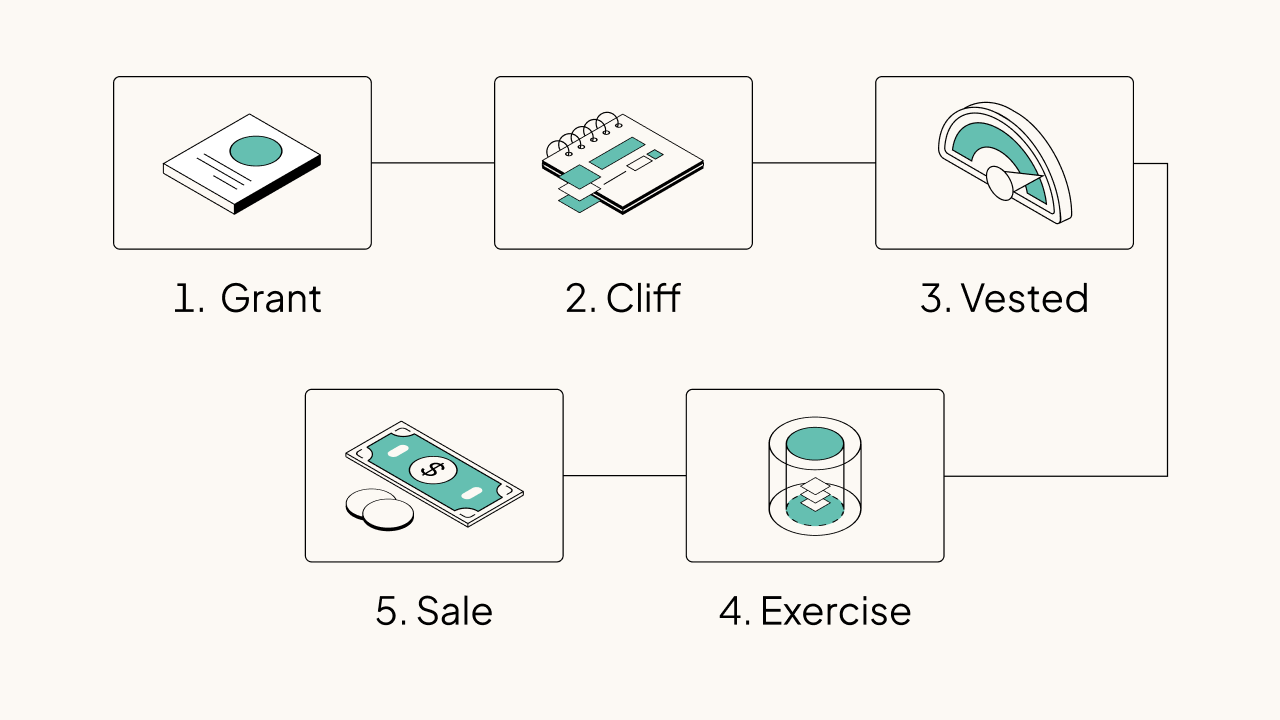
Your option grant will outline a vesting schedule, which details when you’ll earn the right to exercise your options or when you officially own your shares (e.g., 1,000 options over four years).
Some equity plans can allow early exercising, which lets you exercise options before they are vested. This can produce tax advantages, because the recipient is purchasing the shares before the company’s FMV has increased, thus minimizing the income tax they must pay upon acquiring the shares.
The three common types of vesting schedules are time-based, milestone-based, and a hybrid of time-based and milestone-based.
How does equity turn into cash?
For everyone involved—founders, employees, and investors—the equity they hold is just on paper until a specific event happens. The process of converting that paper ownership into actual cash happens during liquidity events. A liquidity event is the moment when the years of hard work can finally pay off and equity becomes a tangible asset. Without a liquidity event or the prospect of a liquidity event, equity in a business is virtually meaningless.
The biggest advantage of investing in the public market is its liquidity: Publicly traded stocks are typically easy to buy and sell on a daily basis. All types of investors can enter the public market, while only accredited investors or qualified purchasers are able to freely invest in the private market.
The following are some of the paths to liquidity for privately held companies:
Merger and acquisition (M&A)
When one company or firm purchases another, shareholders of the acquired company may receive a cash payout or new shares from the buyer making the acquisition. What happens to your equity during a merger and acquisition (M&A) transaction depends on the type of equity, tenure at the company, and the deal terms with the buyer. As in all liquidity events, preferred shareholders are generally paid out before common shareholders. In acquisitions where the price is at or below the total amount that preferred shareholders invested in the company, this can mean common shareholders receive no proceeds from the acquisition.
Initial public offering (IPO)
An initial public offering (IPO) is when a private company offers its stock on the public market for the first time, allowing it to exchange shares for capital from the public and non-accredited investors. Existing shareholders in the company, including employees, can access liquidity by selling some or all of their vested shares for cash.
For startups, M&A and IPO are the two most common exit options, but in 2023, there were nearly four times as many acquisitions of venture-backed companies on Carta as there were IPOs in the entire U.S. market.
Secondary market transactions
The secondary market for private stock allows stockholders of private companies to liquidate their equity before an exit event such as an M&A transaction or an IPO. Secondary market transactions do not function the same as public stock market transactions.
Private market secondaries can be:
A company-sponsored liquidity event, such as tender offers, block sales, or auctions.
Direct stock transactions, which allow investors to purchase company shares directly from existing stockholders.
Tender offer
A tender offer is when multiple sellers (usually employees) can sell their company shares either to an investor, a group of investors, or back to the company. Tender offers happen when a company is still private, allowing shareholders to liquidate equity without having to wait for the company to go public or get acquired. It is the most common type of secondary transaction.
Share buybacks and third-party tender offers are the two types of private company tender offers.
Share buyback: When a company repurchases shares from its shareholders (typically, their employees, investors, and (in some cases) former employees)
Third-party: When a company allows investors to purchase shares from existing shareholders
How to calculate your equity’s value
Knowing how much shares are worth is essential to understanding the value of your equity. In the public markets, the share price of all companies listed on stock market exchanges is publicly available in real time, and is based on supply and demand. Private companies that offer equity calculate share prices in a different way—they use a 409A valuation (an independent appraisal of the FMV of common stock) to calculate the FMV of each share for compliance purposes and to establish the exercise price. Most companies use financial platforms like Carta to track ownership, allowing employees to see how many shares they own and what their company’s latest FMV is.
Many early-stage companies have few assets and may even have more liabilities than assets in the beginning; in fact, data shows that only about 2 in 5 startups are profitable, which is why their value is tied to future potential. This is a normal and expected part of the journey, often requiring founders to focus on extending their runway to survive until the next milestone. For instance, in the third quarter of 2024, about 40% of all fundings raised by seed and Series A startups were bridge rounds: a form of interim financing that shows just how common it is for young companies to need extra capital to bridge the gap to their next primary funding round.
For a new company, the definition of equity ties to the promise of what it could become. This is the value into which investors and early employees are investing their time, money, and careers. The calculation of this future value is complex, especially in a market where a decade-high number of flat or down rounds occur, but it's the foundation upon which you'll build your company.
To evaluate an equity offer from a prospective company, or to calculate the value of your existing employee equity, employees can consider:
The number of options or RSUs in your grant (the total number of options offered to you)
The cost of acquiring the shares (the strike price, or the price per share to exercise your options)
Over time, an employee or other equity holder can monitor the FMV of the company; most companies conduct 409A valuations on an annual basis, or even more frequently. If the valuation of the company rises relative to the strike price, that is a sign that the shares are growing in value. However, any actual profit would only come after several steps: The employee must exercise the shares (or fully vest their restricted stock), the company must have a liquidity event (either an IPO, M&A, or secondary transaction), and the employee must sell their shares at a current market price that is higher than the price for which they purchased their shares.
Equity holders in a company typically are not allowed to sell shares during a lock-up period following an IPO, usually 90 or 180 days.
Why does equity matter for your startup?
Before your company generates significant revenue, equity is your most powerful tool. It's what you use to bring on co-founders, grant advisory shares, hire your first key employees, and secure the initial capital needed to get your idea off the ground. It allows you to build a compensation plan that rewards key people for the risk they are taking by joining your unproven venture.
While a fair market salary offers predictable income, the potential value of an ownership stake provides a financial upside that cash alone cannot. For many talented people, the decision to join a startup is a bet on the company's vision and the once-in-a-lifetime economic opportunity that equity represents—the allure of a massive return, driven by the fact that just 3.6% of exits have historically accounted for nearly 80% of the total value created.
Managing equity professionally from the start is also key to building credibility. A messy or unclear equity story can be a major red flag for potential investors and can seriously complicate your fundraising efforts—a critical issue when nearly 30% of all startups that fail do so because they run out of money. It signals to investors that you may not be organized or serious about the financial health of your company.

Equity in public markets vs. private markets
A common way to own equity in a company is to invest in a publicly traded company listed on a stock exchange. For public companies, information about the company is transparent. Anyone can invest in the stock market, and companies are legally required to make information about the company’s financial situation available to investors so they can make informed decisions. Employees who work for public companies may own stock in the company as part of their employment, as well.
Private companies—small retailers, restaurants, tech startups, or other companies whose shares aren’t publicly available—can offer equity, as well. Unlike public companies, which are open to investment from anyone, equity in private companies is generally not available unless you are an employee, an accredited investor, or a qualified purchaser, such as a venture capital firm.
Note that owning equity in a private company as an investor or employee is a different idea than private equity, which refers to a specific type of investment partnership in which large investment firms buy later-stage private companies and manage them.
The ownership economy
What if issuing equity were as easy and cheap as paying payroll? Could we make ownership as ubiquitous as salaries?
That’s the concept behind the ownership economy. Equity keeps employees invested in their work. It allows them to own a piece of the company and gives them a personal reason to help it succeed.
At Carta, we create more owners. More than 50,000 companies use our platform to map and expand equity ownership to over 2.5 million shareholders.
Managing your equity with confidence
As you've seen, the journey of managing equity is complex, with many critical decisions to make at every stage. Many founders start by tracking ownership in a spreadsheet, but this approach is prone to human error and can lead to costly mistakes and lost investor confidence. You don't have to manage it alone.
An end-to-end equity management platform can grow with you, including issuing your first SAFE to modeling a complex exit waterfall. By partnering with an expert, you can turn equity from an administrative burden into a strategic advantage. This allows you to focus on what you do best: building a great company.
Request a demo to see how Carta can help.

Frequently asked questions about equity
What does owning a percentage of equity in a company mean?
Owning a percentage of equity means you own that portion of the company's total value. The monetary worth of your stake will change as the company's valuation grows or shrinks over time.
What is the difference between equity and stock?
Equity is the broad concept of ownership in a company. Stock is the specific security that represents a unit of that ownership, giving the holder a direct claim on the company's assets and earnings.
How much equity should I give to early employees?
There's no single right answer when deciding how much equity to give early employees, as the ideal amount depends on the role, the employee’s experience, and your company's stage. However, you don't have to make these decisions in a vacuum. Benchmark data can provide a concrete starting point for making competitive offers. For example, Carta regularly publishes reports with additional equity compensation data, including median equity grants for a startup’s first 10 employees, which can help you see what’s standard in the market.
What does a 10% equity stake mean?
An equity stake of this size means you own that percentage of the company’s total outstanding shares on a fully-diluted basis, and its value changes as the company’s valuation grows or shrinks.
How is equity paid out?
Equity is paid out when a shareholder sells their shares for cash during a liquidity event, such as an acquisition, IPO, or a secondary transaction like a tender offer.
What is dilution and should I worry about it?
Dilution is the decrease in your ownership percentage when new shares are issued to investors or employees, but it's a necessary part of growing a company and making the overall pie much larger.

DISCLOSURE: This communication is on behalf of eShares, Inc. dba Carta, Inc. ("Carta"). This communication is for informational purposes only, and contains general information only. Carta is not, by means of this communication, rendering accounting, business, financial, investment, legal, tax, or other professional advice or services. This publication is not a substitute for such professional advice or services nor should it be used as a basis for any decision or action that may affect your business or interests. Before making any decision or taking any action that may affect your business or interests, you should consult a qualified professional advisor. This communication is not intended as a recommendation, offer or solicitation for the purchase or sale of any security. Carta does not assume any liability for reliance on the information provided herein. © 2026 Carta. All rights reserved. Reproduction prohibited.