Topline
Government remains shutdown, portions of the workforce are being laid off
First Brands default, the financial and policy implications
Carta Policy takes SF
Quick hits
The shutdown standoff continues
We are on day 10 of the government shutdown, and there is no end in sight. The House remains in recess, while the Senate unsuccessfully votes on the same funding bill repeatedly. Republicans are seeking a clean funding extension; Senate Democrats oppose the bill unless it addresses expiring healthcare subsidies. Stalemate. The administration is continuing attempts to make the shutdown as painful as possible, with plans to lay off workers and suggestions that furloughed workers are not guaranteed back pay, increasing pressure on Democrats to reopen the government. The two sides seem no closer today than when this started.
Why it matters: While discussions in Washington remain at a stand still, fallout from the shutdown is spreading. Agencies have suspended any regulatory work not essential to national security, health and safety, or market integrity until funding is restored. Of note this week:
IRS furloughed roughly 46% of staff under its updated plan after bridge funds were exhausted following the first five days of the shutdown. This will cause additional strain on the IRS heading into the 2026 filing season.
The shutdown continues to halt the processing of IPOs and other registration statements, which could depress near-term exits. Staff also cannot advance rulemakings on capital formation or a crypto framework, pushing those timelines back.
What’s next: No weekend votes are expected, so the shutdown will spill into next week, at minimum. Active armed service members and a range of other federal employees will miss paychecks on Oct. 15 if a funding bill is not passed—an inflection point that could force a military pay carveout, spur negotiations on the expiring healthcare subsidies, or prompt a shift in some Democrats’ stance. Republicans need to flip at least five Senate Democrats to reopen the government—stay tuned.
First (Brands) crack in private credit may catalyze regulatory scrutiny
The bankruptcy of an Ohio-based autoparts manufacturer, First Brands, has kicked off a cascade of losses in the private credit ecosystem—and may also kick off enhanced regulatory scrutiny of private credit.
Catch-up quick: The privately held auto parts manufacturer, which had rolled up numerous other suppliers, relied heavily on factoring, a type of debt financing. First Brands would sell parts to consumers on credit and then borrow against those accounts receivable. In everyday terms, First Brands sells Jane Smith brake parts for $100, which Jane will pay First Brands over a period of time—this creates the account receivable. Rather than wait patiently for Jane Smith to pay the full amount, First Brand borrows against that account receivable. It would do this over and over again. Between the leverage to acquire other supplies and the borrowing against these receivables, First Brand’s debt grew, reportedly hitting $6B. The debt burden became too great, and First Brands filed Chapter 11.
Why it matters: Failures happen. Not great for anyone involved—the employees, the investors, the lenders, the community. But it happens. Why should an autoparts lender in Ohio matter to the broader ecosystem?
Well, First Brands borrowed a lot. And when it borrowed, it allegedly pledged some of the same receivables to multiple lenders—lenders are banks, hedge funds, private funds, and more. So, the first issue is that the losses are large and the collateral is not clear. The result:
A UBS fund has 30% exposure
A Jeffries fund has $715M of exposure
A joint venture between Japan’s Norinchukin Bank and Mitsui & Co. has $1.75B of exposure
Another credit is claiming $2.3B has simply vanished
It is not just that the creditors are major financial players, but that they are interconnected:
Western Alliance has exposure through a leverage facility (credit offering) that it provided to Jeffries
BlackRock wants to redeem (pull) its investment from the Jeffries fund
Insurers are preparing for claim protection
This is what we know about today. The decline of First Brands—a relatively small autoparts manufacturer—will cascade through the system. It will not take the system or even the private credit market down. We are not trying to overstate the case. But it will hurt the interconnected counterparties and likely push the financial players to be more rigorous. But it will also cascade into the policy world.
The policy implications: As private credit has grown, policymakers have contemplated how to respond. To date, they have held back on expanding regulatory scrutiny and have dispelled systemic risk concerns, with SEC Chairman Atkins even recently signaling he does not believe private credit is systemic.
Transparency: An auto parts manufacturer reportedly pledged the same collateral (accounts receivable) to the most sophisticated financial institutions, and they didn’t catch it until the default. Policymakers will likely want to better understand reporting and push for greater transparency.
Interconnectedness: The financial world is incredibly connected (see above), and regulators will want to better understand how those links operate around transactions and holdings. This visibility is in place in certain areas of the financial market, but expect more scrutiny around private credit.
Will this happen tomorrow? No. But as private capital continues to grow, the policy scrutiny and infrastructure will as well. Carta is building that infrastructure from the product side. We recently acquired Sirvatus to launch Carta Loan Operations—a new product connecting loan administration directly to fund accounting. This marks a major step toward building transparent, audit-ready infrastructure for private credit funds, and advancing our mission to modernize every workflow in private markets.
We are also engaged in shaping the policy infrastructure. If you haven’t already, check out our latest piece on the future of private credit here.
Carta Policy hits SF
The Carta Policy Team spent the week in San Francisco for a packed series of events, diving into the politics and policy shaping today’s innovation economy. From the government shutdown and the SEC’s regulatory agenda to AI regulation and beyond, we explored how founders and fund managers can navigate an increasingly complex and shifting landscape—and how policy is opening new opportunities.
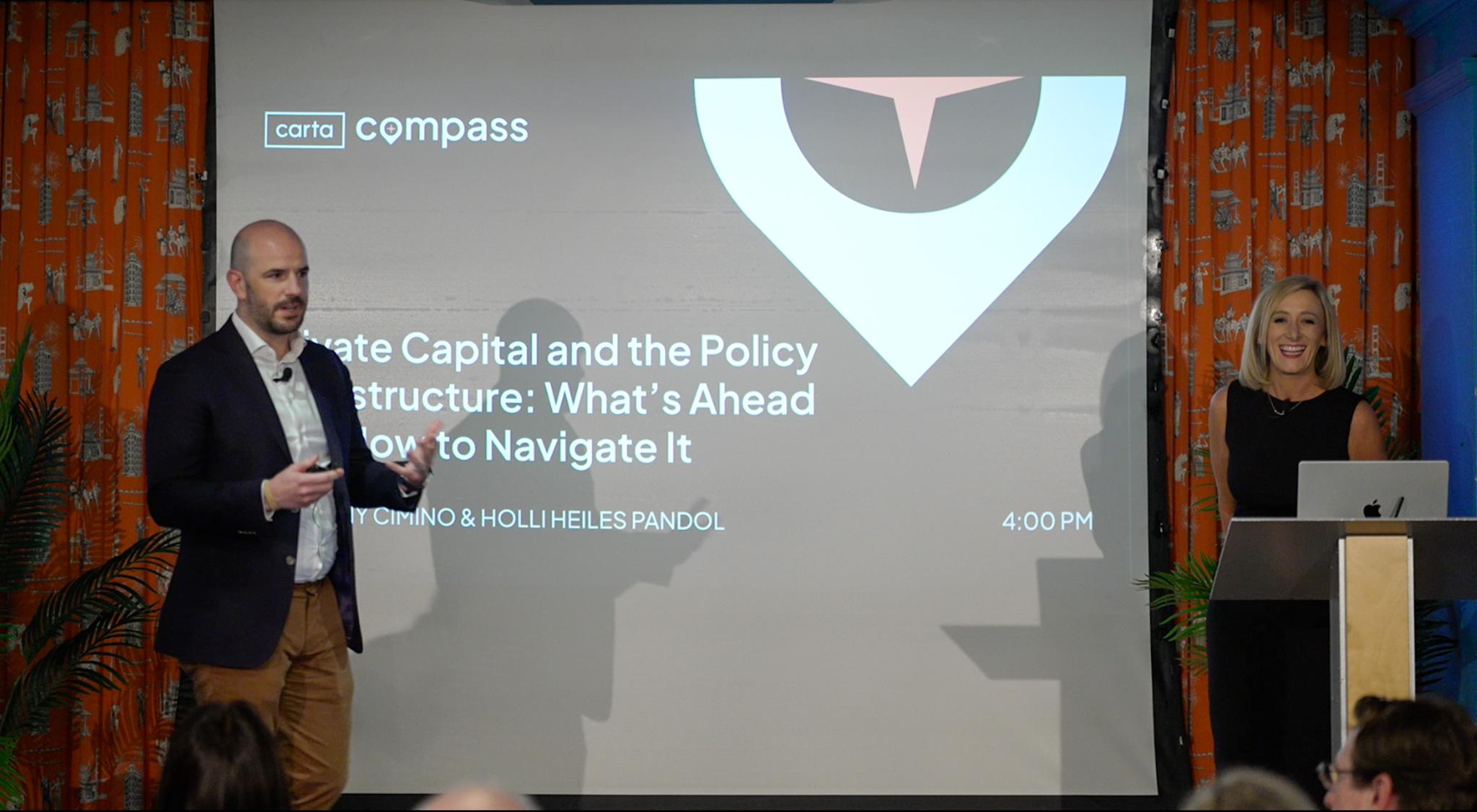
We also participated in SF Tech Week, where Anthony led a discussion with Freshfields partner Nicole Cadman on the recent QSBS expansion and how founders, their investors, and their employees can benefit.
Quick hits
Crypto market-structure talks collapse in Senate. Despite months of bipartisan negotiation, talks have reportedly halted, which could jeopardize congressional action this year.
VC investors leap into defense tech with limited visibility. Venture firms are increasingly investing in defense and dual-use technology, enticed by government incentives and national security demand, but many investors lack the security clearance or access to classified information needed for full diligence.
Trump’s tax law sweetens secondary deals in venture capital. Changes to the Qualified Small Business Stock (QSBS) rules have made early secondary deals more attractive by expanding the exclusion on gains and loosening holding period requirements, boosting liquidity options for founders, early employees, and early-stage investors. Carta led the efforts to expand this important tax provision.
SEC’s Atkins says ballooning private markets not a systemic risk. SEC Chair Paul Atkins said he does not view the private credit market as systemically important, signaling a more permissive regulatory stance as the $1.7T market continues to grow. Speaking at an industry conference, Atkins acknowledged concerns around valuation and leverage but emphasized the market’s importance and dismissed broader risk, aligning with the administration’s efforts to expand retail access and ease oversight of private funds.
Sign up below to receive Carta's Policy Weekly Brief
DISCLOSURE: This communication is on behalf of eShares, Inc. dba Carta, Inc. ("Carta"). This communication is for informational purposes only, and contains general information only. Carta is not, by means of this communication, rendering accounting, business, financial, investment, legal, tax, or other professional advice or services. This publication is not a substitute for such professional advice or services nor should it be used as a basis for any decision or action that may affect your business or interests. Before making any decision or taking any action that may affect your business or interests, you should consult a qualified professional advisor. This communication is not intended as a recommendation, offer or solicitation for the purchase or sale of any security. Carta does not assume any liability for reliance on the information provided herein. © 2026 Carta. All rights reserved. Reproduction prohibited.