At some point in the last year, you sat down with your tax provider to walk them through everything that happened at your fund.
Maybe it was a quarterly call. Maybe it was a one-time catch-up before year-end. Either way, someone from your team pulled together activity logs—capital calls, distributions, new investments, follow-ons, valuation updates, and realized exits—and went line by line to make sure your tax provider understood the context behind the numbers.
That meeting didn't appear anywhere in your fee agreement. It didn't show up on your fund's expense report. But it cost you something.
Why this meeting exists
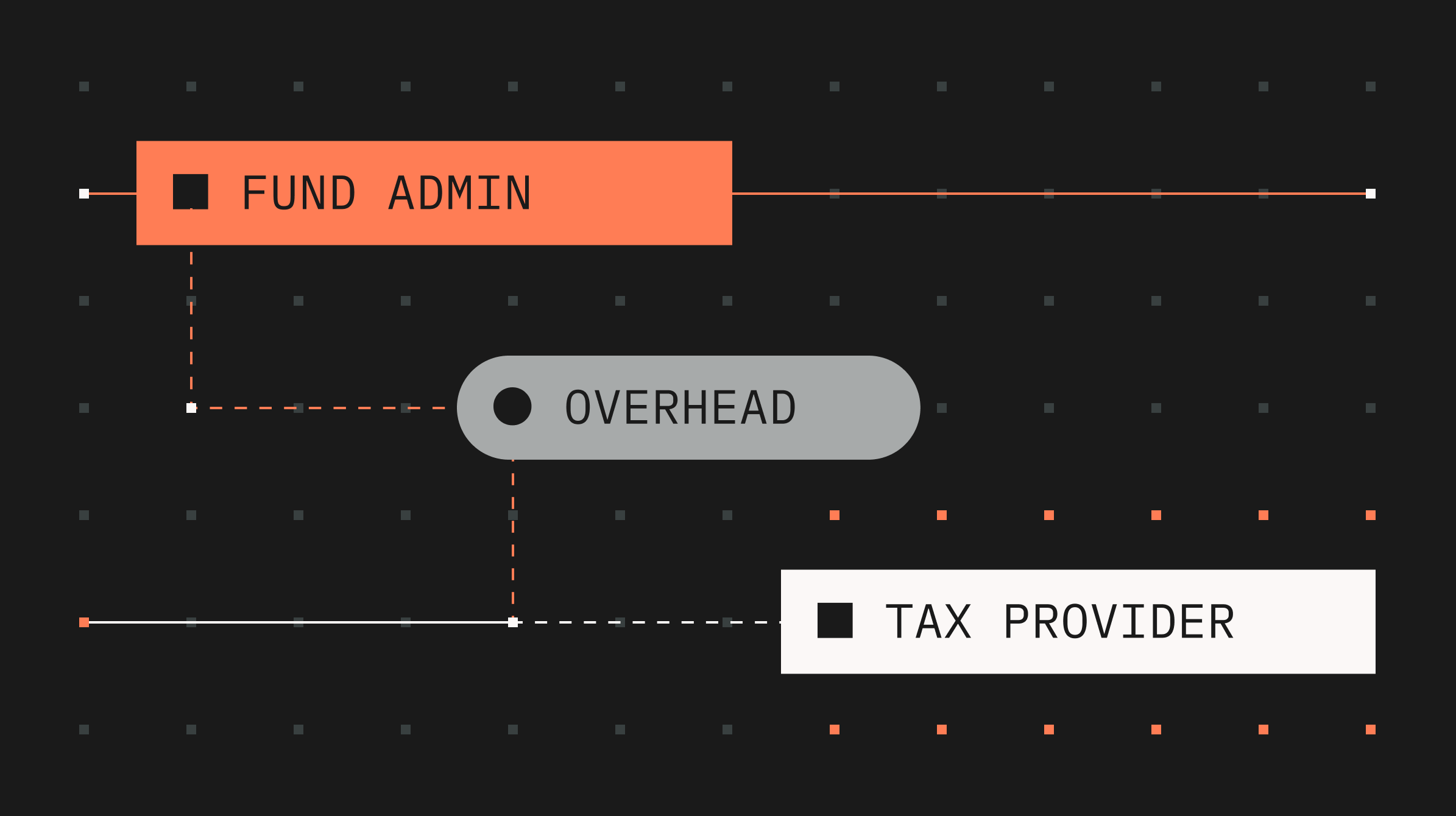
Traditional fund administration and tax preparation are separate services, managed by separate teams, working from separate systems. Your fund admin tracks your portfolio and closes your books. Your tax provider interprets those books to prepare your partnership return and K-1s.
When those two functions live in different organizations, information doesn't flow between them automatically. Your tax provider only knows what you tell them—or what your fund admin exports to them, once a year, after the books close.
That's the structural gap. And filling it requires your time.
The catch-up meeting—or series of emails, or back-and-forth on document requests—is how your team bridges two systems that were never designed to work together. The division of labor is unclear, the handoff is manual, and the coordination cost lands on someone. Your tax provider asks questions. Someone on your team finds the answers. The process repeats throughout tax season and, for some firms, throughout the year.
For Matt Moran, CFO at DataTribe, that dynamic was a constant friction point before moving to Carta: "Time-consuming manual catch-ups with tax providers spanning months of activity." Not just one meeting—months of ongoing reconciliation between two systems that both held pieces of the same story.
DataTribe moved to Carta Fund Tax and eliminated months of manual reconciliation with their tax provider. Read the full story.
The real cost of parallel systems
There's an easy number to calculate: the hourly cost of the time your team spends on tax coordination. Finance staff time at a VC-backed fund runs anywhere from $80 to $200 per hour, depending on seniority and location. If your CFO or controller spends 20 hours a year bridging the gap between your fund admin and your tax provider, that's a real cost—one that never appears in your tax preparation invoice.
But the harder-to-quantify cost is the distraction. For most emerging and growth-stage managers, there isn’t a large finance team—coordination usually falls to you as the GP or a small group of partners. Every hour you spend answering questions from your tax provider about Q3 investment activity is an hour you’re not evaluating new deals, supporting portfolio companies, or fundraising. That opportunity cost is diffuse and difficult to measure, which is exactly why it tends to get overlooked when fund managers evaluate their service providers.
There's a third cost that's harder to see until it happens: data divergence. When your fund admin and your tax provider both hold overlapping records — LP addresses, K-1 status, investor details — the two systems are rarely in sync at the same moment. Any update made in one before it's reflected in the other creates a window where someone is working from stale data. The fund CFO is the one who typically discovers this, usually after a K-1 has already gone out wrong or an LP has already been contacted with incorrect information. Correcting it means owning the error, explaining it to the LP, and tracing the discrepancy back through two separate systems. None of that work generates value. All of it exists because the same data lives in two places.
Carta's own analysis of fund operating expenses finds that for smaller funds—those between $1 million and $10 million in committed capital—operating expenses total a median 3.4% of committed capital over the fund’s first five years, and audit fees alone account for about 17% of those operating expenses for audited funds.
Those figures capture direct fees paid to service providers. They don't capture the coordination work layered on top.
What continuous access changes
The reason catch-up meetings exist is simple: your tax provider only sees your fund data when you share it with them. They're not watching your fund throughout the year. They're not tracking your investments as they happen or following your capital activity in real time.
That changes when fund administration and tax run on the same platform.
When Carta's tax team is working from the same underlying data as Carta Fund Administration, there's no catch-up. The activity that hit your general ledger in October is already visible to the tax team in October. The new investment you made in November doesn't require a separate briefing. Year-end close doesn't trigger a discovery process—it triggers a finalization process, because the work of understanding your fund's activity has been happening throughout the year.
"With our seamless integration with Fund Administration, instant visibility into the books allows the tax team to answer questions much faster and with much more detailed information," says Gifty Minhas, a fund tax operations specialist on Carta's team.
When you can ask a question about your returns and get an answer in hours rather than days, because the person answering it has direct access to your fund data, the nature of the relationship changes. You're not translating between systems. You're working in one.
The LP experience downstream
There's a second effect that tends to get overlooked: Your LPs notice.
When K-1s arrive late—because sequential data handoffs extended your timeline—LPs have to file their own extensions. When LPs ask for status updates, you have to ask your tax provider, who has to check their pipeline, who gets back to you, who then answers your LP. That loop can take days.
With Carta's Tax Dashboard, you can see the status of every return across all your funds without making a single call. Expected due dates, current stage, outstanding action items—all visible in one place. Before the dashboard existed, Minhas notes, "Clients would have to email for the status of returns or when they can receive them." Now, that question has a real-time answer.
When an LP asks where their K-1 is, you should be able to tell them. When your fund is in the middle of return preparation, you should be able to see progress without routing through your tax provider's workflow. That visibility is a function of integrated data, not of how responsive your service provider is.
Evaluate what you're actually paying for
When fund managers compare tax providers, the conversation usually centers on fees, turnaround time, and technical expertise. Those are the right things to evaluate. But they're only part of the picture.
The other part is the work that happens between your team and your tax provider—the coordination, the catch-ups, the data translation. That work has a real cost. It just doesn't show up in any single line item.
Here's a useful diagnostic: How many hours did your team spend last year on activities that only exist because your fund admin and tax provider are different systems? That number—multiplied by your team's hourly rate—is a cost that doesn't have to be there.
For DataTribe, eliminating that overhead was one of the defining benefits of switching to an integrated approach. As Moran described: the platform enables "elimination of lengthy tax provider reconciliation meetings through continuous analysis." When fund data flows continuously rather than in year-end batches, reconciliation becomes ongoing rather than annual—and the year-end crunch shrinks accordingly.
One system, no translation layer
The reason this coordination cost is invisible is that it's friction, not a fee. No one invoices you for the 15-minute call you took to answer your tax provider's question about your Q2 distributions. No one bills you for the email chain that clarified how a co-investment should be reported. That friction just accumulates, tax season after tax season, as a background cost of operating two systems that share data only when forced to.
Integrated fund administration and tax preparation doesn't eliminate the complexity of preparing a partnership return. It eliminates the coordination overhead that lives between the two systems—the part that generates work without generating value.
Your fund administration platform already holds everything your tax team needs to know about your fund. The question is whether they can access it directly, or whether you're the one bridging the gap.

DISCLOSURE: This communication is on behalf of eShares, Inc. dba Carta, Inc. ("Carta"). This communication is for informational purposes only, and contains general information only. Carta is not, by means of this communication, rendering accounting, business, financial, investment, legal, tax, or other professional advice or services. This publication is not a substitute for such professional advice or services nor should it be used as a basis for any decision or action that may affect your business or interests. Before making any decision or taking any action that may affect your business or interests, you should consult a qualified professional advisor. This communication is not intended as a recommendation, offer or solicitation for the purchase or sale of any security. Carta does not assume any liability for reliance on the information provided herein. ©2026 Carta. All rights reserved. Reproduction prohibited.