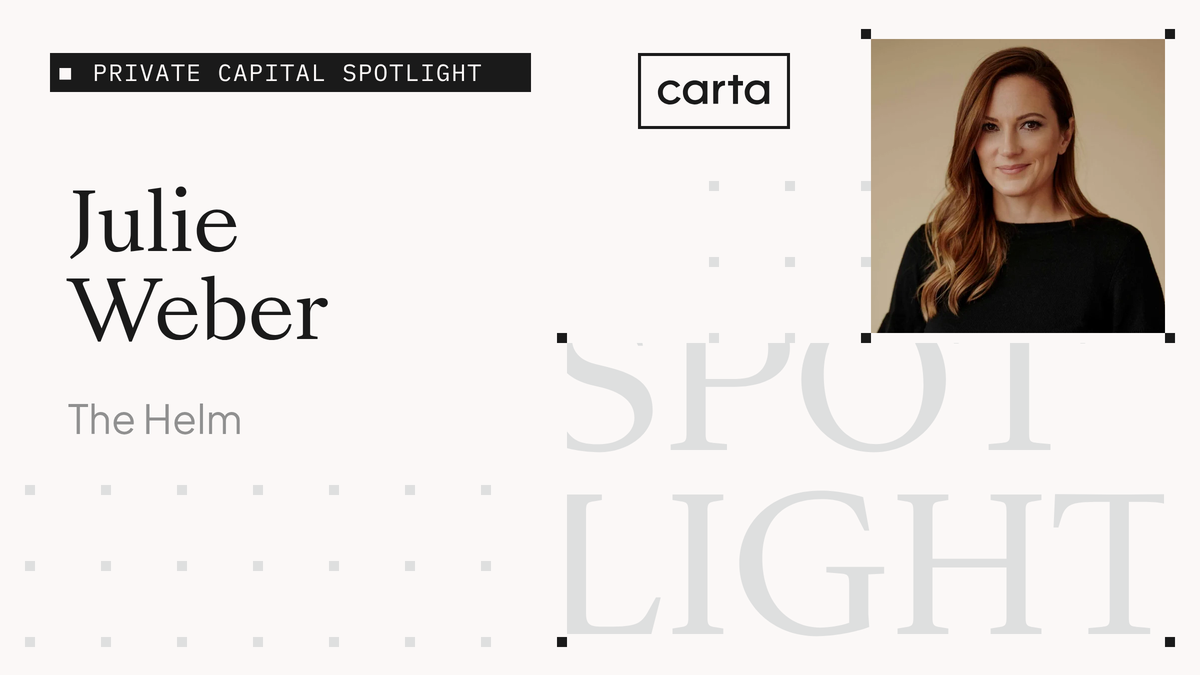
Julie Weber is COO and General Partner at The Helm, an early-stage venture fund and angel network investing in companies founded by women, with a particular focus on healthcare and sustainability. Julie oversees the operational and financial infrastructure of the fund while also sourcing and evaluating investments, supporting portfolio companies, and helping to grow The Helm’s ecosystem. Across its funds and SPVs, The Helm has backed more than 30 companies spanning breakthrough innovations, from early ovarian cancer detection to hypersonic flight.
Julie started her career at the United Nations, where she focused on women’s health and global funding initiatives. She has nearly 20 years of experience spanning venture capital, international development, and startup operations. Her work has consistently focused on how directing capital and resources towards women can drive opportunity and unlock innovation.
We sat down with Julie to talk about her career path, the evolution from advocacy and investing, and how she approaches building great relationships with founders and LPs.
CARTA: Your career has spanned media, NGOs, entrepreneurship, and venture capital. Tell me about what drives your career. What do you see as the throughline? How does your diverse past experience influence your work today?
JULIE WEBER: My career has always lived at the intersection of capital, advocacy, and impact. No matter the role, I’ve been focused on one core idea: how resources get allocated, and how to direct more of them toward women and gender-lens initiatives.
I spent several years at the UN primarily advocating for women’s health, which gave me a view into how global funding decisions get made, and how often women are underinvested in. Later, I moved into the private sector at an early-stage crowdfunding startup (where I first met Lindsey Taylor Wood, founder and GP of The Helm back in 2012), which showed me a different side of capital: how quickly things can move when there’s belief and funding behind an idea.
While my work has evolved from international development to the private markets, the common thread has always been resource allocation—whether that’s via systems, policies, and structures that support women’s education, health, and economic participation, or capital that allows women to build and scale companies.
The underlying thesis has always been that when we invest in women, there’s a ripple effect and everybody wins. Women reinvest in their communities, they build solutions that account for more lived experiences, and create companies that solve different problems and work for more people. The form of investment might look different; policy and infrastructure on one end, venture capital on the other, but the outcome is fundamentally the same: Investing in women is good for communities, good for business, and good for the bottom line.
I recently had the opportunity to hear one of our founders, Sassie Duggleby of Venus Aerospace, speak at the UN’s International Day of Women and Girls in Science and it was a real full circle moment. I hadn’t been back to the UN since I moved on many years ago, but it was a powerful reminder that while the tools I work with have changed, the core belief hasn’t. When you invest in women, you change who’s in the room and ultimately, what the future looks like.
You were an advocate for women and girls with Women Deliver and Catapult, and now you invest in women-founded companies. How does that inform how you approach your work? What’s different about approaching these problems from a nonprofit perspective versus a business perspective?
My earlier career shaped how I think about systems and access. Advocacy and development work are essential; they change narratives, influence policy, and open doors, but they’re often underfunded and dependent on short-term cycles. You’re constantly fighting to keep resources flowing.
Venture is similar in that it also shapes systems and determines who gets access to opportunity; it directs capital, accelerates innovation, and influences which ideas become companies. Like development work, it has structural constraints. Capital is often concentrated within tight networks and follows pattern recognition, which means certain founders and markets are consistently overlooked. And just as nonprofits are dependent on short-term funding cycles, venture operates within defined fund lifecycles and return expectations. You’re constantly working within those parameters while trying to push capital toward places it hasn’t historically flowed.
At their core, both sectors are about correcting misallocation. In development, that might mean highlighting populations that aren’t being served by existing policy or funding structures. In venture, it means recognizing where capital markets are systematically underestimating certain founders or markets.
A good example of this convergence is our portfolio company, Testmate, an over-the-counter STI test that delivers at-home results in 30 minutes, no lab required. One of the things that drew our team to the company was not just the size of the domestic market, but the global potential. From my time at the UN working on women’s health, I saw firsthand the enormous barriers people in the Global South face in accessing basic sexual healthcare: stigma, infrastructure gaps, lack of labs, long travel times. A product that removes those barriers has obvious commercial appeal, but it also has the potential for meaningful impact at scale.
Having that broader context helped me understand both sides of the equation: the market opportunity and the real-world urgency of the problem. Experience across sectors strengthens your ability to see scalable opportunities embedded in real-world problems.
So much of venture capital is about people and relationships with both founders and LPs. How do you cultivate and maintain these relationships? What advice do you have on building long-term relationships?
Yes, you’re absolutely right. Venture is ultimately a people business. At The Helm, we spend a lot of time thinking about how to build relationships that are real and lasting with founders, LPs, and our wider community. Because we are such a mission-driven firm, most of our relationships start with connecting around shared values, which I think naturally lends itself to richer and more genuine interactions.
We’re very intentional about building community to foster existing relationships, create new ones, and add value to all the different stakeholders we work with. Creating shared experiences is one of the best ways to do this. We host cocktail events, panels featuring our founders, intimate dinners, and plenty of more casual connections.
One of our favorite things to do is bring our founders together, often over long, casual lunches, and watch the genuine connections form. Being a founder is hard at the best of times, but female founders face a unique set of challenges. Creating space for them to build alliances, partnerships, and real friendships not only brings value to them, it brings us a lot of joy.
It is especially powerful when our LPs get to interact directly with our founders. We can talk about how impressive our founders are all day long, but the magic really happens when LPs get to experience a founder's energy firsthand; when they hear the vision directly, ask questions, and see the conviction up close. Those shared experiences build trust in a way no memo ever could.
We recently hosted a dinner in London with several of our LPs and founders, and watching the connections form across the table (LPs with LPs, founders with founders, and LPs with founders) was truly electric. Moments like that are a great reminder of how much this work matters.
Being both a founder and an investor in this space can feel isolating at times. What we’re all doing is really, really hard. Every time we bring our community together, I think we all walk away feeling inspired, uplifted, energized, more committed to the cause and the outcome, and to one another. This shared energy deepens relationships, refills the tank, and helps all of us to keep moving forward.
In terms of advice, I’d say that one of the most important things to keep in mind is that meaningful connections can start in unexpected ways. Some of the most valuable relationships come from conversations that aren’t supposed to “go anywhere.” They just start with curiosity and mutual respect.
How do you typically connect with founders? Are there any unusual practices (e.g., maybe a funny story of how you first met a founder)? When investing in often overlooked communities, how do you think about breaking the “boys’ club” cycle?
This is a great segue from the previous question because our strategy around connecting with founders is rooted in community and the strength of our network. If you want to break the so-called “boys’ club,” you can’t wait for it to change; you have to build a different table. For women, that table involves access to community, camaraderie, tools, and resources that invite them (both as founders and funders) into an asset class and ecosystem they’ve historically been excluded from.
In the early days of The Helm, we invested significant time and resources into building a robust content platform that centered the stories of female founders and funders. We set out to become a trusted voice in the ecosystem; not just a fund writing checks, but a platform amplifying ambitious women building transformative companies. That early brand-building work paid off. It gave us visibility and credibility while we were still building our investment track record.
Today, most founders come to us already understanding what we stand for. Increasingly, our strongest referrals come from our own founders. As they grow, they bring other exceptional women into our orbit. We’ve also built a network of more than 200 angel investors through our syndicate, who are advocates for The Helm out in the world. As they move through their industries and communities, they often surface valuable opportunities and introductions. That expands our reach, strengthens our brand, and creates another meaningful pathway to connect with founders. The longer we do this work, the stronger and more interconnected the network effect becomes.
We’re also part of an incredible community of women fund managers who are generous with insights and deal flow. There’s a real spirit of collaboration, and that creates access to opportunities you don’t always find in more traditional circles.
Sourcing for us isn’t just about inbound flow, it’s about trust. When you consistently show up for a community, that community shows up for you. And over time, that becomes one of the strongest competitive advantages you can build.
Women have historically raised single-digit percentages of venture funding (with recent numbers putting it around 2%). It seemed like in the early 2020s, there was a wave to change this, but recently some have backtracked given the changing political environment. Tell me about your experience investing in women-backed companies amid this changing environment. What do you say to those who think investing diversely was a fad?
The idea that investing in women or diverse founders was a “fad” misunderstands both the data and the opportunity.
Women still receive roughly 2% of venture capital, despite building companies that are often more capital-efficient and operating in massive, underserved markets. That gap isn’t a signal of lower quality, it’s a structural inefficiency. And inefficiencies are exactly where strong investors make money.
We’re seeing this play out in the data. A new report on women’s health from our portfolio company AOA Dx found that women’s health companies have generated over $100 billion in exit value over the past 25 years, with nearly half of those exits occurring in just the last five. This challenges the long-standing myth that women’s health is a small, unproven category. It is in fact a scaled, durable segment of healthcare with repeat demand and realized value.
What was fleeting was performative interest: capital that showed up when diversity was fashionable and pulled back when it became uncomfortable. But the underlying fundamentals haven’t changed; large markets don’t disappear because headlines shift. If anything, moments like this clarify who’s investing with real conviction versus who was following momentum.
At The Helm, we’re building our firm for the long term. That means we’re intentional about alignment, both with founders and with LPs. We’re looking for partners who understand that the kind of change we’re trying to drive is structural and takes time, and who see this not as a trend but as a fundamental, winning, and necessary strategy.
You built a robust content platform at The Helm. What are you reading these days? What writers or books (or podcasts) would you recommend?
I try to strike a balance between a few different kinds of content: industry-specific, professional and personal development, and content purely for pleasure. Some weeks I’m on a great roll, and other times I feel paralyzed by just how much content is out there and the pressure to be “consuming the right things” and constantly optimizing and maximizing my time, including what I’m consuming.
Lately, a lot of what I’ve been reading has come from friends’ recommendations. On the personal development side, I have recently read and enjoyed Meditations for Mortals, Miracle Mornings, and The Second Mountain by David Brooks; all quite different, but each helpful in its own way, with a similar thread of thinking about purpose, seasons of life, and how we show up in life and work.
I’ve also been really enjoying memoirs. Keith McNally’s I Regret Almost Everything stood out as refreshingly honest and a great reminder that there’s no single path to building something meaningful. It’s always fascinating to hear someone’s full life story. From the outside, success can look linear or lucky, but you rarely see the twists, setbacks, missteps, and moments of doubt that shaped the journey. Memoirs are a good reminder that what looks like an “overnight success” is usually anything but, and that tracks so closely to the venture journey as well.
On the podcast side, I gravitate toward thoughtful, long-form conversations. I listen to I’ve Got Questions with Sinéad Bovell for smart takes on AI and the future, Halle Tecco’s The Heart of Healthcare, and StartUp Health NOW, among others, for industry-specific perspectives. And then, of course, I balance all of that with daily doses of news and current events to stay grounded in what’s happening in the world.
I often have to remind myself that content isn’t just about volume, it’s about resonance. I try to follow curiosity more than obligation and trust that what I need to read or listen to usually finds me when the timing is right.
What advice would you give women who want to make an impact and build a career in the social justice/impact space?
Take time to explore what kind of change you want to make,and at what level. Not all impact looks the same. Some people are incredible advocates and organizers. Others thrive in policy, research, or philanthropy. Some people are builders and they want to create institutions, companies, or platforms that last. There’s no single “right” lane, but understanding where you want to start can help to narrow your focus at the beginning.
One tendency that I think is quite common, especially among women, is equating impact with sacrifice. Working harder, longer, or with fewer resources doesn’t automatically make the work more meaningful. Sustainable impact actually requires sustainability for the work and for the person doing it. If you’re constantly exhausted or underpaid, your ability to create change over the long term is limited.
I’d also say, don’t feel like you have to do everything at once. Careers are long. You can move between sectors, roles, and approaches over time. What matters most is staying clear on your values, building durable skills, and giving yourself permission to grow without knowing exactly where you’ll end up.
What advice would you give young women who want to work in finance/VC?
Spend time with entrepreneurs. Not just at pitch events, but across the full arc of their journey; when they’re fundraising, hiring, missing targets, and figuring things out in real time. Venture can look polished from the outside, but building a company is incredibly hard. The more you understand what it actually takes to create something from nothing, the sharper your judgment will be, and the better you’ll be at assessing founders, opportunities, and markets. It will also provide you with an ability to understand, empathize, and connect with your founders, which will be incredibly important as you support them through their highs and lows.
You don’t have to look or sound like everyone else in the room to belong there. That can be hard to embody in practice, especially when you sit outside the traditional venture capitalist archetype. But ultimately, venture is about people making decisions with imperfect information and under uncertainty. If you can think clearly, be curious, ask thoughtful questions, and form independent opinions, you’re already building the right muscles.
And play the long game. This industry requires a great deal of patience. Be generous, be curious, and be consistent. The returns, professionally and financially, compound over time.

DISCLOSURE: This communication is on behalf of eShares, Inc. dba Carta, Inc. ("Carta"). This communication is for informational purposes only, and contains general information only. Carta is not, by means of this communication, rendering accounting, business, financial, investment, legal, tax, or other professional advice or services. This publication is not a substitute for such professional advice or services nor should it be used as a basis for any decision or action that may affect your business or interests. Before making any decision or taking any action that may affect your business or interests, you should consult a qualified professional advisor. This communication is not intended as a recommendation, offer or solicitation for the purchase or sale of any security. Carta does not assume any liability for reliance on the information provided herein. ©2026 Carta. All rights reserved. Reproduction prohibited.