Between December 2024 and April 2025, the average salary among new hires at startups on Carta rose by 1.2%. Then, in the two-month span between April and June, it climbed another 0.8%.
This continued a shift in the compensation market that’s been underway for the better part of two years: Ever since the start of 2024, the average startup salary has been steadily rising. As of June, the average salary across all roles on Carta was up 5.8% compared to April 2022.
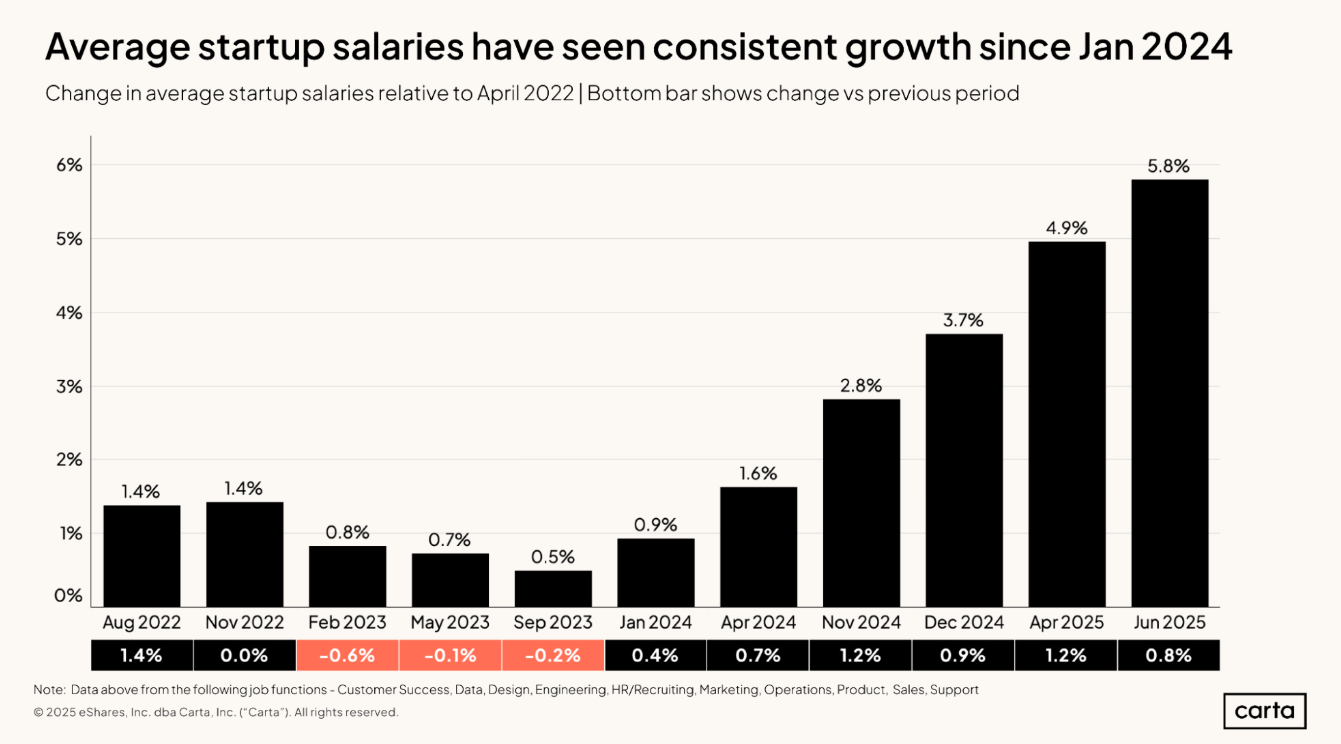
Across 2022 and 2023, salaries held much more steady. In fact, during 2023, the average startup salary was in decline for a period of several months, as companies and hiring managers reacted to a broader slowdown in the startup market that followed the revved-up years of the early 2020s. But this period of shrinking salaries proved to be a blip.
Just as that 2023 downturn in startup salaries coincided with slowing activity across the wider venture landscape, the recent gains in average salary have coincided with a broader startup boom. In this case, the boom has been driven by AI. And as you might expect, workers who can help their employers build and implement new AI tools and workflows are in particular demand.
>> See our full State of Startup Compensation report for H1 2025.
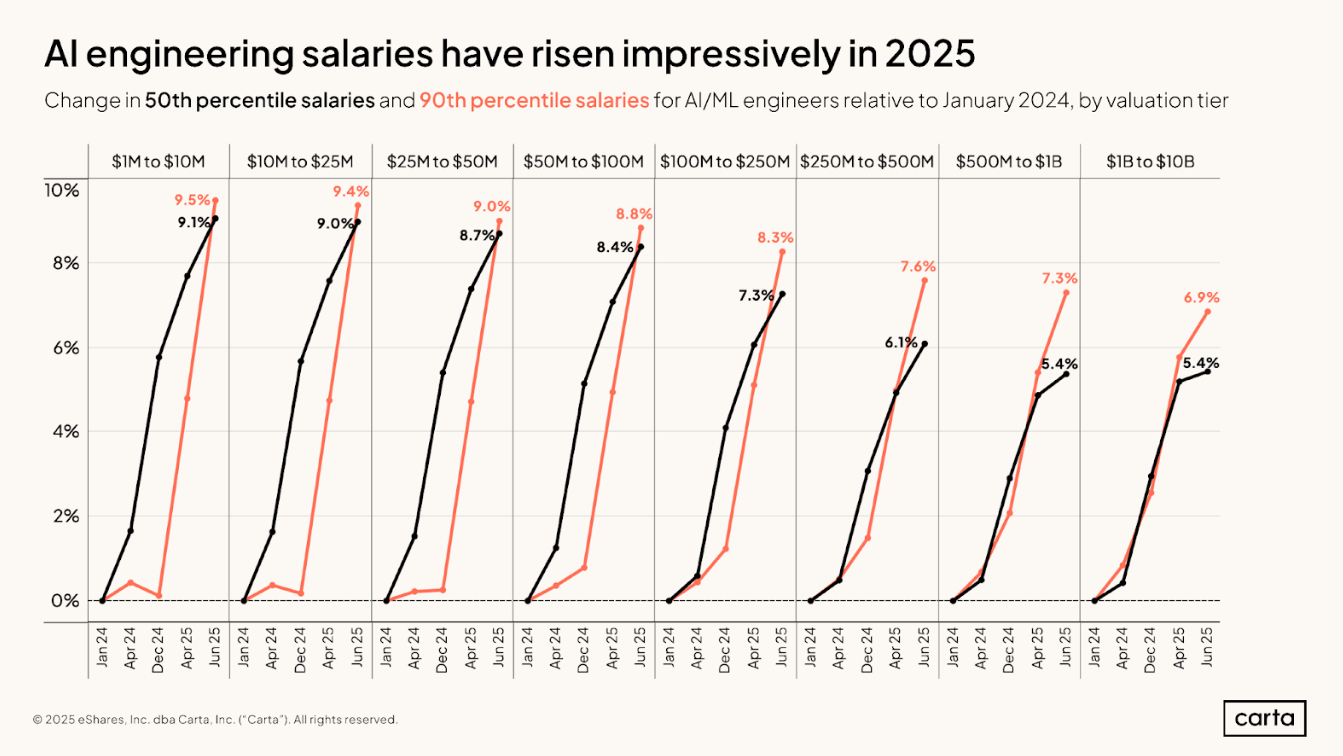
Between January 2024 and June 2025, the median salary for AI and machine learning engineers increased by somewhere from 5.4% to 9.1%, depending on the size of the startup. At the 90th percentile, increases in salaries ranged from 6.9% to 9.5%. As shown in the chart below, salaries for AI/ML engineers experienced the biggest gains among smaller companies, while AI engineering hires at startups with higher valuations saw slightly smaller gains.
For many founders and executives, the meteoric ascent of AI tools and technology has prompted a profound reckoning about how to build a startup in a new technological age. Different companies may arrive at different answers. But for every solution, engineers will likely play a critical role.
“At any intersection of technology revolution and old processes, you need some really talented engineers to be able to figure out how to incorporate that technology,” says Lacey Kaelani, co-founder and CEO of Metaintro, an AI-powered job search platform.
More roles, more dollars for engineers
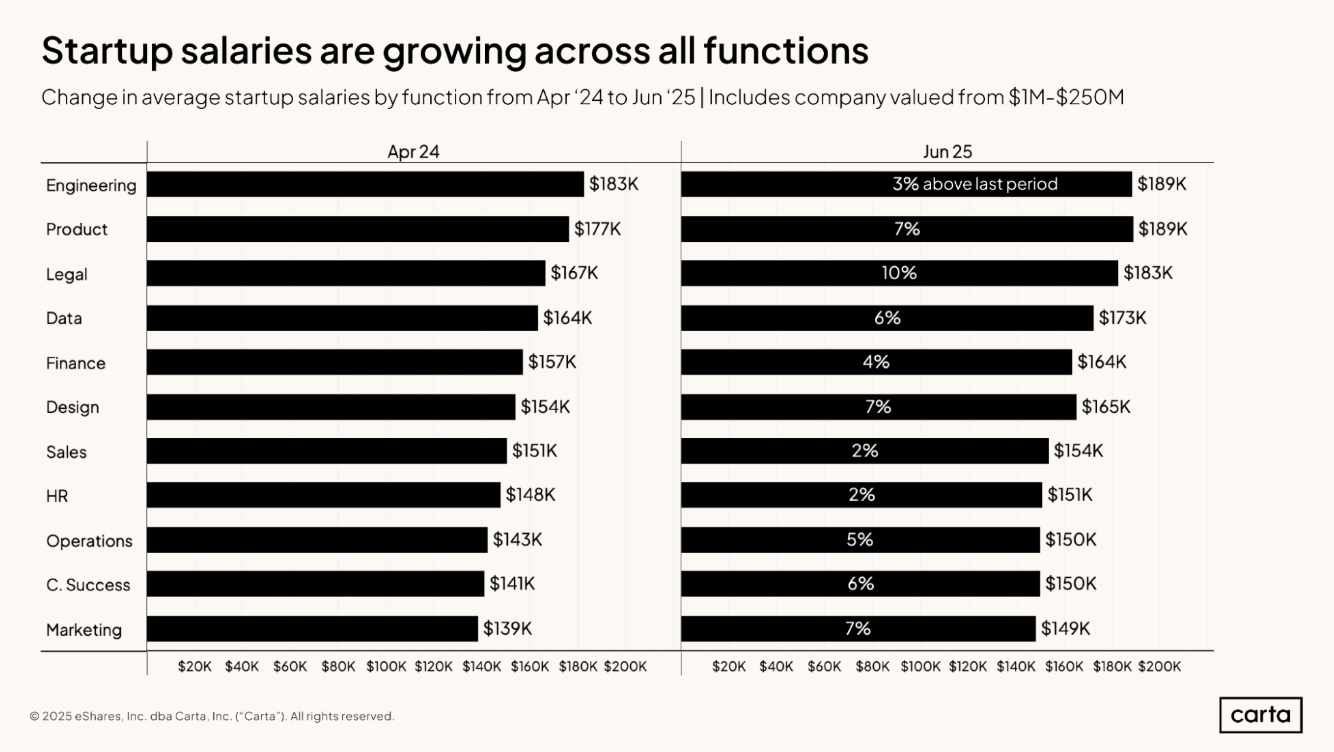
Engineers of all kinds—not just those in AI/ML—command some of the highest salaries of any startup employees. As of June 2025, the average salary among new engineering hires on Carta was about $189,000, tied with product for the highest average among any common job function.
In the first half of 2025, engineers accounted for 29.7% of all new hires made by startups on Carta, easily the largest share of any job function. Since 2022 in particular, the percentage of all new hires who work in engineering has been on a steady upward trajectory.
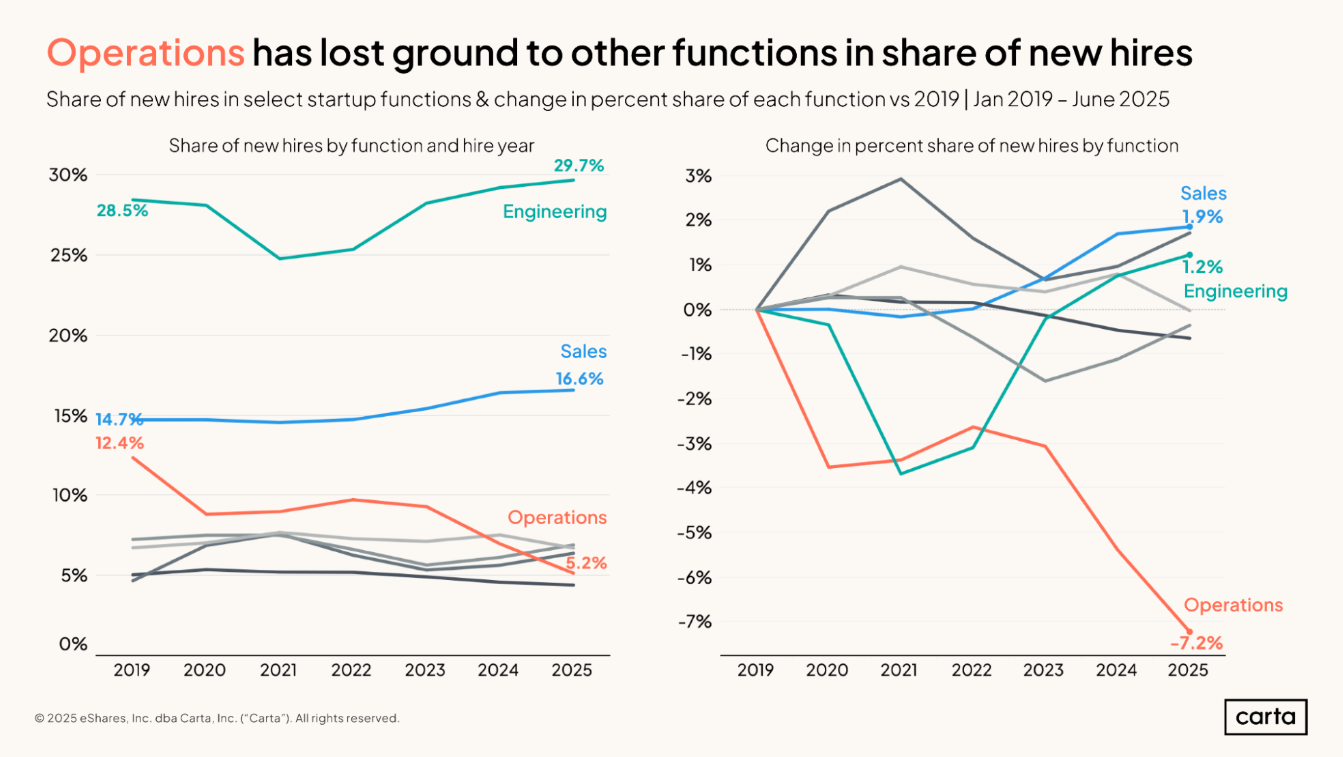
As engineers comprise a larger percentage of all startup hires, it makes sense that they also command higher salaries. Kaelani sees the same thing on her company’s platform. It’s Economics 101—a simple matter of supply and demand.
“On the one side, companies are seeing the value,” Kaelani says. “And on the other side, talent can demand higher salaries, because they know they have the skills and the know-how and the edge in the market to be able to command those salaries.”
In addition to engineers who can help build and manage AI tools and processes, Kaelani says hiring managers at startups are also targeting workers with diverse skillsets who can excel in cross-functional environments. As average headcount at early-stage startups continues to shrink, employees who can contribute in multiple ways are increasingly valuable.
“Right now, the entire job market or employer market is trying to find the people that can integrate,” Kaelani says. “If you’re the person that can integrate across teams, whether that’s across engineering, business, sales, content creation, marketing—that’s a massive selling point on your résumé.”
A first-person perspective on AI
Kaelani’s position as the CEO of an AI-powered job search platform places her in a unique position. Her business helps track how companies are adapting their hiring and compensation strategies in a world of omnipresent AI. But she is also the leader of a company that is itself having to adapt its hiring and compensation strategies.
Metaintro was founded in 2022, and is thus a native of this new AI age. Kaelani says that AI tools permeate the company culture.
“We have a small team of seven,” Kaelani says. “And we use AI in every aspect of our business, which has allowed us to everything way faster—ideate, whiteboard, build and deploy, A/B test.”
For Metaintro, this reliance on AI has allowed Kaelani to operate with a leaner team than might have otherwise been possible. This increased efficiency has obvious benefits from a financial perspective. Kaelani says it’s also been a clear positive in terms of compensation and hiring.
“It allows me to pay higher-than-market rates, give better benefits, et cetera,” she says. “I have friends that are startup founders too, and they’re doing the same thing. They’re asking, how can I do more with the capital that I raise by integrating certain technology into my stack?”
Witnessing firsthand the new possibilities unlocked by AI has prompted Kaelani to think deeply about how best to approach hiring and compensation in a world where so many powerful AI tools are just a few clicks away. And her company’s platform indicates that similar conversations are playing out in walking meetings and conference rooms all across Silicon Valley.
“I’ve been thinking a lot about what talent is worth,” Kaelani says. “Am I compensating my team right? How much is the next hire going to cost me? And is that justified? It’s something that definitely keeps me up at night.”
Subscribe to the Data Minute newsletter

DISCLOSURE: This communication is on behalf of eShares, Inc. dba Carta, Inc. ("Carta"). This communication is for informational purposes only, and contains general information only. Carta is not, by means of this communication, rendering accounting, business, financial, investment, legal, tax, or other professional advice or services. This publication is not a substitute for such professional advice or services nor should it be used as a basis for any decision or action that may affect your business or interests. Before making any decision or taking any action that may affect your business or interests, you should consult a qualified professional advisor. This communication is not intended as a recommendation, offer or solicitation for the purchase or sale of any security. Carta does not assume any liability for reliance on the information provided herein. ©2026 Carta. All rights reserved. Reproduction prohibited.