The rise of artificial intelligence (AI) is rewriting the playbook on how to build and scale startups. Tools like generative AI and workflow automation are massive force multipliers, allowing individuals to prototype and launch products faster. The emergence of the world’s first one-person unicorn feels closer than ever before.
These developments raise a series of questions for founders, investors, and operators. How common are solo founders compared to two- or three-person founding teams? How much capital are they raising? Is the industry, geographical, or gender composition of solo-led teams different from multi-founder teams? What do their early team structures look like? How do their equity ownership and exit outcomes look?
Carta Insights partnered with Solo Founders to answer these questions using Carta’s rich dataset on tens of thousands of U.S. companies plus qualitative interviews with founders. In this report, we aim to provide a comprehensive understanding of the state of solo founders in 2025.
Highlights
A growing share of startups have solo founders: From 2019 to H1 2025, the share of new startups with a solo founder has risen from 23.7% to 36.3%. As the barriers of entry to launching a startup fall, this trend will likely continue.
Evolving fundraising trends: While solo-led companies represented 30% of startups founded in 2024, they received only 14.7% of cash raised in priced equity rounds that year. Still, the share of venture dollars going to solo founders is growing.
Solo founders tend to hire faster: Startups with a single founder hire their first employee earlier than those with multiple founders, though in both cases the median days from incorporation to first hire has risen. For solo founders the median stands at 399 days, while it is 480 for multi-founder companies.
Share of solo-founded companies
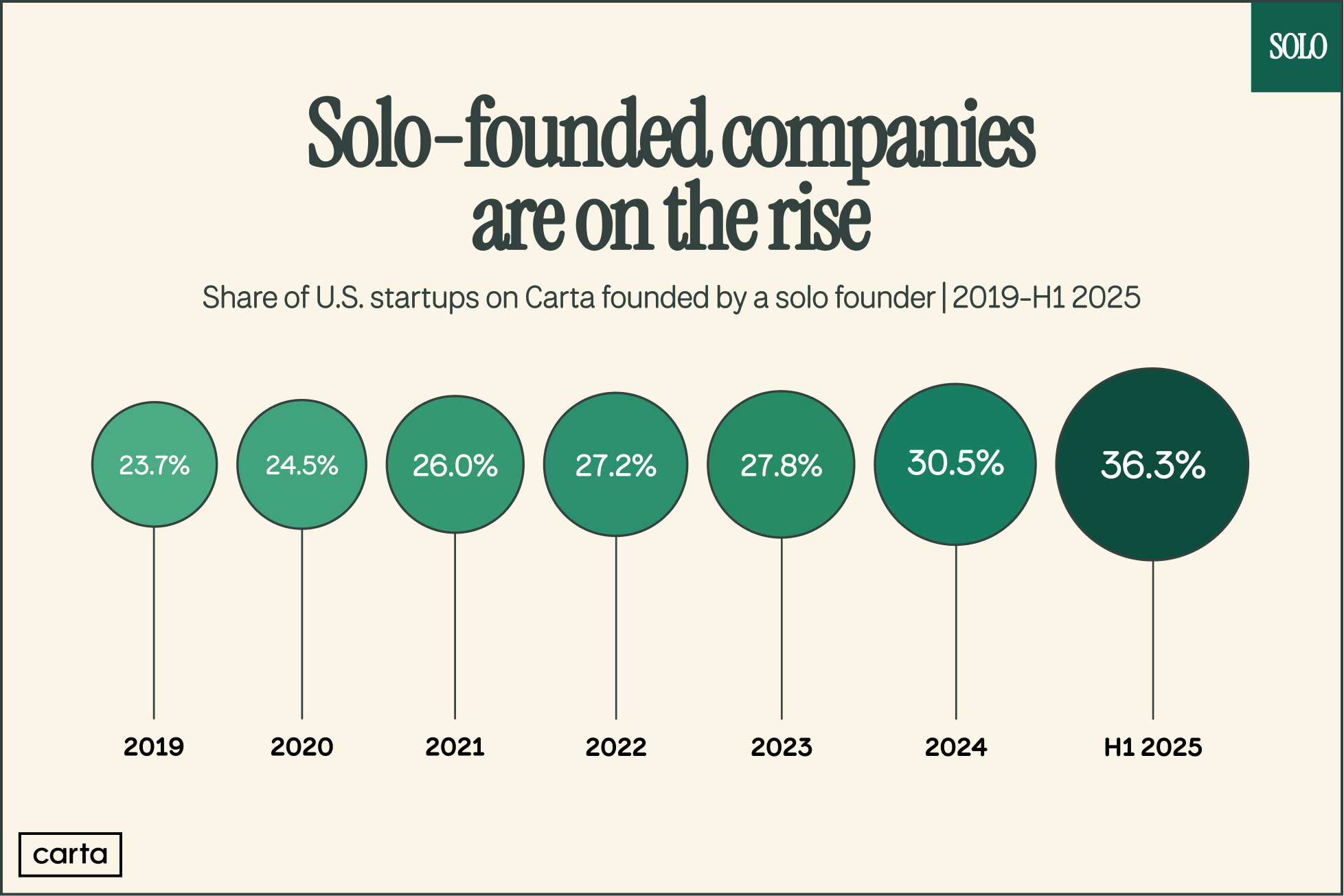
The share of new companies that were started by solo founders steadily increased over the last few years. This trend accelerated in the first half of 2025, when over one-third of new companies were solo-founded.
Several factors may be contributing to the rise of solo founders.
First, AI has expanded what individuals can accomplish in a finite amount of time, making it more feasible for a single founder to both build and sell.
Second, the success of solo-led companies, such as Polymarket, Vercel, and Wander, has helped validate the model among investors and may also be inspiring more entrepreneurs to follow a similar path.
And for some founders, building solo may reflect a preference for maintaining creative control from the start.
As Peter Walker, Head of Insights at Carta, comments: “A 13-point rise in about five years is a big shift. Some of this reflects the changing environment. It has become consistently easier to start a company. This trend reflects technology lowering the cost of company creation.”
Julian Weisser and Kieran Ryan of Solo Founders contributed to this article.
To continue reading, click here to download the full report.