
This summer, the U.S. government has taken a series of notable steps to bring crypto and blockchain technology further into the mainstream. Venture capitalists are taking note.
In July, Congress passed its first-ever major piece of legislation related to crypto: The GENIUS Act, which establishes the country’s first regulatory framework for payment stablecoins. That same month, the House of Representatives passed the CLARITY Act, which aims to better define jurisdictional boundaries for crypto regulation between the SEC and the Commodity Futures Trading Commission (CFTC). Shortly thereafter, the Senate Banking Committee introduced its own draft legislation aimed at clarifying regulatory jurisdiction.
At an executive level, the White House released a first-of-its-kind report outlining policy recommendations to help drive growth across the digital assets industry. In response, SEC chairman Paul Atkins introduced Project Crypto, his agency’s new strategy for adapting securities regulation to better align with the rise of digital assets.
Carta’s policy team noted that the overall signal is clear: “The U.S. government is all in on crypto.”
VCs in the crypto space say this wave of new regulation could represent an opening of the floodgates. Years of regulatory muddiness created uncertainty among crypto startups about how they were legally allowed to behave, causing many investors to be understandably cautious about pushing capital into the space. By clarifying the rules of the road—and by moving to better incorporate crypto and blockchain technology into existing financial infrastructure—the new administration hopes to mitigate many of the concerns that have inhibited more widespread interest and adoption.
Alex Marinier, founder and general partner at fintech and blockchain investment firm New Form Capital, believes that a seismic shift may be underway.
“It’s been really exciting over the last six months or so to see the regulatory changes here in the U.S.,” Marinier says. “Investment firms underwrite risk for a living. But one risk they don’t like taking is regulatory risk. Now that’s been removed, to a large degree.”
The crypto space is known for wild swings, with periods of rapidly rising asset prices followed by extended troughs of investor interest. But investors who are used to these twists and turns say the current market momentum is different.
“I’ve seen the ups and downs,” says Marcos Fernandez, a veteran of blockchain startup Ripple who’s now the managing partner at Fiat Ventures, an early-stage fintech firm. “And I have never been more excited about the adoption of this technology than I am right now.”
The data on crypto dealmaking
This wave of optimism around new regulation in the crypto space has led to a spike in VC investment.
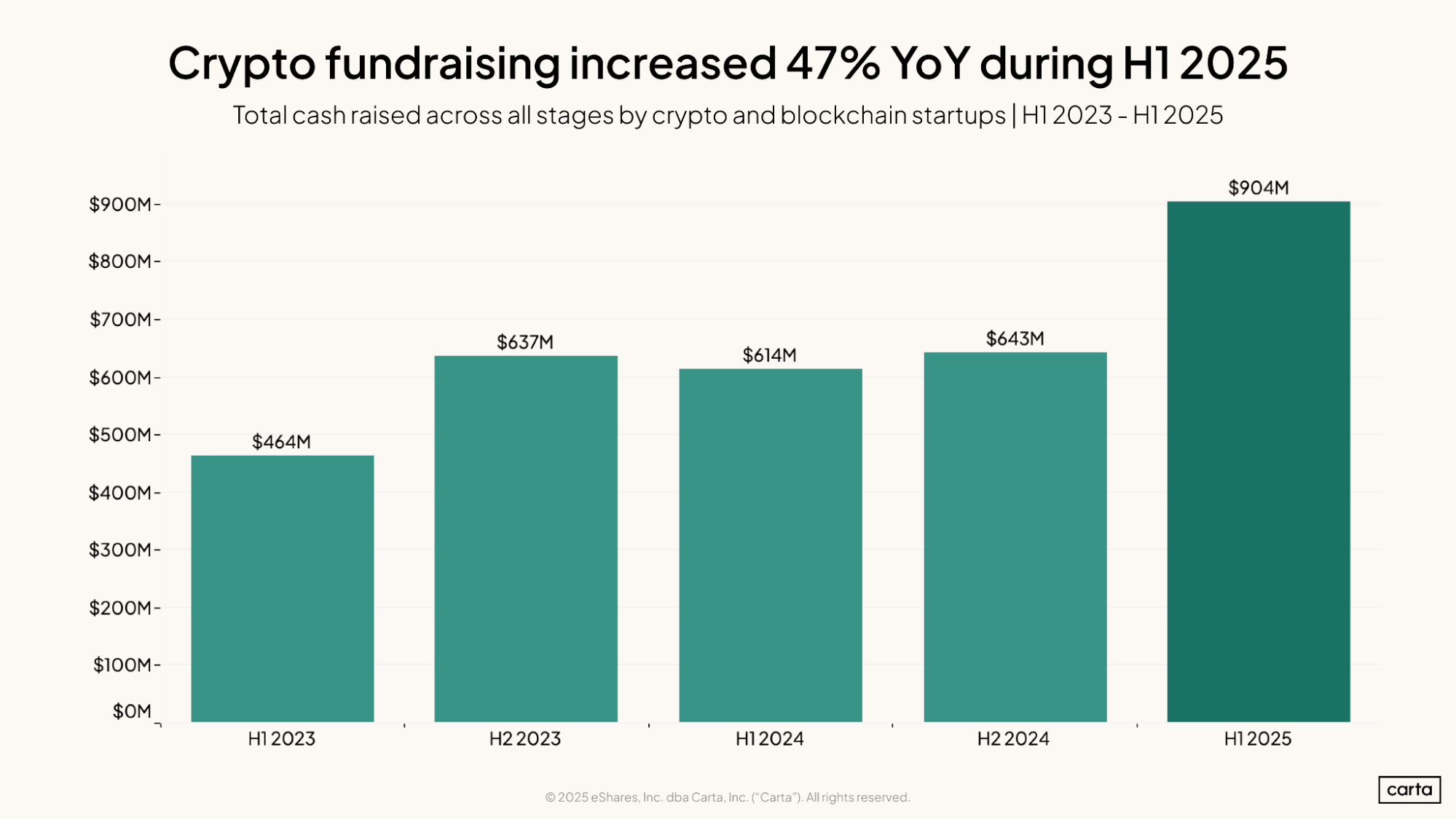
During the first half of 2025, crypto and blockchain startups on Carta combined to raise about $904 million, a 47% increase over the same period a year ago. If that pace of dealmaking keeps up in H2, this would be the third-busiest year on record for VC investment in the crypto space, trailing only the boom years of 2021 and 2022.
At the seed stage, valuations are mostly holding steady: The median pre-money valuation for seed-stage crypto and blockchain startups on Carta was $21.7 million in H1, compared to $20.9 million in the second half of 2024. Those figures are significantly higher than recent median valuations for seed startups across all industries ($15.6 million in Q2 2025).
Beyond the seed stage, valuations are trending up. The median pre-money valuation for early-stage funding rounds in crypto and blockchain (mostly Series A and Series B rounds) soared 159% in H1 2025, per a recent PitchBook report, while the median late-stage valuation rose by 34%.
Exit activity is also on the rise. PitchBook logged 65 exits in the crypto industry during H1 2025, on pace to easily surpass the current high of 100 crypto exits in any one year. And total exit value in H1 climbed to $12.1 billion, compared to about $400 million for the full year 2024—an increase of nearly 3,000%.
The largest of those exits came from Circle, a stablecoin payments company that raised more than $1 billion with an IPO in June. In September, two more prominent crypto startups completed IPOs, with blockchain lender Figure raising $787.5 million and crypto exchange operator Gemini bringing in $425 million.
In many cases, new regulations are a key part of how these companies are pitching their story to investors. For instance, in its IPO prospectus from June, Circle cites the GENIUS Act more than 350 times.
This is emblematic of how many crypto startups have embraced new regulation as a way to drive the industry forward, rather than a hindrance that might hold it back. In the view of Fernandez, legislation like the GENIUS Act marks a welcome move away from the industry’s Wild West, providing crypto startups with much-needed rules about how they’re allowed to operate.
“A lot of crypto firms have been asking for regulation for a very, very long time,” Fernandez says.
What crypto VCs are watching
Stablecoin companies like Circle aren’t the only types of crypto startups that could benefit from the new administration’s regulatory stance.
Fernandez says he’s also excited about new opportunities related to decentralized finance, cross-border payments, and other types of stablecoins—particularly ways these new technologies can interact with existing infrastructure and make it easier for people around the world to manage their finances.
“There are some phenomenal companies out there that are utilizing stablecoin infrastructure to provide better financial services and access to hundreds of millions of consumers globally,” he says. “[Consumers] are not having to go to an exchange. They’re not having to sell bitcoin for [stablecoins]. They’re literally downloading these apps and using a card to pay for it. … You’re seeing crypto adoption within real financial frameworks.”
When Marinier launched New Form Capital in 2019, his long-term thesis was that crypto would eventually cross the Rubicon and complete the transformation from a niche bit of financial ephemera into a central aspect of the world’s financial infrastructure. Today, that vision looks closer than ever.
“The tide is changing for how people view these technologies and these companies,” Fernandez says.
Subscribe to the Data Minute newsletter