
Among venture fund managers and their LPs, a TVPI of 3x is often seen as a threshold for exemplary performance. For funds raised in the late 2010s, however, it remains a challenging benchmark to achieve.
For the uninitiated, TVPI (total value to paid-in capital) is a multiple that expresses the relationship between the total present value of a fund—including both realized and unrealized gains—and the amount of capital that LPs initially paid in. In simple terms, a fund with a TVPI of 3x is on pace to provide its backers with at least a 3x return.
In the 2017 vintage of venture funds on Carta, the current 90th percentile for net TVPI sits at 3.52x, well above this 3x threshold. In the 2018 vintage, the 90th percentile figure is 3.07x. The top-tier funds from these years are on track to provide their LPs with the sort of return they likely expected—one that will outpace the gains they might have achieved by investing in the public markets over the same period of time.
Yet most recent funds currently sit well below this mark. In the 2017 vintage, the median net TVPI through the end of Q3 is 1.76x, and the 75th percentile is 2.27x. The median fund from 2018 has a net TVPI of 1.38x, while the 75th percentile is 1.97x. Among fund vintages from 2019 through the present, a TVPI of 3x—or even 2x—is even harder to find. To a large extent, these sorts of figures are to be expected. Nearly every venture fund raised since 2017 is still being actively managed, with plenty of time in the future for gains to accumulate. This is particularly true as venture-backed companies continue to stay private for longer, extending the expected lifespan of many VC vehicles.
Performance multiples for these recent VC fund vintages will almost surely continue to improve in the years to come. Many of the funds raised since 2017 will eventually reach a TVPI of 3x. But many of them will not. As these funds continue to mature in the years to come, managers and LPs alike will be watching their TVPIs closely.
Highlights
More recent funds are starting to realize gains: About 14% of all VC funds in the 2020 vintage made their first distributions to LPs in the past year. Overall, 42% of 2020 funds now have a DPI over zero, compared to 28% a year ago. In the 2021 vintage, some 25% of funds have begun to distribute returns, up from 14% as of Q3 2024.
Median IRRs are now positive for 2021, 2022 funds: The median IRR rose to 0.5% in Q3 for funds in the 2021 vintage and to 0.1% for the 2022 vintage. At the upper end of performance, though, the 2021 vintage continues to lag: It has a top-decile IRR of 14.8%, compared to 19% for 2022.
Pre-2021 funds are almost fully deployed: Funds in every vintage from 2017 through 2020 have now invested at least 89% of their available capital, with 11% or less remaining as dry powder. The 2021 vintage isn’t far behind, with 83% of available capital now deployed.
Fund details
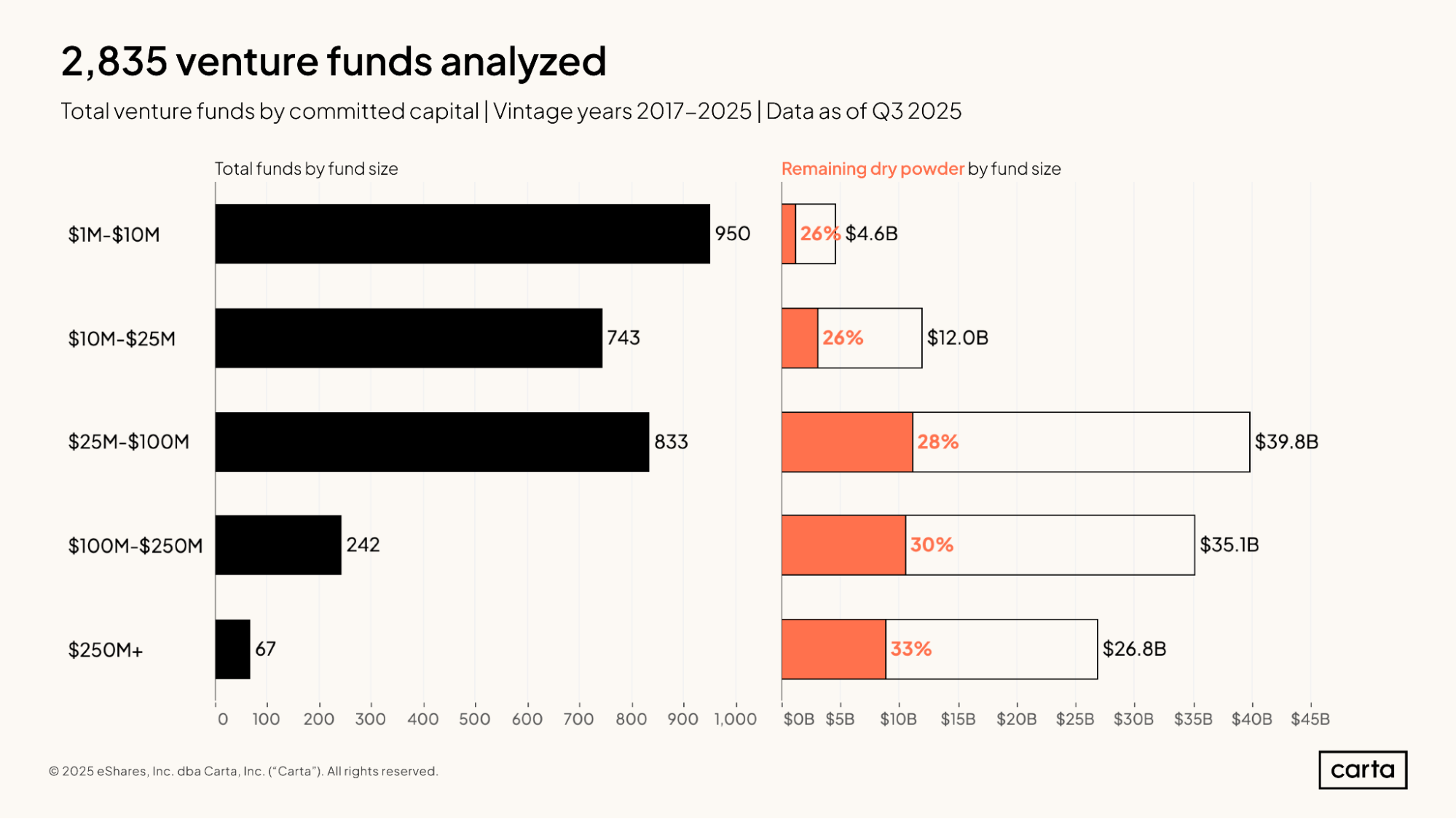
This report examines data from 2,835 different venture funds from the 2017 through 2025 vintages, the majority of which are smaller than $100 million in size. However, this sample also includes more than 300 funds that are larger than $100 million, and these are where the majority of all capital is concentrated. Combined, these $100 million-plus funds claim about $61.9 billion in capital commitments, out of a total of $118.3 billion in commitments across the full sample of all fund sizes.
Across all five intervals of fund size shown, somewhere between 26% and 33% of all initial capital commitments remains undeployed. Larger funds tend to have a slightly higher percentage of dry powder than smaller funds.
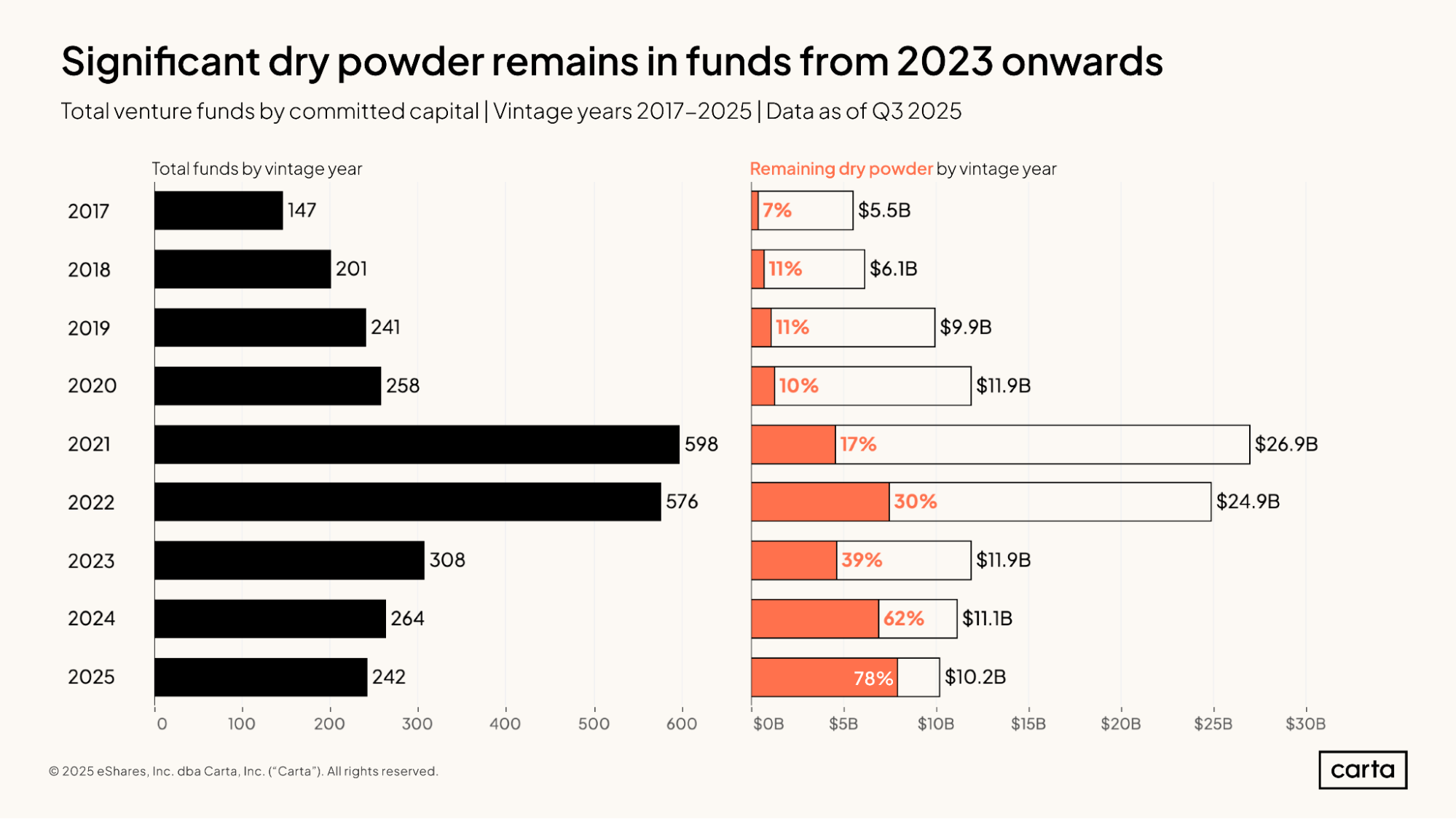
As expected, newer fund vintages have more remaining dry powder than older vintages. On one end of the spectrum, funds from the 2017 vintage have just 7% of their total committed capital still unspent, compared to a 78% portion of dry powder for funds from the 2025 vintage.
The gaps from one vintage to the next in the percentage of dry powder remaining tend to be significantly larger for newer vintages, evidence that the majority of a VC fund’s spending tends to take place in its first few years of management. For example, the share of remaining dry powder drops from 78% for the 2025 vintage down to 39% for the 2023 vintage, a difference of 39 percentage points across a two-year span. The dropoff in remaining dry powder between the 2021 and the 2019 vintages, say, is much smaller.
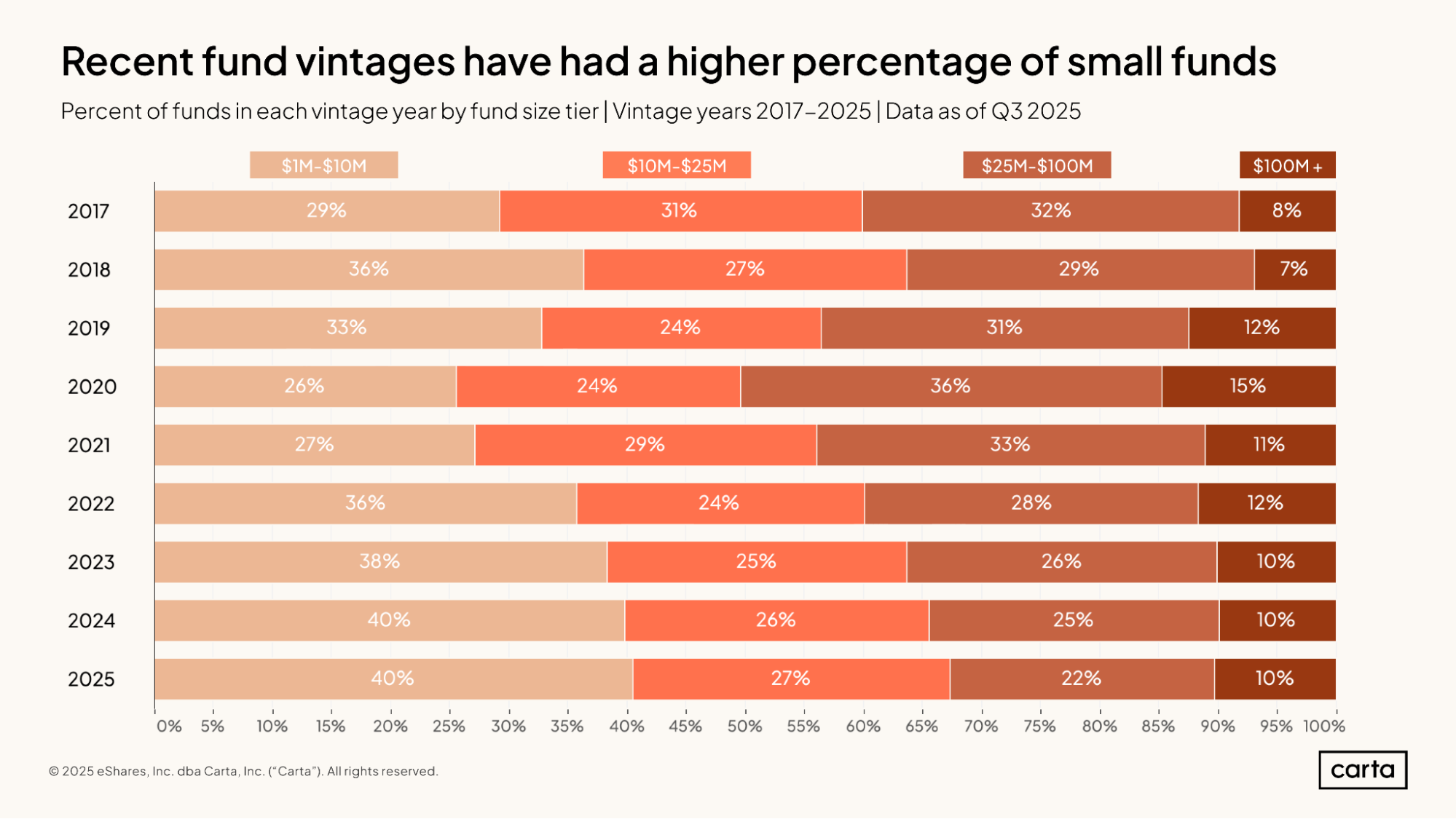
Over the course of the 2020s, smaller venture funds have grown increasingly common. Some 40% of funds from the 2025 vintage are between $1 million and $10 million in size, and 67% have $25 million or less in capital commitments. Back in the 2020 vintage, about 26% of funds are between $1 million and $10 million, and 50% are smaller than $25 million.
The reverse side of this coin is that larger funds have become less common. But this trendline has flattened out in recent years. The portion of new VC funds with $100 million or more in commitments has held steady at 10% across each of the three most recent vintages.
Full report available: Start reading now for free
See our complete VC Fund Performance Q3 report, with 25 charts and best-in-class data on fund performance including IRR, TVPI, DPI, and more.



DISCLOSURE: This communication is on behalf of eShares, Inc. dba Carta, Inc. ("Carta"). This communication is for informational purposes only, and contains general information only. Carta is not, by means of this communication, rendering accounting, business, financial, investment, legal, tax, or other professional advice or services. This publication is not a substitute for such professional advice or services nor should it be used as a basis for any decision or action that may affect your business or interests. Before making any decision or taking any action that may affect your business or interests, you should consult a qualified professional advisor. This communication is not intended as a recommendation, offer or solicitation for the purchase or sale of any security. Carta does not assume any liability for reliance on the information provided herein. ©2026 Carta. All rights reserved. Reproduction prohibited.