- Capital gains
- What are capital gains?
- What assets are taxed as capital gains?
- Short-term capital gains vs. long-term capital gains
- Capital gains tax rates for 2025
- Short-term capital gains tax rate
- Long-term capital gains tax rate
- Long-term capital gains exceptions above 20%
- What is a capital loss?
- How are capital losses taxed?
- Capital gains taxes & AMT for stock options
What are capital gains?
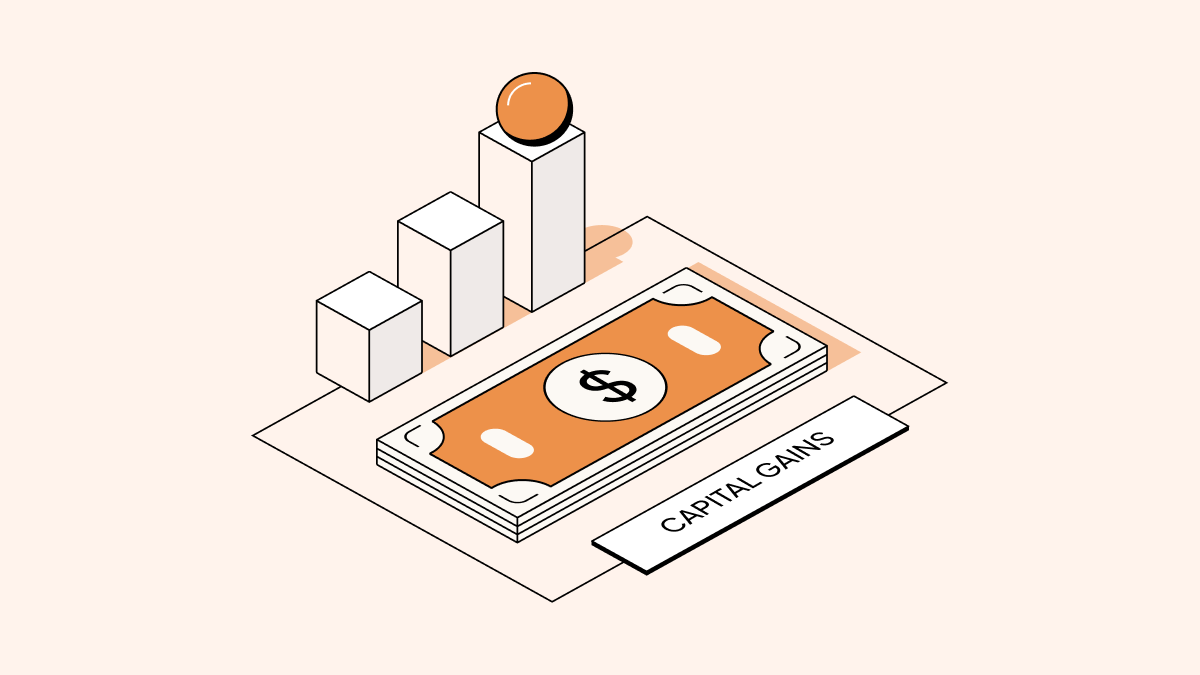
Capital gains are any profits realized from the sale of a capital asset. These profits are classified as either short-term or long-term capital gains, depending on whether the asset was held for shorter or longer than one year. Long-term capital gains qualify for a lower tax rate than short-term capital gains, which are taxed at the same rates as ordinary income.
Important note: While we’re here to help you understand how short- and long-term capital gains taxes work, we aren’t giving tax advice in this article. We recommend working with your own tax advisor or CPA.
What assets are taxed as capital gains?
Most investment holdings and other important possessions—including your home—are considered capital assets. Any profits from selling these assets are thus taxed as capital gains. Common examples of assets that might generate significant capital gains include:
Stock in a public or private company
Bonds
Real estate
Cars
Boats
Gems and jewelry
Cryptocurrency and NFTs
Other asset types are classified as noncapital assets and are not subject to capital gains tax but may be subject to other types of taxes. These may include:
Merchandise for sale to customers (inventory)
Patents, inventions, and copyrights
Certain commodities derivatives
Certain hedging transactions
Short-term capital gains vs. long-term capital gains
A short-term capital gain is any profit realized from the sale of a capital asset after one year or less of ownership. Short-term capital gains are taxed at the seller’s marginal tax rate, the same rate that’s applied to personal income. In other words, the government taxes short-term capital gains the same way it taxes your salary (income tax).
A long-term capital gain is any profit realized from the sale of a capital asset after more than a year of ownership. Long-term capital gains are taxed at a lower rate than short-term gains and income taxes.
Short-term capital gains | Long-term capital gains | |
Length of ownership (holding period) | ≤ one year | > one year |
Tax rate | Marginal (the same as ordinary income tax rate) | Preferential rates (lower than ordinary income) |
Capital gains tax rates for 2025
Capital gains become taxable in the year those gains are realized. So if you sold stock in a private company in 2025, then you’ll owe capital gains tax when you file your tax return in 2026.
Short-term capital gains tax rate
Short-term capital gains are taxed at the seller’s marginal income rate. This rate ranges from 10% to 37%, depending on the filer’s federal income tax bracket and filing status.
For the 2025 tax filing year (due April 2026), the marginal rates are as follows:
Income for single filers | Income for married couples filing jointly | 2025 marginal tax rate |
> $626,350 | > $751,600 | 37% |
> $250,525 | > $501,050 | 35% |
> $197,300 | > $394,600 | 32% |
> $103,350 | > $206,700 | 24% |
> $48,475 | > $96,950 | 22% |
> $11,925 | > $23,850 | 12% |
< $11,925 | < $23,850 | 10% |
Source: Internal Revenue Service (IRS)
Long-term capital gains tax rate
Long-term capital gains are taxed at a rate of 0%, 15% or 20%, again depending on the filer’s tax bracket and filing status. The long-term capital gains rate is lower than the marginal rate, sometimes significantly so.
Income for single filers | Income for married filing separately | Income for married filing jointly and qualifying surviving spouse | Income for head of household | 2025 long-term capital gains tax rate |
> $518,900 | > $291,850 | > $583,750 | > $551,350 | 20% |
> $47,025 but | > $47,025 but | > $94,050 but | > $63,000 but | 15% |
≤ $47,025 | ≤ $47,025 | ≤ $94,050 | ≤ $63,000 | 0% |
Source: IRS
For example, a married couple filing jointly with $400,000 in taxable income would pay 32% tax on any short-term capital gains, based on 2025 tax rates. That same couple would pay 15% tax on any long-term capital gains. A single filer with $40,000 in taxable income would pay 12% short-term capital gains tax and 0% long-term capital gains tax.
Long-term capital gains exceptions above 20%
Long-term capital gains from a few select capital assets are taxed at a higher rate than most others. Most notably, long-term capital gains from selling Section 1202 qualified small business stock (QSBS) that is excluded based on the phased three-year or four-year holding period is taxed at a maximum 28% rate; any remaining capital gain is taxed at the normal 20% rate.
The sale of art and other collectibles are also taxed at 28% and the portion of any unrecaptured Section 1250 gain from selling Section 1250 real property (such as commercial buildings, warehouses, or rental properties) is taxed at a maximum 25% rate.
What is a capital loss?
Capital losses are the opposite of capital gains. If someone sells a capital asset for less than they paid for it, they incur a capital loss.
How are capital losses taxed?
Short-term capital losses and long-term capital losses receive the same tax treatment. In both cases, the taxpayer can use any capital losses to offset capital gains from the sale of other capital assets and reduce their overall tax bill. However, the maximum net loss you can claim in any year is $3,000, and any excess will carry forward.
Capital gains taxes & AMT for stock options
When you exercise stock options and sell the stock later for a profit, you’ll likely owe capital gains taxes. Whether you pay short-term or long-term capital gains taxes depends on how long you’ve held the stock, like any other capital asset.
Another tax to keep in mind specifically for incentive stock options (ISO) is the alternative minimum tax (AMT), which applies only to those who bought ISOs but sold them in a different tax year. AMT is calculated independently from your regular income tax calculation and you must pay whichever calculation is higher. You cannot use capital losses to offset any AMT income triggered by the exercise of your ISOs.
→ Learn more about stock option taxes.


DISCLOSURE: This communication is on behalf of eShares, Inc. dba Carta, Inc. (“Carta”). This communication is for informational purposes only, and contains general information only. Carta is not, by means of this communication, rendering accounting, business, financial, investment, legal, tax, or other professional advice or services. This publication is not a substitute for such professional advice or services nor should it be used as a basis for any decision or action that may affect your business or interests. Before making any decision or taking any action that may affect your business or interests, you should consult a qualified professional advisor. This communication is not intended as a recommendation, offer or solicitation for the purchase or sale of any security. Carta does not assume any liability for reliance on the information provided herein. © 2024 Carta. All rights reserved. Reproduction prohibited.