- Vesting: A guide to equity schedules
- What is vesting?
- Vesting for stock options
- Vesting for RSUs
- Vesting for retirement plan contributions
- How does vesting work?
- What is a vesting schedule?
- Time-based vesting
- Milestone-based vesting
- Hybrid vesting
- Acceleration
- Vesting schedule example
- Why is vesting a founder’s best friend?
- How should you structure vesting for your startup?
- For co-founders
- For employees and advisors
- What happens to equity when someone leaves?
- How to manage vesting schedules without the chaos
- Get your vesting right from day one
- Frequently asked questions about vesting
- What does a four-year vesting schedule mean?
- Can a vesting schedule be changed?
- What is the difference between vesting and exercising?
When you grant equity to an employee as part of their compensation package, you are offering partial ownership of the company. However, their stock usually has to vest first, meaning that they typically need to work for the company for a period of time if they want to become an owner.
What is vesting?
Vesting is the process of earning full ownership of equity over a set period of time. Companies often use vesting to encourage team members to stay longer at the company. This process is a fundamental part of most forms of equity compensation, which has long been the standard for startups to grant ownership to founders, employees, and advisors. As companies grow, so does their commitment to employee ownership; the median seed-stage startup has an employee stock option pool of around 13.5% of fully diluted shares, with that proportion rising to around 17.2% for the median Series D company.
The most common types of equity awards that use vesting are stock options and restricted stock awards (RSA). While both grant ownership vesting over time, they have different rules and tax implications. Vesting makes sure that the people helping to build your company are rewarded for their long-term commitment. Unless your company allows early exercising, you can only exercise stock options that have vested.
Vesting for stock options
When you grant stock options, like incentive stock options (ISO) or non-qualified stock options (NSO), employees aren’t getting actual shares of stock—yet. Instead, they’re getting the right to exercise the stock options, meaning the right to buy a set number of shares at a fixed price later on.
Vesting for RSUs
If you grant restricted stock units (RSU), you are giving actual shares of stock, which they’ll be able to sell in the future. Grantees may have to stay at the company for a certain amount of time, and sometimes the holder or the company must also hit a stated milestone (like an initial public offering (IPO), for example) for RSUs to vest. But unlike stock options, they don’t need to purchase them to own them—they just need to wait for them to vest.
Vesting for retirement plan contributions
For retirement plans like 401(k)s and pension plans, employee contributions are always 100% vested, while employer contributions follow the vesting schedule set by the employee benefits plan. Sometimes, employees own these employer-matched contributions right away (immediate vesting), but often they have to work at the company for a certain number of years to fully vest.
This video explains how vesting works for stocks and options.
How does vesting work?
The specific rules for earning equity are laid out in a formal document, usually called a Stock Option Grant Notice or Restricted Stock Award Agreement. This agreement details the total number of shares or options granted, which must comply with regulations like Rule 701, and the timeline over which the recipient will earn them. This timeline is known as the vesting schedule.
What is a vesting schedule?
A vesting schedule is a timeline that determines when an employee gains full ownership of their equity. It is typically detailed in the option grant (for example, 1,000 options over four years). There are three common types of vesting schedules: time-based, milestone-based, and a hybrid of time-based and milestone-based.
For startups, vesting is almost always based on how long someone works at the company, which is called time-based vesting. While milestone-based vesting that ties to specific performance goals is common in certain corners of the private markets, it's far less prevalent for early-stage companies. For example, while nearly 61% of initial management grants at private equity (PE)-backed LLCs are tied to a specific performance metric, the standard for venture capital (VC)-backed corporations and their equity incentive plans remains overwhelmingly time-based, usually a four-year grant with a one-year cliff.
Time-based vesting
Time-based stock vesting is when you earn options or shares over a specified period of time. The two most common types of time-based vesting schedules are:
Graded vesting: This is the most common schedule, where you earn your equity in small increments over time, like monthly or quarterly.
Cliff vesting: This involves a waiting period before you earn your first portion of equity. After this initial "cliff," the rest of your equity may begin to vest on a graded schedule.
Most time-based vesting schedules have a vesting cliff to motivate employees to stay for at least a year. If you leave before the one-year mark, any unvested options are put back into the employee option pool.
Cliff vesting
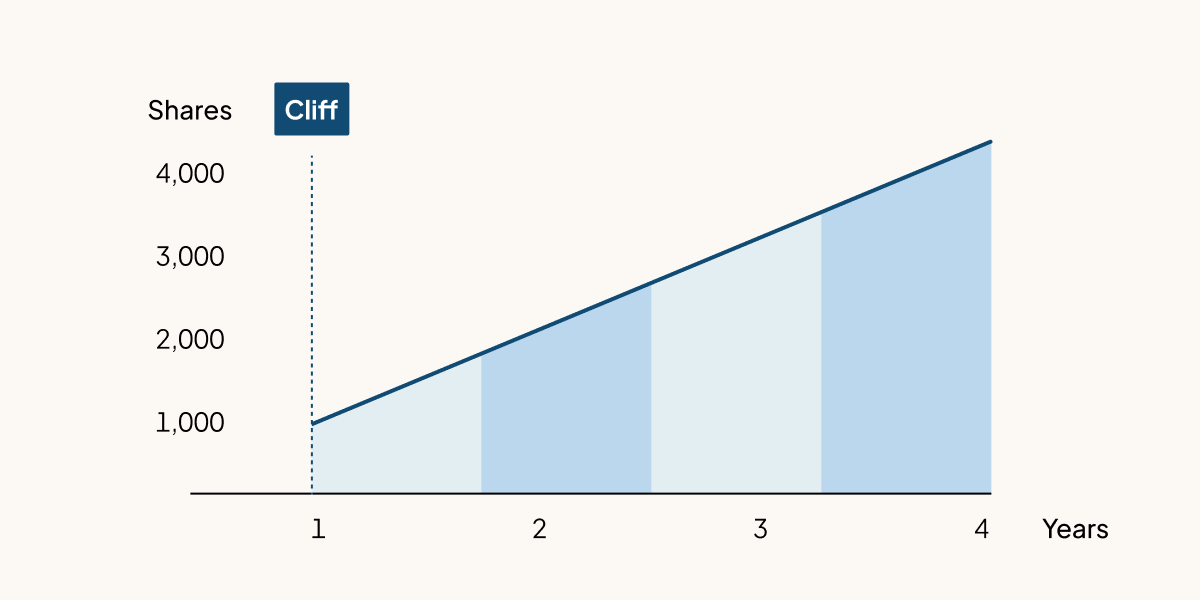
A vesting cliff is an initial waiting period before any equity vests, which is typically one year in the startup world. If a person leaves before this date, they get no equity. This protects the company from granting ownership to someone who doesn't stay long enough to make a meaningful contribution.
Under a standard four-year time-based vesting schedule with a one-year cliff, 1/4 of your shares vest after one year. After the cliff, 1/36 of the remaining granted shares (or 1/48 of the original grant) vest each month until the four-year vesting period is over. After four years, you are fully vested.
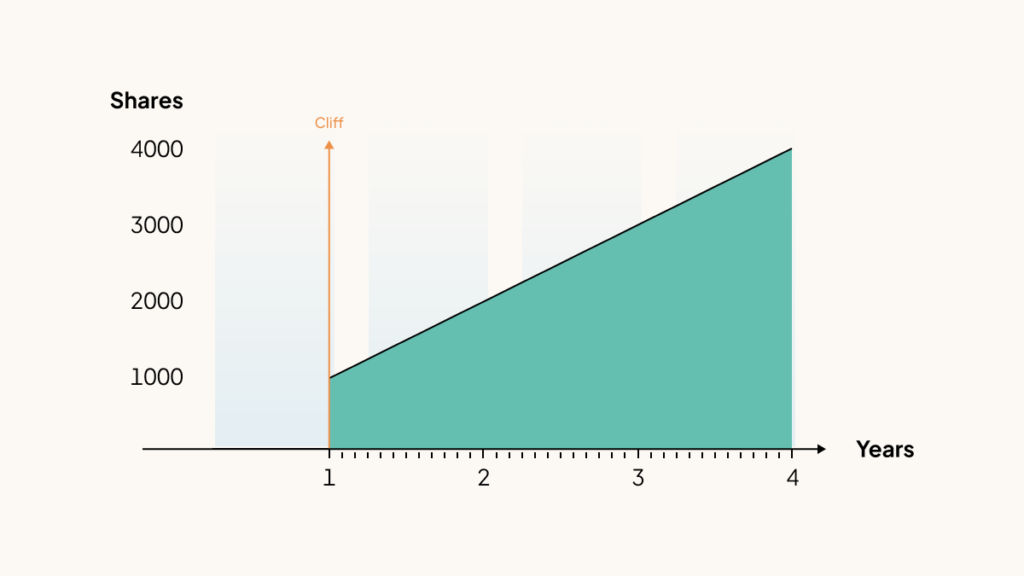
Keep in mind that each option grant has its own vesting schedule—vesting isn’t necessarily based on their overall tenure at the company. For example, if you received one grant with a four-year vesting schedule in 2025 and a second grant with a four-year vesting schedule from the same company in 2027, you wouldn’t fully vest all of the options from both grants until 2031.
Milestone-based vesting
Milestone vesting is when you earn your options or shares after a specific milestone. Other than IPO, milestones could be completing a project, reaching a business goal, or hitting a certain valuation. Milestone-based vesting isn’t as common as time-based vesting.
Hybrid vesting
Hybrid vesting is a combination of time-based and milestone vesting. This model requires you to simultaneously work at the company for a certain amount of time and hit one or more milestones to receive your options or shares.
Acceleration
Acceleration is a clause in the grant agreement that can speed up the vesting schedule if a specific event occurs. The most common event that triggers acceleration is an acquisition of the company. It’s a key term that can be a major benefit for employees during an exit, whether it’s an acquisition or an IPO.
There are two main types of acceleration triggers. Understanding the difference is important for both you and your employees.
Trigger type | What it is | When it happens |
Single-trigger | All unvested equity vests at once | After a single event, which is almost always an acquisition |
Double-trigger | Vesting accelerates only if two events happen | Requires an acquisition (the first trigger) and the employee being terminated without cause (the second trigger) |
Double-trigger acceleration is more common because it protects the acquiring company from having employees leave immediately after the deal closes. This provides stability during a transition, which is also beneficial for you as the founder.
Vesting schedule example
Meetly, Inc. (a hypothetical company) hired Blake on January 1, 2026. As part of the compensation package, Meetly gave Blake an option grant with the following details:
Grant date: 1/1/2026
Options granted: 192
Vesting schedule: Time-based; monthly for four years with a one-year cliff
One year after Blake’s hire date, on January 1, 2027, she reached the vesting cliff and 1/4 of the shares (48 shares) vested. At that time, Blake could have exercised those 48 shares (though she wasn’t obligated to).
Date | Options vested | Cumulative |
1/1/2027 | 48 | 48 (192/4 = 48) |
2/1/2027 | 4 | 52 |
3/1/2027 | 4 | 56 |
4/1/2027 | 4 | 60 |
5/1/2027 | 4 | 64 |
6/1/2027 | 4 | 68 |
7/1/2027 | 4 | 71 |
8/1/2027 | 4 | 76 |
9/1/2027 | 4 | 80 |
Over the next three years, an additional four shares vest every month. By January 1, 2030, Blake’s options will be completely vested, and she can exercise all 192 of the shares in the option grant if she chooses.
Date | Options vested | Cumulative |
1/1/2027 | 48 | 48 (192/4 = 48) |
1/1/2028 | 48 | 96 |
1/1/2029 | 48 | 144 |
1/1/2030 | 48 | 192 |
If Blake leaves the company before January 1, 2030, she will surrender all unvested shares, which will be returned to the company’s option pool.
Why is vesting a founder’s best friend?
As a founder, vesting isn’t just a formality. It’s a strategic tool that protects your company’s ownership structure. It helps you build a committed team and maintain a clean, investor-ready cap table, which is much easier to do with equity management software.
There are two main benefits of vesting for a founder:
Aligning incentives: Vesting ensures that co-founders, employees, and advisors are all motivated to stay with the company and contribute to its long-term success. To get their full equity, they have to stick around and help build the company.
Protecting your cap table: Imagine a co-founder leaves after a few months but keeps a large portion of the company’s equity. A vesting schedule prevents this by making sure that early leavers only walk away with the small amount of equity they have earned, if any.
How should you structure vesting for your startup?
When you’re setting up equity for your team, following market standards can give you confidence. For VC-backed and bootstrapped corporations, the most common recipe for equity grants is a four-year vesting schedule with a one-year cliff. This structure applies to both founders and early employees. While not every grant includes a cliff, data shows that about half of management grants have a cliff, and that figure rises to nearly 70% for employees. When a cliff is used, it's almost always for one year; in fact, the vast majority of cliffs (at least 95%) are set at the one-year mark.
For co-founders
It can feel awkward to put vesting schedules on your co-founders, who are in the trenches with you from day one. However, it’s a professional standard that protects everyone involved if one founder decides to leave the venture for any reason. Without it, a departing co-founder could walk away with a significant piece of the company they are no longer helping to build.
The industry standard for founders is a four-year vesting period with a one-year cliff. This is what investors expect to see when they are reviewing your company. Adopting this standard shows that you and your co-founders are committed for the long haul and have set up your company properly.
For employees and advisors
The market standard for early employees is also a four-year vesting schedule with a one-year cliff. Using this standard helps you compete for talent and signals that you run a well-organized company. Some companies are exploring more creative vesting schedules to attract and retain talent. However, for early-stage companies, sticking to the standard is often the simplest and most effective approach. As noted during Carta’s Startup Compensation in 2024 webinar, longer vesting schedules can sometimes be more employee-friendly by locking in a low strike price for a larger grant, essentially building in an equity refresh from the start.
Advisory shares often have shorter vesting periods, such as two years. This timing is designed to match the typical length of an advisor engagement, which rewards them for their contributions during the period they are actively helping the company.
What happens to equity when someone leaves?
Vesting also defines what happens to your vested stock and unvested equity when an employee leaves the company. Any unvested equity is returned to the company’s option pool, so it can be granted to future hires. This recycling of equity is a key mechanism for continuing to attract new talent as your company grows.
For the equity that has already vested, the former employee has a limited window of time for exercising stock options. While a 90-day post-termination exercise period (PTEP) has historically been common, many companies now offer longer periods as an employee-friendly benefit. This trend appears to have settled into a new normal; for the past year and a half, about 20% of terminated options on Carta have included a PTEP longer than 90 days.
How to manage vesting schedules without the chaos
When you’re just starting out, tracking a few vesting schedules in a spreadsheet might seem manageable. But as your team grows, each with their own grant date, cliff, and schedule, that spreadsheet quickly becomes a source of risk. A single formula error or an outdated version can lead to massive headaches and costly legal fees to clean up the cap table.
As your company grows beyond a few grants, you’ll need more than a spreadsheet to track ownership, manage equity plans, and stay audit-ready. To help you build a scalable system for equity management, we’ve outlined the suite of tools and services that support founders at every stage.
Get your vesting right from day one
Clean equity management isn’t just about avoiding mistakes; it’s about building trust with your investors and your team. A well-managed cap table with standard vesting terms shows that you are a serious founder who is building a company meant to last, which is critical for attracting future investment from VC or PE firms. It gives everyone confidence that ownership is being handled fairly and professionally.
Carta helps founders look professional from the start. With Carta Launch, our free plan for early-stage companies, you can set up your cap table and issue your first equity grants with proper vesting schedules at no cost. It’s the ideal starting point for a founder who is price-sensitive and needs guidance to get equity right from day one.
Request a demo to see how Carta’s platform can support your company as it grows.

Frequently asked questions about vesting
What does a four-year vesting schedule mean?
A four-year vesting schedule means an employee earns their full equity grant over a four-year period. It often includes a one-year cliff, meaning no shares vest until the first anniversary, after which shares typically begin to vest monthly.
Can a vesting schedule be changed?
Once an equity grant is approved by the board and accepted by the recipient, the vesting schedule is legally binding, and any amendments must comply with IRC regulations.
What is the difference between vesting and exercising?
Vesting is the process of earning the right to buy your shares over time, which will have a strike price based on the fair market value of the stock at the time of the grant. Exercising is the separate action of actually purchasing those shares at the predetermined strike price.

DISCLOSURE: This communication is on behalf of eShares, Inc. dba Carta, Inc. ("Carta"). This communication is for informational purposes only, and contains general information only. Carta is not, by means of this communication, rendering accounting, business, financial, investment, legal, tax, or other professional advice or services. This publication is not a substitute for such professional advice or services nor should it be used as a basis for any decision or action that may affect your business or interests. Before making any decision or taking any action that may affect your business or interests, you should consult a qualified professional advisor. This communication is not intended as a recommendation, offer or solicitation for the purchase or sale of any security. Carta does not assume any liability for reliance on the information provided herein. ©2026 Carta. All rights reserved. Reproduction prohibited.