- Fund forecasting: The fund CFO’s playbook
- What is fund forecasting?
- Fund forecasting vs. fund accounting
- Why fund forecasting is a strategic imperative for CFOs
- The fund forecasting playbook
- Step 1: Model your portfolio construction
- Step 2: Connect to live fund and portfolio data
- Step 3: Forecast capital deployment and reserves
- Step 4: Model exit scenarios and fund returns
- Step 5: Report with impact to LPs and stakeholders
- Choosing your fund forecasting platform
- Frequently asked questions about fund forecasting
- What are the primary types of fund forecasts?
- How often should you update your fund forecast?
- What are the key inputs for a fund forecast?
What is fund forecasting?
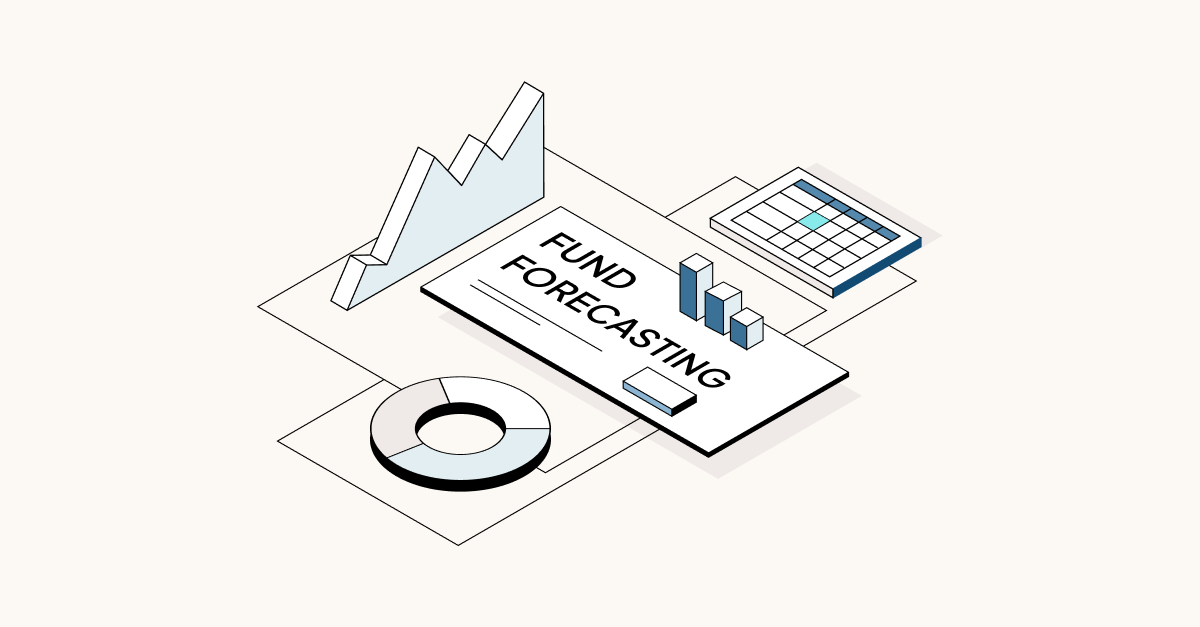
Fund forecasting is the process of modeling a venture fund’s future financial activity to inform strategic decisions. While corporate financial forecasting often centers on projecting metrics like annual recurring revenue (ARR) and expenses, fund forecasting for venture capital (VC) is a distinct discipline focused on modeling future cash flows, including capital calls from investors and distributions back to them. It involves projecting a range of fund performance metrics, including internal rate of return (IRR), total value to paid-in (TVPI), and gross multiple on invested capital (MOIC). This process relies on a sophisticated set of assumptions about investment pacing, portfolio company growth, and potential exit scenarios.
Fund forecasting serves as a strategic tool rather than a simple accounting exercise. It allows fund managers to anticipate capital needs, manage liquidity, and communicate a clear vision of future performance to limited partners (LPs). By creating a dynamic financial model of the fund's lifecycle with a dedicated fund forecasting software, you can move from reacting to events to proactively shaping your fund's future.
In this article, fund forecasting refers to the discipline of modeling a private fund’s future financial activity. When we reference the Carta product, we’ll say Carta Fund Forecasting.
Fund forecasting vs. fund accounting
It’s helpful to draw a clear line between fund forecasting and fund accounting, as they serve different but related purposes. Fund accounting is a backward-looking discipline focused on accurately recording historical data and transactions to produce auditable financial reporting documents. These reports, which are key outputs of the fund administration process, such as the Partner's Capital Account Statement (PCAP) and the Schedule of Investments (SOI), provide a precise record of what has already happened in the fund.
Fund forecasting, on the other hand, is a forward-looking, strategic process that uses the outputs of fund accounting as its foundation. Think of fund accounting as the rearview mirror; while it provides a precise record of what has happened, it is not a reliable indicator of future results, which is why forecasting is essential. Fund forecasting is the GPS, using your current position and destination to help you plan the road ahead and anticipate what's to come.
Carta Fund Forecasting consumes actuals from Carta Fund Administration’s general ledger (capital calls, distributions, fees, expenses) to keep performance metrics current in your fund-level model.

Why fund forecasting is a strategic imperative for CFOs
For a fund CFO, robust forecasting is not just a best practice but a strategic imperative tied to core fiduciary responsibilities, especially as the industry grapples with an exit conundrum that has LPs starved for distributions. Your ability to manage liquidity, maximize returns for your LPs, and maintain their trust are all core tenets of fund management that hinge on your visibility into the fund's future.
A dynamic forecast can help the CFO proactively manage capital and communicate with confidence. This shift is already reflected in how executive roles are incentivized. For management teams at many PE-backed companies, about 52% of equity grants with performance conditions are tied to metrics that measure financial return, such as MOIC or IRR, underscoring the growing focus on strategic contributions.
The fund forecasting playbook
Implementing a robust forecasting process allows you to move from reactive reporting to proactive strategy. This playbook provides a tactical, step-by-step guide for building a forecast that can serve as the operational and strategic backbone of your fund.
Step 1: Model your portfolio construction
A defensible forecast begins with a well-defined portfolio construction model. This model serves as your fund's initial strategic plan and the blueprint against which all future performance is measured. For emerging managers, in particular, translating a thesis into a functional model can be a significant hurdle.
This was the challenge for Sophia Amoruso, Founder and Managing Partner at Trust Fund, who found that legacy tools were cumbersome and impersonal. As an emerging manager, she needed a guided experience to build her fund construction strategy and see the domino effect of each decision. A strong portfolio construction model is built on several key inputs:
Fund size and terms: This includes the total committed capital, management fees, and getting to your investable capital as defined in your limited partnership agreement (LPA).
Investment thesis: This covers the number of initial investments you plan to make from your deal flow, your average check size, and the target ownership you aim for in each deal.
Reserve strategy: This defines the amount of capital you will set aside for follow-on investment. This strategy should be informed by market data to accurately model potential future round sizes and valuations, which ultimately determines the ownership stake you can protect.
“Carta Fund Forecasting simplifies the complexities of fund construction, and it’s been incredibly helpful for us to model out our first fund and track performance.”
-Sophia Amoruso, Founder and Managing Partner, Trust Fund
Step 2: Connect to live fund and portfolio data
The primary failure of static spreadsheet models is that they become outdated the moment they are built. Manual data collection isn't just an operational drag; it introduces integrity risks that can undermine your entire forecast's credibility. The potential for human error is significant, even in high-stakes financial decisions.
A modern, platform-based approach allows you to sync your portfolio companies' cap table and valuations data for real-time ownership and fair value information. This integration, often starting with the cap table, provides universal benefits for all fund types, including corporate VCs and family offices. It also connects directly with your fund administration general ledger for actual cash flows, including capital calls, fees, and expenses. This integration helps keep your forecast, including your portfolio valuation, grounded in the most current and accurate data available.
With Carta Fund Forecasting, actual fund cash flows sync from Carta Fund Administration, while ownership and financing data sync from Carta cap tables, eliminating manual entry and keeping scenarios current.
“Carta provides transparency into all of our data. I can look at any given second and know that it’s up to date in real time, not from three months ago or last quarter-end. I can export it in easily reportable formats.”
-Jarred Morales‑Mckinzie, Director of Finance, Base10
Step 3: Forecast capital deployment and reserves
One of a CFO's primary concerns is managing liquidity effectively. An adaptive forecast helps you model your capital call schedule based on your actual investment pace, not just your initial plan. This helps you have the capital you need, when you need it, without calling it down too early and creating a cash drag, a fund-level equivalent of a startup's burn rate, that impacts IRR. This isn't a trivial concern, as recent data shows a significant pattern of slow capital deployment; for example, funds in the 2022 vintage have deployed approximately 67% of their committed capital after two years, meaning 33% remains uninvested.
Reserve management also becomes a more strategic exercise. Instead of relying on a simple percentage, you can model different follow-on scenarios to understand their impact.
Pro-rata rights: Model the capital required to achieve or maintain a desired ownership stake in subsequent financing rounds.
Round dynamics: With dynamic scenario modeling, analyze the structural impact of new financing events, including the effects of changing valuations and the entry of new investor classes on existing ownership structure.
Capital concentration: Effective portfolio monitoring helps you assess how follow-on investments affect your fund's diversification, overall risk profile, and dilution.
Step 4: Model exit scenarios and fund returns
Given that current market dynamics mean exit valuations can be harder to achieve and holding periods are lengthening, you must use exit scenario modeling to model multiple potential outcomes for each company, such as an M&A event, an IPO, or a write-off. By assigning probabilities to each scenario, you can create a risk-weighted expected return for every investment in your portfolio.
These company-level projections then roll up to a fund-level forecast. This allows you to project key performance indicators like TVPI, gross MOIC, and net IRR, with a particular emphasis on DPI, as LPs now rank distributions to paid-in capital as a critical performance metric 2.5 times more frequently than they did just three years ago. This process provides a clear picture of the expected J-curve and the timing of future distributions to your LPs, which are often governed by distribution waterfalls processed by your fund administrator. Carta Fund Forecasting projects the timing and amount of these distributions at a fund level, but does not handle the operational processing of the actual LP payouts.
“Whenever we make a new investment, we’ll use Carta Fund Forecasting for pro-forma analysis and stress testing. The platform is going to help us make decisions based on real-time understanding of companies and sectors.”
-Donald Yang, CEO, Starport Capital Management
Step 5: Report with impact to LPs and stakeholders
Ultimately, the forecasting process is about enabling clear and confident communication with your key stakeholders. This capability helps you shift the conversation with LPs from simply reporting on past performance to proactively discussing future strategy, a critical shift during a period of volatility that requires general partners (GPs) to clearly articulate their approach to risk management and diversification, often visualized through an interactive, forward-looking dashboard.
This can be a powerful tool during fundraising. With Carta Fund Forecasting, you can publish a read-only, interactive version of your fund model to share securely with prospective LPs. This level of transparency builds trust, strengthens your track record, and demonstrates a sophisticated approach to fund management. In a market with no single industry standard for valuing portfolio companies, your methodology is always under scrutiny. As fintech investor Stephanie Choo explains, “LPs will question your credibility if you’re trying to mark things up in a way that’s too aggressive.” A conservative and consistent approach to valuations, communicated clearly, is therefore foundational to maintaining the long-term trust that encourages LPs to reinvest in your next fund.

Choosing your fund forecasting platform
A modern fund forecasting platform should be purpose-built for the unique structures of private funds, from standard VC funds to a fund of funds (FoF). It must integrate portfolio construction, dynamic scenario modeling, and flexible reporting into a single, cohesive system.
Capability | The old way (Disconnected spreadsheets) | The modern platform (Integrated system) |
Data source | Manual data entry from multiple sources, creating version control issues, and risk of error | Live synchronization from the fund's general ledger and portfolio company cap tables |
Scenario analysis | A cumbersome and time-consuming process of copying formulas and creating new tabs | Instant and dynamic modeling of multiple scenarios with auditable assumptions |
Static, historical PDF reports that are outdated as soon as they are sent | Interactive, forward-looking dashboards that can be shared securely with stakeholders | |
Non-existent, making it difficult to defend assumptions or trace calculations | Every assumption and calculation is fully traceable back to the source data, which is critical for defending assumptions and tracing calculations during valuations audits |
Moving away from outdated methods is a significant step toward operational excellence: request a demo to see how an integrated platform can improve your fund’s strategy.

Frequently asked questions about fund forecasting
What are the primary types of fund forecasts?
Fund forecasting typically includes a portfolio construction model to set the initial plan, a liquidity forecast to project cash needs and capital calls, and an exit scenario model to project fund returns and distributions.
How often should you update your fund forecast?
Your fund forecast is a living document that you should update at least quarterly. This cadence aligns with industry best practices, where fund progress is regularly measured in quarterly increments. For example, a recent analysis of the 2023 fund vintage found that 15% of funds had already started returning capital to LPs after just six quarters.
What are the key inputs for a fund forecast?
Key inputs include fund-level terms from the LPA, portfolio construction assumptions, real-time portfolio company data like ownership and valuation, and fund accounting data like called capital and expenses.

DISCLOSURE: This communication is on behalf of eShares, Inc. dba Carta, Inc. ("Carta"). This communication is for informational purposes only, and contains general information only. Carta is not, by means of this communication, rendering accounting, business, financial, investment, legal, tax, or other professional advice or services. This publication is not a substitute for such professional advice or services nor should it be used as a basis for any decision or action that may affect your business or interests. Before making any decision or taking any action that may affect your business or interests, you should consult a qualified professional advisor. This communication is not intended as a recommendation, offer or solicitation for the purchase or sale of any security. Carta does not assume any liability for reliance on the information provided herein. ©2026 Carta. All rights reserved. Reproduction prohibited.