Topline
SEC Chairman Atkins backs reforms to expand access to private capital
Carta participating in SEC Small Business Forum
Private credit’s inflection point
Quick hits
SEC Chairman Atkins backs reforms to expand access to private capital
SEC Chairman Paul Atkins testified before the House and Senate last week to outline the Commission’s agenda, the shift in regulatory posture from the prior administration, and notably, what this means for private capital and emerging technologies like crypto and AI. Democrats criticized the agency’s decline in enforcement actions, particularly related to high-profile crypto dismissals, and raised concerns about SEC independence, political influence, and staffing reductions. Atkins characterized the shift as a reset, refocusing on the agency’s core mission, re-anchoring disclosure in materiality, and using enforcement to pursue investor harm rather than set regulatory policy.
Here are the key highlights:
Digital assets: Crypto clarity remains a top priority. Atkins reiterated support for congressional market structure legislation through the bipartisan CLARITY Act to provide durable certainty. In the interim, the SEC is advancing “Project Crypto” in coordination with the CFTC. The Commission has already provided targeted guidance and exemptive relief to support on-chain settlement and tokenization projects, and it aims to finalize an innovation exemption for digital assets before year-end to allow firms to experiment within guardrails as legislation and rulemaking efforts advance.
Capital formation: A central theme in both hearings was bipartisan support for the INVEST Act and its proposals to expand access to capital beyond traditional funding hubs and increase investment opportunities for everyday Americans. Atkins explicitly aligned the SEC’s agenda with those objectives. Of particular note:
Accredited investor reform is on the table, and the SEC is actively evaluating ways to redefine financial sophistication to broaden private-market participation, including through potential testing.
Atkins acknowledged the need to modernize private fund rules to broaden participation, reduce unnecessary friction, and bolster the private capital ecosystem—the driver of U.S. innovation and economic growth. He signaled support for revisiting exempt reporting adviser (ERA) thresholds for private equity and venture capital fund managers and acknowledged the need to modernize rules around secondaries to support liquidity and capital flows in the private markets.
During the hearing, Rep. Timmons used Carta data to highlight geographical gaps in VC funding, positioning the INVEST Act as a critical lever for more effective capital formation and deployment and reinforcing Carta’s role as a source of truth for policymakers in Washington, D.C.
Make IPOs great again: Atkins detailed efforts make public markets a viable path for growth-stage companies, including by re-anchoring disclosures in materiality, depoliticizing the proxy process, and allowing public companies to have litigation alternatives. The Commission is also reviewing proposals to reduce quarterly reporting for public companies—or at least smaller issuers—as a way to right-size compliance and relieve pressure associated with short-termism.
AI: Atkins expressed support for regulatory sandboxes that would allow broker-dealers, investment advisers, and other market participants to test AI tools under structured oversight. The SEC has established a dedicated AI task force to monitor developments and recommend policy responses. He acknowledged emerging risks, particularly around agentic AI systems that are capable of executing trades autonomously, but rejected a prohibition-first approach. Instead, the Commission is pursuing a calibrated approach to allow experimentation within defined parameters, monitor risk, and adjust as necessary.
Why it matters: The SEC has broad rulemaking authority, but congressional action is critical to “future-proof” any reforms against reversal by future commissions. At the same time, bandwidth constraints are real. Capital formation, crypto, disclosure reform, and AI initiatives will largely run through the Division of Corporation Finance amid staffing reductions and additional interagency workstreams and review. Engagement—and bipartisan congressional support—could help with respect to prioritization.
The opportunity: We are at an inflection point where policy and innovation are converging to reshape the capital markets infrastructure. The boundaries between public and private markets are blurring, new investor classes are gaining access, and technology is transforming how markets operate.
The SEC is open for business, and there is a real opportunity to shape the future of private capital in a way that not only bolsters the ecosystem but also broadens it in a more responsible and sustainable manner. The constraint will be bandwidth and competing priorities. Engagement will be critical, and Carta will continue to drive these priorities.
Speaking of engagement…
Carta participating in SEC Small Business Forum
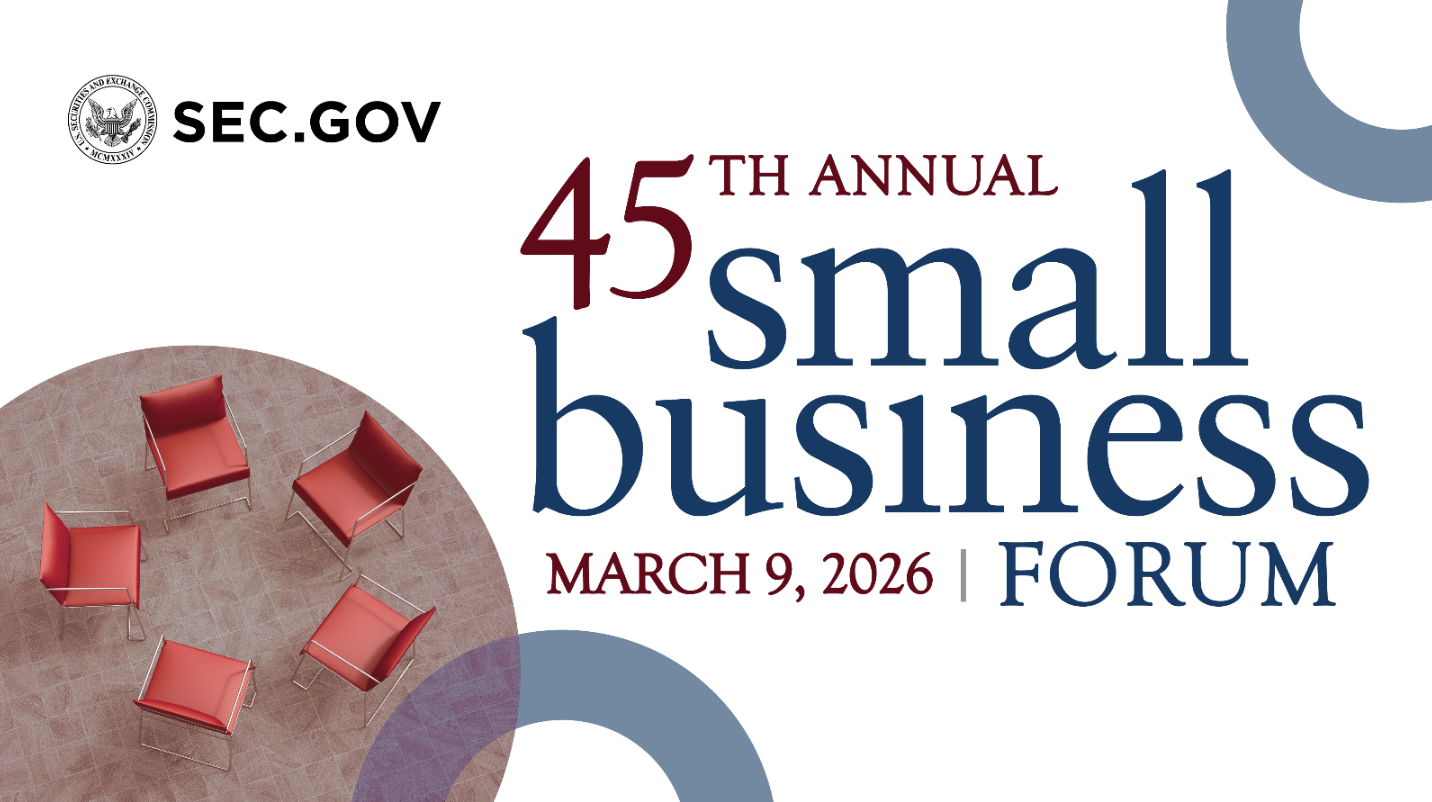
On March 9, the SEC will host its 45th Annual Small Business Forum, which focuses on opportunities to improve capital formation for startups, small businesses, and their investors. Carta’s Head of Policy Holli Heiles Pandol will be participating on the panel: Investing in Innovation: Supporting Growth-Stage Companies, highlighting how policies like the INVEST Act can improve access to capital for companies and their investors. Register to attend in person or virtually here.
But participation is not just reserved for the panels; the ecosystem can participate too! The public can propose and vote for policy recommendations, which will be reported to the Commission and to Congress. Many of the capital formation initiatives that have recently been enacted or have bipartisan support (like provisions in the INVEST Act) have advanced because of the discussions that happen in this forum. You can submit your policy recommendations by March 5.
Private credit's inflection point
Private credit’s rapid expansion into a multi-trillion dollar asset class is entering a new phase, one defined less by growth and more by governance. Recent fraud headlines tied to receivables-backed loans have highlighted operational weaknesses in underwriting, documentation controls, and verification practices as the market moves deeper into asset-based strategies. While isolated incidents do not define the broader market, they do raise important questions about whether due diligence, valuation discipline, and governance practices are evolving at the same pace as capital deployment.
At the same time, broader credit markets are experiencing pressure tied to AI-related volatility in software and tech sectors that make up a significant share of private credit portfolios. Combined with increasing retail access through BDCs, interval funds, and potential retirement channels, as well as signals that some institutional allocators are moderating exposure to the asset class, policymaker scrutiny around the asset class is intensifying.
Why it matters: As the market grows and sector risk becomes more visible, policymakers and investors will increasingly focus on due diligence, valuation rigor, and liquidity management, particularly where retail capital is involved. Private credit is not in crisis, but the asset class is maturing. The next chapter will be shaped by whether governance, transparency, and risk controls can keep pace with scale, and whether the industry can proactively demonstrate resilience before policymakers feel compelled to intervene.
Quick hits
CFTC pushes back on states. State regulators are mounting a significant challenge to the federal government’s authority over prediction markets industry, with dozens of active cases seeking to classify “event contracts” as illegal gambling rather than financial derivatives. If successful, these efforts could fragment oversight and subject platforms to a patchwork of state regulations that could stifle market participation, liquidity, and investment in this rapidly expanding information marketplace. CFTC Chairman Michael Selig has forcefully pushed back, asserting the Commodity Exchange Act grants the CFTC exclusive jurisdiction over event contracts, and therefore, these markets, and has begun intervening in state-led litigation to defend that authority. The outcome will determine whether prediction markets operate under uniform federal supervision or face a fragmented state regime that could materially alter their growth trajectory.
DOJ’s top antitrust cop resigns. Assistant Attorney General Gail Slater, who led the Justice Department’s Antitrust Division, resigned after less than a year amid reported disagreements with senior leadership over enforcement strategy, particularly related to major merger reviews. Slater’s departure has drawn bipartisan scrutiny from policymakers and watchdogs concerned that the administration’s posture toward antitrust enforcement is shifting from its earlier populist tone toward a more permissive, corporate-friendly approach. The leadership transition will influence the trajectory of pending merger reviews and high-profile federal litigation. State attorneys general may increase scrutiny to fill any perceived gap, including sector-concentrated transactions in healthcare, tech, and roll-up strategies.
White House stablecoin talks stall again. A second high-level meeting between traditional banking representatives and crypto industry leaders at the White House failed to bridge deep disagreements over stablecoin yield and reward provisions. Participants described the session as “productive,” but the core dispute around whether holders of payment stablecoins should be permitted to earn yield or rewards remained unresolved. The banks arrived with “Yield and Interest Prohibition Principles,” stating that financial benefits tied to stablecoin holdings should be prohibited to protect deposit funding and lending capacity. Crypto firms countered that rewards are essential to growth, consumer choice, and U.S. competitiveness, urging that overly restrictive language could stifle innovation and push activity offshore. It’s unclear whether a deal can be reached by the administration’s March 1 deadline, but progress on market structure legislation will continue to stall until it happens.
DOL releases AI literacy framework. The Department of Labor (DOL) published a national AI literacy framework designed to guide states, educational institutions, workforce programs, and employers in developing AI skill-building programs. The voluntary framework outlines foundational content areas and delivery principles to guide implementation of training programs across sectors, but does not impose regulatory mandates or funding requirements, leaving adoption up to state and local discretion. The move aligns with broader administration efforts to position AI workforce readiness as a pillar of U.S. competitiveness and complements earlier DOL guidance encouraging the use of existing funding programs to support AI skills training.
Upcoming events
Carta Event: Driving Fund Decisions with Visual Accounting - February 19 at 10:30 a.m. PT/1:30 p.m. ET
SEC Small Business Advisory Committee: Regulatory Framework for Finders - February 24 at 7:00 a.m. PT/10:00 a.m. ET
Carta Event: Startup Taxes 101: Strategies for Navigating Equity and Startup Growth - February 19 at 11:00 a.m. PT/2:00 p.m. ET
Carta Event: Driving Digital Transformation in the Middle Office - February 26 at 10:00 a.m. PT/1:00 p.m. ET
45th Annual SEC Small Business Forum: March 9 at 1:00 p.m. - 5:00 p.m. ET/10:00 a.m. - 2:00 p.m. PT
Sign up below to receive Carta's Policy Weekly Brief

DISCLOSURE: This communication is on behalf of eShares, Inc. dba Carta, Inc. ("Carta"). This communication is for informational purposes only, and contains general information only. Carta is not, by means of this communication, rendering accounting, business, financial, investment, legal, tax, or other professional advice or services. This publication is not a substitute for such professional advice or services nor should it be used as a basis for any decision or action that may affect your business or interests. Before making any decision or taking any action that may affect your business or interests, you should consult a qualified professional advisor. This communication is not intended as a recommendation, offer or solicitation for the purchase or sale of any security. Carta does not assume any liability for reliance on the information provided herein. ©2026 Carta. All rights reserved. Reproduction prohibited.