- Private credit pressures and policy implications
- Topline
- Private credit under pressure
- SEC previews digital assets agenda
- New year, new State of Private Markets and Pre-Seed reports
- AI corner
- Carta participating in SEC Small Business Forum
- Quick hits
- Upcoming events
- Sign up below to receive Carta's Policy Weekly Brief
Topline
Private credit under pressure
SEC previews digital assets agenda
New year, new State of Private Markets and Pre-Seed reports
AI corner
Carta participating in SEC Small Business Forum
Quick hits
Private credit under pressure
Blue Owl Capital has permanently halted quarterly redemptions at its retail-focused private credit vehicle, replacing scheduled tender offers with ad hoc capital distributions as loans are repaid or assets are sold. The move followed a failed merger attempt and rising redemption pressure that the firm concluded it could not meet without restricting withdrawals. To facilitate payouts, Blue Owl sold approximately $1.4 billion of credit assets across affiliated funds. While Blue Owl has characterized the move as an orderly return of capital rather than a redemption freeze, the episode underscores a structural tension: retail structures offering periodic liquidity are backed by long-dated, illiquid loans. That design holds during steady markets; it is tested when redemption pressure rises. The fact that institutional buyers were willing to purchase assets near par supports valuation stability, but widening discounts in publicly traded BDC shares and activist tender offers signal that secondary market confidence is not uniform.
At the same time, AI-driven disruption is adding another layer of pressure. Software-heavy portfolios represent a meaningful share of many direct lending books, and concerns about AI exposure were explicitly cited as a driver of Blue Owl’s rising redemption requests. As growth decelerates across parts of the technology sector, investors are reexamining underwriting assumptions, covenant protection, and valuation marks. Liquidity design risk and sector exposure risk are converging.
Why it matters: As policymakers debate broader retail access to private markets, recent stress events will sharpen scrutiny around liquidity terms, valuation transparency, and investor protections in retail credit vehicles. SEC Chairman Paul Atkins has signaled that expanded retail access will require guardrails to prevent lower-quality assets from being pushed onto retail and retirement accounts. Others are advocating for a more interventionist approach. Sen. Elizabeth Warren has called for halting the expansion of private credit into retirement accounts, increasing capital requirements for bank exposures, mandating greater transparency, and conducting immediate stress testing of the market.
Bottom line: Private credit is not in crisis, but it is under pressure from market dynamics, technological disruption, and political scrutiny. The next phase of the asset class will be defined not by growth alone, but by liquidity discipline, underwriting rigor, and structural durability.
These themes framed the discussion led by Carta’s Head of Policy, Holli Heiles Pandol, at AIMA’s 2026 Private Credit Investor Forum.

SEC previews digital assets agenda
SEC Chairman Atkins and Commissioner Hester Peirce previewed the next phase of the SEC’s digital asset policymaking agenda under Project Crypto.
Innovation exemption. Atkins previewed a proposed “innovation exemption”—a temporary safe harbor that would allow traditional finance and crypto-native firms to experiment with trading tokenized securities via automated market makers and DeFi platforms, subject to volume limits and a white-listing process. The exemption would be time-limited, enabling the SEC to develop or amend rules to enable trading to continue under appropriate conditions. Peirce sought to manage expectations, emphasizing that the exemption would not change markets overnight or dismantle existing rules to allow crypto firms to bypass regulation, but instead provide an incremental, but important, first step to integrating tokenized securities into our existing financial markets.
Rulemaking and guidance. The SEC is expected to propose rules to help facilitate capital formation through the sale of crypto assets, modernize transfer agent rules to accommodate blockchain-based recordkeeping, and outline custody standards for non-security crypto assets like stablecoins. The Commission is also expected to provide a framework clarifying when crypto assets involve an investment contract and issue no-action letters and exemptive relief to address wallets and other user interfaces not subject to SEC registration.
Why it matters: While Congress continues to work on market structure regulation, the SEC is providing a path to encourage mainstream integration of digital assets into traditional financial infrastructure, despite the current market downturn.
New year, new State of Private Markets and Pre-Seed reports
By nearly every measure, 2025 was a strong year for startup fundraising, capping a multi-year recovery from the 2022 market reset, with capital, valuations, and deal terms all trending in founders’ favor. But the interest in AI is not just infusing much-needed capital into the private markets; it’s fundamentally changing what normal looks like. Meanwhile, the pre-seed market saw a slight 1% decline in total cash to $10.4 billion.
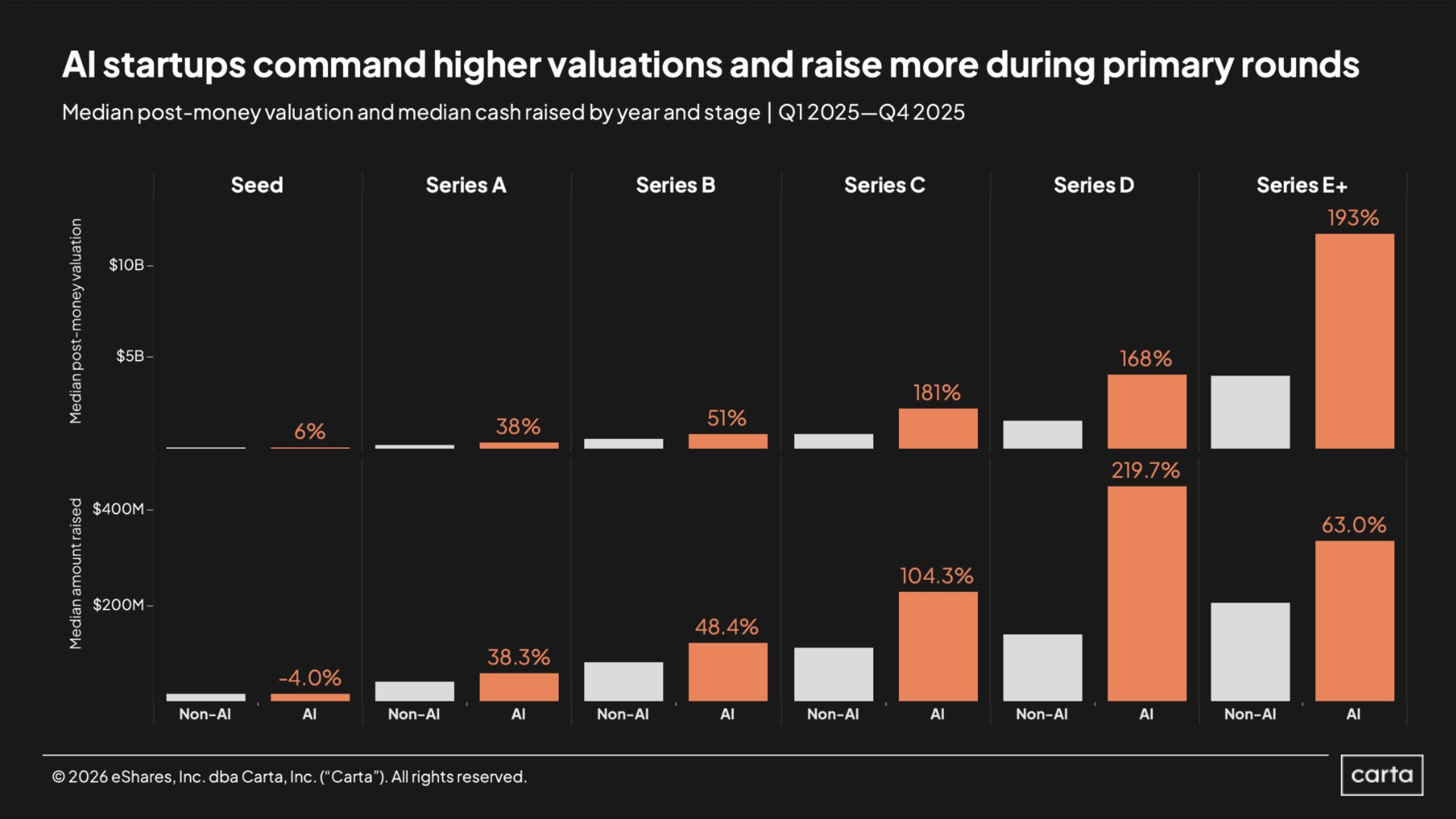
The Carta Insights Team crunched the numbers to bring a definitive breakdown of the year. Read the State of Private Markets and State of Pre-Seed 2025 in review.
AI corner
AI policy is becoming a political flashpoint, dominating much of the policy discussion in Washington. Here are some of the highlights from the week:
NIST launches AI Agent Standards. The National Institute of Standards & Technology (NIST) launched its AI Agent Standards Initiative aimed at ensuring systems capable of independently writing code, managing communications, and executing tasks can operate securely and interoperably across the digital ecosystem. As agentic AI moves from novelty to enterprise infrastructure, establishing common standards early is critical to preventing a fragmented ecosystem that could slow adoption and create security vulnerabilities. Stakeholders can weigh in now through two open comment processes, with listening sessions on sector-specific adoption barriers beginning in April.
Tensions escalate between the Pentagon and Anthropic. The Pentagon is reviewing its relationship with Anthropic over disagreements over how the company’s frontier model can be deployed on classified military systems. The DoD is pushing for all lawful use authority, while Anthropic has drawn firm lines around domestic mass surveillance and fully autonomous weapons. CEO Dario Amodei is scheduled to meet with Defense Secretary Pete Hegseth as both sides attempt to resolve the impasse, but the stakes are high. Pentagon officials are reportedly considering designating Anthropic a “supply chain risk,” a label normally reserved for foreign adversaries that would effectively sever the company’s ties to U.S. defense contracts if it refuses to accept the terms. Claude is currently the only AI model deployed on classified military systems under a roughly $200 million contract, so any break with Anthropic would create significant operational disruption.
Treasury releases financial sector AI guidance. The Treasury Department published two new resources aimed at helping financial institutions adopt and govern artificial intelligence safely and effectively as part of the administration’s AI Action Plan: (1) the AI Lexicon, which establishes common definitions for key AI concepts, capabilities, and risk categories to improve communication across legal, technical, regulatory, and business functions; (2) a Financial Services AI Risk Management Framework, which tailors the NIST framework to the operational, consumer protection, and regulatory realities of the financial sector. These tools aim to give institutions practical language and risk management guidance to evaluate AI use cases, embed accountability and resilience throughout the AI lifecycle, and strengthen cybersecurity and operational controls. Both resources were developed through the Treasury-led Artificial Intelligence Executive Oversight Group (AIEOG) in partnership with industry and regulators, and are part of a coordinated six-part series that Treasury will release to support responsible AI adoption across the financial system.
Carta participating in SEC Small Business Forum
On March 9, the SEC will host its 45th Annual Small Business Forum, which focuses on opportunities to improve capital formation for startups, small businesses, and their investors. Carta’s Head of Policy, Holli Heiles Pandol, will be participating on the panel: Investing in Innovation: Supporting Growth-Stage Companies, highlighting how policies like the INVEST Act can improve access to capital for companies and their investors. Register to attend in person or virtually here.
But participation is not just reserved for the panels; the ecosystem can participate too! The public can propose and vote for policy recommendations, which will be reported to the Commission and to Congress. Many of the capital formation initiatives that have recently been enacted or have bipartisan support (like provisions in the INVEST Act) have advanced because of the discussions that happen in this forum. You can submit your policy recommendations by March 5.
Quick hits
Atkins signals materiality-first reset for public company disclosure. SEC Chairman Paul Atkins used a Texas A&M law symposium to preview a leaner, materiality-focused overhaul of the SEC’s public company disclosure regime. He argued Regulation S-K has become bloated and misaligned with investor needs and signaled reforms targeting executive compensation disclosures, risk factor sections, and pay-versus-performance rules. Atkins also praised Texas’s recent corporate governance changes, which limit disclosure-only merger litigation, expand forum selection flexibility, and open the door to further litigation reforms such as fee-shifting and arbitration (the SEC has cleared the path for mandatory arbitration provisions in IPO registration statements). Key takeaway: If implemented, streamlined disclosure and reduced corporate governance frictions could lower compliance costs, shorten IPO timelines, and incentivize companies to go public, improving exit opportunities for venture- and PE-backed companies.
SCOTUS strikes down Trump’s tariffs. In a 6-3 decision, the Supreme Court struck down Trump’s global tariffs, holding that the president exceeded his authority by imposing sweeping duties without explicit congressional authorization. The decision invalidates a substantial portion of Trump’s second-term tariff framework, which was projected to raise $1.5 trillion over the next decade. In response, the administration imposed a replacement 15% global tariff that will expire in 150 days without congressional action under a different legal precedent, setting the stage for renewed legal and political battles. The Court’s decision reinforces separation-of-powers limits but injects fresh uncertainty into supply chains and cross-border investment. With replacement tariffs in effect and potential refund litigation over previously collected duties looming, businesses may face continued volatility as Congress confronts growing pressure to clarify the scope of executive tariff authority.
FTC defends expanded HSR form. The Federal Trade Commission (FTC) secured an emergency stay from the Fifth Circuit, keeping the expanded Hart-Scott-Rodino (HSR) premerger notification form in effect while it appeals a lower court decision that vacated the rule. The Biden-era amendments significantly broadened disclosure requirements, including detailed reporting on ownership structures, prior acquisitions, competitive overlaps, and labor market impacts. For private equity sponsors, the expanded form increases filing complexity, preparation time, and transaction costs, particularly for roll-up strategies and multi-layered fund structures. Although the broader antitrust environment has moderated under Trump relative to the prior administration, the FTC’s move to defend the rule underscores continued institutional commitment to deeper premerger scrutiny and reinforces antitrust process risk as a central consideration in deal execution and exits.
FinCEN streamlines customer due diligence requirements. FinCEN issued exceptive relief from portions of its Customer Due Diligence (CDD) Rule, eliminating the requirement for financial institutions to identify and verify beneficial owners each time a customer opens a new account. Under the order, beneficial ownership must be collected at initial onboarding, when prior information becomes unreliable, or as required under risk-based ongoing monitoring. For private capital, the change could reduce duplicative onboarding friction for complex fund structures and portfolio companies with layered or cross-border ownership, particularly where multiple accounts are opened with the same institution. Treasury is expected to pursue a broader overhaul of its BSA program, including reconsideration of its application to investment advisers, and the CDD relief signals a shift toward more tailored, risk-based standards that better align compliance expectations with operational realities while preserving core AML/CFT safeguards.
Upcoming events
2026 State of the Union Address - February 24 at 6:00 p.m. PT/9:00 p.m. ET
Senate Banking, Housing, and Urban Affairs Committee Hearing: Update from the Prudential Regulators: Rightsizing Regulation to Promote American Opportunity - February 26 at 7:00 a.m. PT/10:00 a.m. ET
Carta Event: Driving Digital Transformation in the Middle Office - February 26 at 10:00 a.m. PT/1:00 p.m. ET
House Financial Services Committee Hearing: The Role of Self-Regulatory Organizations in U.S. Markets: Examining FINRA (Financial Industry Regulatory Authority) and the MSRB (Municipal Securities Rulemaking Board) - March 5 at 11:00 a.m. PT/2:00 p.m. ET
45th Annual SEC Small Business Forum - March 9 at 10:00 a.m. PT/1:00 p.m. ET
House Financial Services Committee Hearing: Updating America’s Financial Privacy Framework for the 21st Century - March 17 at 7:00 a.m. PT/10:00 a.m. ET
House Financial Services Committee Hearing: Tokenization and the Future of Securities: Modernizing Our Capital Markets - March 25 at 7:00 a.m. PT/10:00 a.m. ET
House Financial Services Committee Hearing: Innovation at the Speed of Markets: How Regulators Keep Pace with Technology - March 26 at 7:00 a.m. PT/10:00 a.m. ET
Sign up below to receive Carta's Policy Weekly Brief

DISCLOSURE: This communication is on behalf of eShares, Inc. dba Carta, Inc. ("Carta"). This communication is for informational purposes only, and contains general information only. Carta is not, by means of this communication, rendering accounting, business, financial, investment, legal, tax, or other professional advice or services. This publication is not a substitute for such professional advice or services nor should it be used as a basis for any decision or action that may affect your business or interests. Before making any decision or taking any action that may affect your business or interests, you should consult a qualified professional advisor. This communication is not intended as a recommendation, offer or solicitation for the purchase or sale of any security. Carta does not assume any liability for reliance on the information provided herein. ©2026 Carta. All rights reserved. Reproduction prohibited.