Topline
The State of the Union
U.S. vs. Anthropic
Carta joins policymakers, industry leaders in support of INVEST Act
SEC Small Business Forum
The new and improved Carta Policy Desk
Quick hits
Upcoming events
The State of the Union
Last week, President Trump delivered the longest State of the Union address in history. The president largely touted first-year economic and foreign policy achievements, but was objectively light on forward-looking policy objectives. Two affordability-focused policy signals stood out:
PE housing ban: The administration doubled down on restricting large institutional investors from purchasing single-family homes, even though institutional ownership represents a relatively small share of the overall housing market. Historically, this approach has aligned more closely with proposals advanced by Sen. Elizabeth Warren than with traditional Republican policies, but the Senate’s housing reform package was recently amended to include the ban—a notable signal of how the affordability frame is reshaping political coalitions across party lines.
Retirement access. The president announced plans to create a new federal retirement savings option for the roughly 56 million Americans who lack access to an employer-sponsored plan. The accounts would be modeled on those available to federal employees and eligible for a government match of up to $1,000 per year. The proposal underscores the administration’s focus on expanding investment opportunities, including enabling greater exposure to alternative assets through professionally managed accounts.
Side note: Carta agrees that more Americans need access to retirement options. We recently launched Carta 401(k), powered by Vestwell and Morgan Stanley, helping founders and their employees access sophisticated retirement plans that were previously available only to large enterprises. Learn more here.
SOTU silence: What was perhaps more notable was what Trump did not mention. Despite the sustained focus on innovation and competition with China, there was no mention of crypto or the digital asset market structure language that the industry has been pushing, which has been a priority for the administration and Congress. Artificial intelligence—arguably the most consequential economic and national security issue on the horizon—only received passing references tied to data centers and youth education.
That silence proved short-lived.
U.S. vs. Anthropic
Tensions between the U.S. government and Anthropic escalated sharply following a breakdown in negotiations over contractual guardrails governing the military’s use of the company’s AI systems. The Pentagon reportedly gave Anthropic a deadline of 5:01 p.m. ET on Friday to drop restrictions on Claude’s use for domestic mass surveillance or fully autonomous weapons, or face losing its contract. When Anthropic held firm, President Trump directed all federal agencies to cease use of Anthropic’s tools. Defense Secretary Pete Hegseth went further, designating Anthropic as a supply chain risk and prohibiting U.S. military contractors and partners from commercially engaging with the company.
Within hours, OpenAI announced a deal with the Pentagon to provide AI models for classified systems, under terms that intended to address the same red lines that Anthropic insisted on.
Unprecedented moves: Anthropic was previously the only AI company operating in classified government settings; now, they have been formally excluded from federal procurement channels under a designation normally reserved for foreign adversaries. The move was not triggered by a security failure or technical incident, but by a contractual dispute over deployment authority, specifically whether the Pentagon (buyer) or Anthropic (developer) has final say over how the technology is used. Anthropic has indicated it will challenge any designation in court, though resolution will likely take months, if not years. In the meantime, general counsels at Fortune 500 companies with Pentagon ties may question whether Claude is worth the risk. The impact is immediate and operationally significant.
What was also unprecedented was how publicly the dispute played out. And it did so against the backdrop of rising instability in the Middle East, as the U.S. was on the verge of military confrontation with Iran, reinforcing the national security stakes and entrenching both sides in ways that could make near-term resolution even harder.
Why it matters: This episode marks a significant inflection point in AI policy. Until now, AI governance has largely been framed around safety, liability, and innovation. That frame is shifting. AI companies are no longer just commercial actors; they are strategic national assets embedded in defense, intelligence, and critical infrastructure. Congress is likely to assume a larger role through oversight and legislative efforts. As the debate evolves from traditional regulation toward industrial policy and national security alignment, the case for federal preemption of state AI regimes may strengthen. At the same time, pressure will increase for Congress to establish clear statutory guardrails, particularly in the defense and surveillance contexts.
Carta joins policymakers, industry leaders in support of INVEST Act
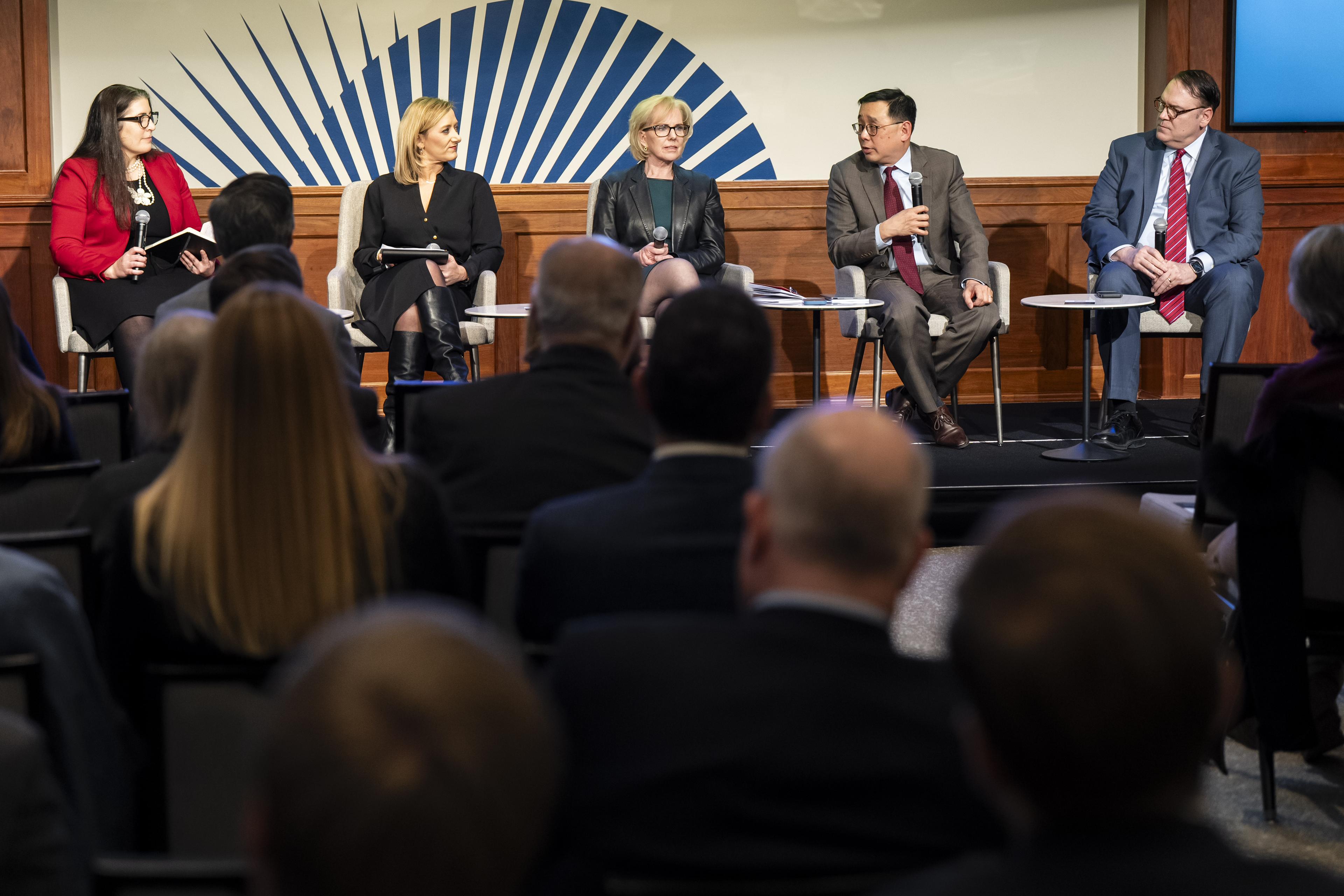
Last week, Carta’s Head of Policy Holli Heiles Pandol joined SEC Chairman Paul Atkins, HFSC Chairman French Hill, and Capital Markets Subcommittee Chair Ann Wagner at the “Shaping the Future of Capital Formation” forum hosted by the U.S. Chamber of Commerce. The event convened policymakers and industry leaders to discuss the importance of expanding access to capital, empowering entrepreneurs, and revitalizing our public markets to build momentum behind the House-passed INVEST Act. At the forum, Holli highlighted why private capital is critical to drive innovation and how the INVEST Act can help empower fund managers to bolster and broaden access to more communities.
Why it matters: The INVEST Act is the most ambitious capital markets legislation since the 2012 JOBS Act. The legislative package will unlock capital for entrepreneurs at every stage, modernize outdated regulations, and expand investment opportunities, including:
Enabling VC funds to invest in other VC funds and secondaries, helping unlock liquidity so capital can be recycled back into the ecosystem
Expanding the size and investor limits for qualifying VC funds, helping emerging managers assemble competitive funds, and reach a broader base of investors
Raising the private fund exemption threshold and indexing it for inflation, ensuring smaller fund managers can continue to support small businesses without added regulatory burden
Expanding accredited investor on-ramps based on financial sophistication vs financial metrics alone
Increasing liquidity and lowering barriers for companies to go and stay public has been central to this effort by educating policymakers, building coalitions, and advocating for the provisions that matter most.
Next steps: The window to get this done is now. Carta and our coalition partners have been working over the past year to educate, shape the contours, and engage the broader innovation community to build consensus. The House delivered a strong bipartisan vote; the SEC stands ready to support implementation. The Senate has signaled that capital formation is a priority, but continued engagement from the innovation ecosystem will be critical to sustain momentum and ensure these priorities make it across the finish line.
Speaking of next steps...
SEC Small Business Forum
Next Monday, Carta’s Holli Heiles Pandol will be participating in the SEC’s 45th Annual Small Business Forum as part of the Investing in Innovation panel, where she’ll highlight how policies like the INVEST Act can lower barriers and expand capital access. Register here.
The new and improved Carta Policy Desk
Carta Policy launched a revamped Policy Desk, a centralized hub featuring our private capital policy content, data, and actionable insights to help the ecosystem navigate the shifting regulatory landscape. The new site features a streamlined interface with advanced search filters, making it easier than ever for our customers, partners, and policymakers to access our Policy Weekly newsletter archive, past and upcoming events, and featured content.
Quick hits
SBIR/STTR compromise reached. After a nearly five-month lapse, Sens. Joni Ernst and Ed Markey reached a bipartisan agreement to reauthorize the Small Business Innovation Research (SBIR) and Small Business Technology Transfer (STTR) programs through September 2031. The compromise establishes a new “Strategic Breakthrough” initiative to prioritize high-impact, mission-critical technologies; strengthens protections against Chinese and other foreign influence over U.S. intellectual property; and replaces the proposed lifetime funding cap with annual application limits—a meaningful shift that preserves growth pathways for startups and emerging companies that depend on SBIR/STTR as a critical early-stage source of capital while addressing concerns about program concentration. The House and Senate are expected to move quickly to pass the deal and restart these programs.
OCC issues stablecoin framework. The Office of the Comptroller of the Currency (OCC) became the first federal regulator to release a comprehensive framework for stablecoin issuance and supervision under the GENIUS Act. The proposal outlines reserve composition and segregation requirements, custody standards, redemption mechanics, and a registration regime for stablecoin issuers. Notably, the OCC would supervise non-bank stablecoin issuers with more than $10 billion in assets, marking a significant expansion of its oversight footprint into the digital asset ecosystem. The FDIC is expected to follow with a parallel rulemaking, while BSA/AML requirements will be addressed in coordination with the Treasury at a later stage. The comment period runs 60 days.
SEC Small Business Committee discusses finders, private secondary markets. At last week’s Small Business Capital Formation Advisory Committee meeting, Chairman Atkins and Commissioners Peirce and Uyeda signaled targeted reforms to help companies raise capital and increase liquidity, both through private secondary markets and IPOs. On finders, the commissioners acknowledged longstanding regulatory ambiguity that has chilled smaller capital raises and committed to advancing a tailored framework aligned with actual risk. On private secondaries, the commissioners recognized structural growth in liquidity markets and expressed an openness to easing blue sky constraints to help encourage further developments, while emphasizing that secondaries should complement, not replace, a stronger IPO market. Atkins reiterated that revitalizing public markets through materiality-focused disclosure reform and reduced litigation friction remains a top priority.
Upcoming events
SEC Private Markets Roundtable - March 4 at 10:00 a.m. PT/1:00 p.m. ET
House Financial Services Committee Hearing: The Role of Self-Regulatory Organizations in U.S. Markets: Examining FINRA (Financial Industry Regulatory Authority) and the MSRB (Municipal Securities Rulemaking Board) - March 5 at 11:00 a.m. PT/2:00 p.m. ET
45th Annual SEC Small Business Forum - March 9 at 10:00 a.m. PT/1:00 p.m. ET
House Financial Services Committee Hearing: Updating America’s Financial Privacy Framework for the 21st Century - March 17 at 7:00 a.m. PT/10:00 a.m. ET
House Small Business Committee Hearing: Connecting SBA to Main Street: Examining the SBA Offices of Field Operations and Rural Affairs - March 18 at 7:00 a.m. PT/10:00 a.m. ET
House Financial Services Committee Hearing: Tokenization and the Future of Securities: Modernizing Our Capital Markets - March 25 at 7:00 a.m. PT/10:00 a.m. ET
House Financial Services Committee Hearing: Innovation at the Speed of Markets: How Regulators Keep Pace with Technology - March 26 at 7:00 a.m. PT/10:00 a.m. ET
Sign up below to receive Carta's Policy Weekly Brief

DISCLOSURE: This communication is on behalf of eShares, Inc. dba Carta, Inc. ("Carta"). This communication is for informational purposes only, and contains general information only. Carta is not, by means of this communication, rendering accounting, business, financial, investment, legal, tax, or other professional advice or services. This publication is not a substitute for such professional advice or services nor should it be used as a basis for any decision or action that may affect your business or interests. Before making any decision or taking any action that may affect your business or interests, you should consult a qualified professional advisor. This communication is not intended as a recommendation, offer or solicitation for the purchase or sale of any security. Carta does not assume any liability for reliance on the information provided herein. ©2026 Carta. All rights reserved. Reproduction prohibited.