Topline:
Government shutdown reaches fourth week as stalemate continues
Carta Policy on the road
Crypto CEOs descend on DC in attempts to salvage market structure negotiations
Administration narrows scope of $100K fee on H-1B visas
Quick hits
Shutdown stretches on (and on…)
The government shutdown has entered its fourth week with no meaningful progress toward reopening. Twelve shutdown votes have now failed in the Senate. Democrats remain firm that any continuing resolution (CR) must include extensions of Affordable Care Act premium subsidies. Republicans — including the president—remain opposed to attaching a fix to government funding. Against this backdrop, Senate leadership forced a vote to pay federal employees who are currently working without pay—a move to put pressure on Democrats to break their position. The effort fell short, with Democrats offering a counterproposal instead. With no resolution in sight, frontline federal employees are bearing the brunt of the standoff, as politics play out and paychecks stay on hold.
Looking ahead: In Washington, things can turn on a dime—but for now, there’s no clear path to ending the shutdown. The short-term funding bill from September has failed in the Senate a dozen times, and even if it eventually passes, it only keeps the lights on through November 20, setting the stage for another shutdown battle before Thanksgiving. No one will want to go through that again, so there is increasing pressure to reach a longer-term solution, which could be unpopular among conservative Republicans. President Trump has largely stayed out of discussions to resolve the spending debate, leaving it to House and Senate leadership. And he will likely remain disengaged in the near term as he heads to Asia for the week.
Two early-November flashpoints could shift the politics around the shutdown debate:
Nov 1: Millions of federal workers will miss paychecks, key nutrition programs could pause, and open enrollment for ACA plans begins—a reminder of the One Big Beautiful Bill’s health-care changes.
Nov 4: Virginia and New Jersey gubernatorial elections and California’s redistricting referendum will offer the first electoral readout of public sentiment during the shutdown.
Carta Policy on the road
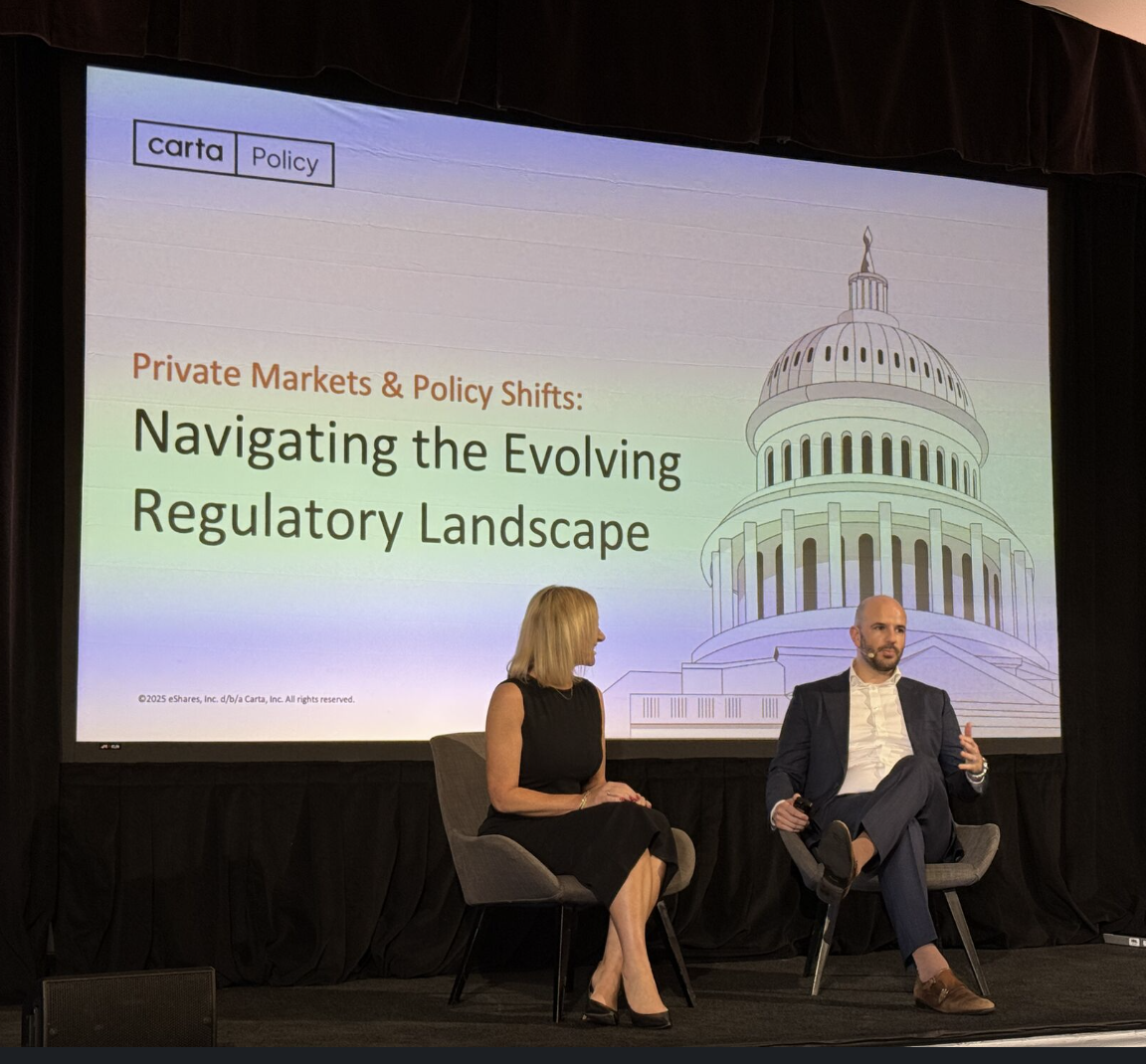
The Carta Policy Team had a great lineup of events across the country this week, where we shared insights on how the policy infrastructure is shifting on topics from AI to investor access and capital formation. We kicked off the week with a VC Policy Dinner in the heart of the action in DC, before heading to New York to engage with emerging managers at the EMex Exchange conference. Then we wrapped the week on the beautiful Presidio in San Francisco at the RAISE Global Summit.
Crypto CEOs descend on DC in attempts to salvage market structure negotiations
Crypto CEOs met with key senators in Washington this week in an attempt to revive bipartisan efforts to pass crypto market structure legislation. While the House passed its market structure bill—the CLARITY Act—earlier this year, Senate Republicans have been working on their own framework. Senate negotiations with Democrats have stalled over process and policy disagreements on how to treat decentralized finance (DeFi) protocols, the scope of intermediary registration, and state preemption. Democrats have pushed to extend registration and AML/KYC requirements to front-end DeFi applications and protocol deployers, while Republicans and industry leaders argue such provisions would stifle innovation. While there is still strong bipartisan interest in advancing a framework, it's unlikely to happen before the end of the year.
All eyes on the SEC: SEC Chairman Paul Atkins has signaled support for the House’s CLARITY framework, but has indicated the agency will move ahead with rulemaking even in the absence of legislation. According to Atkins, the SEC has “plenty of authority” to clarify what constitutes a security and to issue related exemptions. The Commission is expected to formalize rules related to token issuance, tokenization, trading, and custody. While the Commission works to amend its rules to accommodate crypto, the agency will continue to issue guidance and potentially provide relief through an “innovation exemption” to support the development of a tokenized securities ecosystem and facilitate trading and crypto projects. All of this work, however, is on hold during the shutdown.
White House narrows scope of H-1B visa fee
The administration clarified that the new $100,000 fee on H-1B visa applications will apply only to first-time applicants residing outside the United States, according to updated guidance from the U.S. Citizenship and Immigration Services.
The fee was initially understood to apply to all new H-1B petitions, including those filed by individuals already in the country under other visa categories. By further limiting the fee’s scope, the administration effectively shields roughly half of all H-1B applicants, many of whom transition to H-1B status after entering the U.S. on student or temporary work visas. Existing visa holders remain exempt.
Why it matters: The updated guidance offers a more measured approach, offering partial relief to startups, tech firms, and research institutions that depend on foreign technical talent to sustain growth and innovation. However, it still represents a substantial new cost for companies hiring directly from abroad—especially early-stage ventures that are already facing tighter labor markets and elevated compliance costs and competing with larger firms for global talent. While legal challenges to the fee are ongoing, the refined scope may strengthen the rule’s legal footing by demonstrating a more targeted intent.
Quick Hits
Fed previews scaled down bank capital proposal. Reports indicate that the Federal Reserve is socializing a leaner bank capital proposal with other financial regulators. The Biden-era version of the Basel III proposal drew concern from industry and lawmakers on both sides of the aisle, with most large banks predicted to see a 19% increase in total capital. The Fed’s forthcoming rule is rumored to result in a more modest 3-7% increase in total capital at the same banks.
Trump pardons Binance founder. Changpeng Zhao, founder and former CEO of the world’s largest cryptocurrency exchange, received a presidential pardon on Thursday. The pardon will also free Zhao to resume his former leadership role at the company; in November 2023, he pleaded guilty to anti-money laundering violations and served four months in prison. Binance also agreed to pay over $4 billion to resolve a Department of Justice investigation into violations of the Bank Secrecy Act, among other statutes.
IRS updates 1099-K guidance to reflect OBBBA changes. The IRS released 12 new FAQs concerning Form 1099-K, Payment Card and Third Party Network Transactions. The FAQs cover a range of topics, including the purpose and intended recipients for Form 1099-K, the impacts of OBBB’s change in third-party settlement organization reporting thresholds, when multiple Forms are received/required, reporting sales to multiple buyers within a single transaction, and several other technical matters.
SBA publishes state-level data on the shutdown’s lending impacts. The SBA’s 7(a) and 504 loan programs are shuttered during the shutdown, and the agency released state-level data this week indicating: (1) how many loans were not issued as a result, and (2) the dollar value of SBA loan proceeds that could not be distributed. On loan issuances, the disruptions ranged from 212 loans in California to four loans in West Virginia.
Sign up below to receive Carta's Policy Weekly Brief
DISCLOSURE: This communication is on behalf of eShares, Inc. dba Carta, Inc. ("Carta"). This communication is for informational purposes only, and contains general information only. Carta is not, by means of this communication, rendering accounting, business, financial, investment, legal, tax, or other professional advice or services. This publication is not a substitute for such professional advice or services nor should it be used as a basis for any decision or action that may affect your business or interests. Before making any decision or taking any action that may affect your business or interests, you should consult a qualified professional advisor. This communication is not intended as a recommendation, offer or solicitation for the purchase or sale of any security. Carta does not assume any liability for reliance on the information provided herein. ©2026 Carta. All rights reserved. Reproduction prohibited.