Topline
Senate punts crypto market structure to 2026
SEC opens the door for tokenization
SEC flags ongoing gaps in Marketing Rule compliance
ICYMI: INVEST Act + what they’re saying
Carta Q3 VC Fund Performance Report
Quick hits
We’ll return to our regularly scheduled Policy Weekly in 2026, but keep an eye out for our 2025 Carta Policy Wrap, which will be hitting your inboxes over the holidays.
Senate punts crypto market structure to 2026
Despite an end-of-year push, the Senate Banking Committee has delayed formal consideration of its digital asset market structure legislation until next year. Bipartisan negotiations and industry engagement continued this week, and while there are signals of “real progress,” key policy disagreements remain:
SEC v. CFTC jurisdiction: Whether and when digital assets are classified as securities or commodities remains a central fault line. Assets deemed securities would fall under SEC oversight and its investor-protection regime, while commodities would be regulated by the CFTC, raising questions about regulatory scope, disclosure standards, and enforcement authority.
DeFi: Lawmakers are debating how decentralized finance protocols should be treated under a market structure framework, including whether certain activities should be subject to reporting requirements, security standards, or other guardrails without undermining decentralization or innovation.
Stablecoins: Whether stablecoin issuers should be able to pay interest or yield, which some policymakers and traditional banks argue could lure deposits away from community banks, threatening traditional banking stability.
AML and illicit finance: Democrats are pushing for provisions to strengthen anti-money laundering efforts and eliminate illicit finance loopholes, particularly as they relate to self-custody, intermediaries, and decentralized platforms.
Conflicts: Democrats are pushing for ethics language to restrict public officials and their families from endorsing, issuing, or profiting from digital assets while in office (e.g., Trump family crypto ventures).
What’s next: Both the Senate Banking and Senate Agriculture Committees are targeting early January to markup their respective bills when Congress returns from the holiday recess. But even if that timeline holds, there is still a way to go before we see a market structure framework signed into law. Policymakers will need to reconcile the banking and ag provisions before a comprehensive package can pass the Senate. And any Senate-passed version will need to be reconciled with the House-passed CLARITY framework, which passed the House with significant bipartisan support earlier this year.
Bigger picture: The Senate Banking Committee is expected to remain focused on digital assets until there is bipartisan agreement around a framework. This means other ecosystem priorities—like capital formation—will be on hold. With a crowded Senate agenda, another government funding deadline, and the rapidly approaching midterms, time is becoming a binding constraint, which makes it even more critical for the industry to engage and ensure our House-passed efforts to broaden access to capital and investment opportunities make it across the finish line.
Why it matters: Crypto market structure clarity remains a priority for Congress and the administration. While legislation is important to create a durable framework, the absence of near-term congressional action does not mean regulatory stasis. The SEC is continuing to move forward with Project Crypto, which includes targeted regulatory relief, interpretive guidance, and anticipated rulemaking to further integrate blockchain technology into mainstream finance.
SEC opens the door for tokenization
The SEC issued a no-action letter to The Depository Trust Company (DTC)—the central securities depository for U.S. securities—allowing it to develop and operate a pilot tokenization service that records tokenized entitlements to selected DTC-custodied securities on pre-approved blockchains. By embedding tokenized entitlements into DTC’s existing custody framework, the three-year, voluntary pilot seeks to explore how blockchain can improve efficiency, transparency, and transferability of ownership while maintaining stability and regulatory oversight.
Why it matters: The SEC’s controlled greenlight for a tokenization pilot at DTC represents real regulatory momentum behind blockchain infrastructure in regulated markets, transitioning tokenization from isolated experiments toward market-level integration. DTC sits at the core of U.S. clearance and settlement infrastructure, servicing broker-dealers, custodians, and banks. Allowing a tokenization layer to sit alongside DTC’s centralized systems is a major step toward integrating blockchain technology into mainstream financial infrastructure.Broader adoption will depend on technical interoperability, regulatory clarity, and the outcome of these early controlled tests.
What to watch: Questions remain about how blockchain will be integrated into current market infrastructure, presenting both opportunities for efficiency gains and considerable challenges related to legacy system compatibility, regulatory compliance, and operational risk:
Interoperability and standardization: Integrating blockchain systems with legacy clearing, settlement, and custody platforms requires rigorous standards and synchronized data exchange across disparate technologies.
Legal framework: Existing regulations governing securities, payments, and financial market infrastructure were not designed with decentralized, immutable ledgers in mind. The pilot operates under specific no-action terms, and broader rules governing tokenized securities—either through legislation or anticipated rulemaking—will evolve.
Data governance and operational risk: Blockchain’s immutable recording must be reconciled with traditional requirements for auditability, access control, and compliance with regulatory mandates.
SEC flags ongoing gaps in Marketing Rule compliance
The SEC’s Division of Examinations released a new Risk Alert highlighting recurring Marketing Rule compliance issues. The alert focuses on areas that continue to draw examiner scrutiny, particularly around how fund managers are using testimonials, endorsements, and third-party ratings.
Key takeaways:
Disclosures matter: Testimonials and endorsements must include clear, prominent disclosures, with appropriate adviser oversight.
Third-party ratings require diligence: Advisers should document the rating’s methodology and ensure required disclosures are provided.
Policies must match practice: Written policies and procedures should be updated and implemented to reflect how marketing is actually conducted.
Compensation still a focus: Examiners are reviewing promoter compensation arrangements, including how advisers define and apply any de minimis exceptions.
Why it matters: Despite the more deregulatory posture under the Atkins SEC, the Risk Alert reinforces that marketing practices of private fund RIAs remain a core exam priority and provides a roadmap of where advisers should expect questions.
ICYMI: INVEST Act + what they’re saying
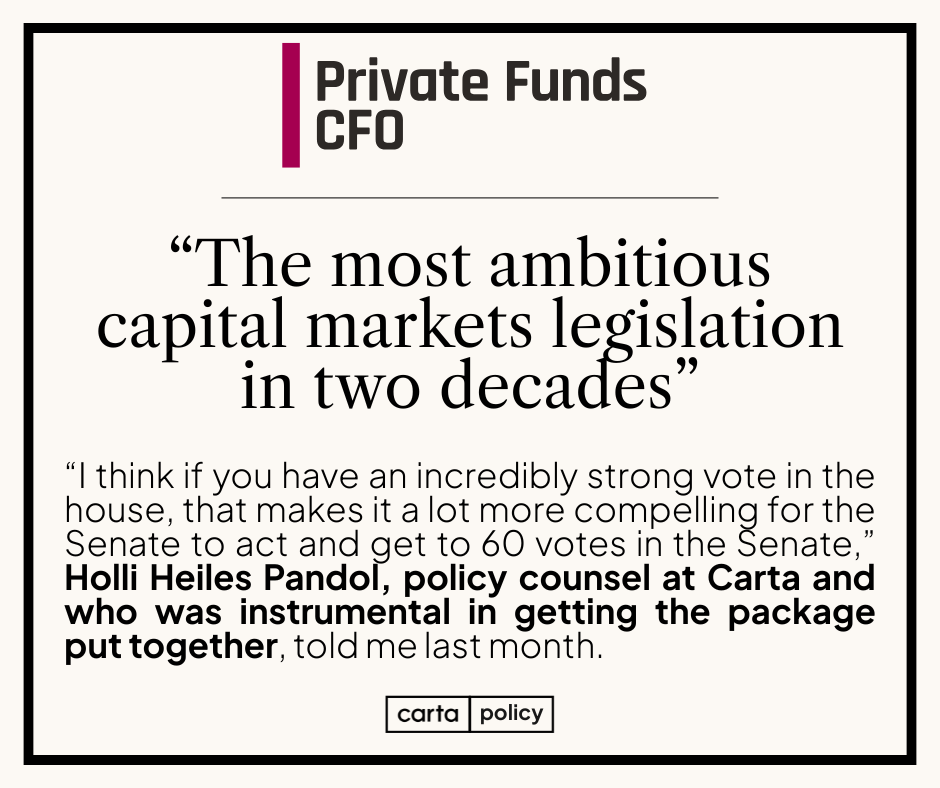
The House passed the INVEST Act in a decisive 302-123 vote, with 87 Democrats joining Republicans to advance “the most ambitious capital markets legislation in two decades.” The legislation promises to unlock liquidity and broaden access by modernizing accredited investor standards, expanding fund limits for emerging managers, and lowering barriers for IPOs. Carta and its Innovator Alliance partners have built the foundation for bipartisan support of our legislative priorities, resulting in this win.
Next steps: The focus shifts to the Senate, where Banking Committee Chairman Tim Scott plans to advance capital formation legislation post-crypto. Given the stacked 2026 legislative agenda, engagement from the ecosystem will be critical to ensure our INVEST Act priorities are signed into law. Join our effort by reaching out to policy@carta.com, visiting InnovatorAlliance.org, or getting in touch with us on LinkedIn.
Carta Q3 VC Fund Performance Report
Carta released its Q3 VC Fund Performance Report, with updated data on which funds are poised to deliver expected returns to LPs, surpassing potential gains in public markets. Here are a few highlights:
More recent funds are starting to realize gains: About 14% of all VC funds in the 2020 vintage made their first distributions to LPs in the past year. Overall, 42% of 2020 funds now have a DPI over zero, compared to 28% a year ago. In the 2021 vintage, some 25% of funds have begun to distribute returns, up from 14% as of Q3 2024.
Median IRRs are now positive for 2021, 2022 funds: The median IRR rose to 0.5% in Q3 for funds in the 2021 vintage and to 0.1% for the 2022 vintage. At the upper end of performance, though, the 2021 vintage continues to lag: It has a top-decile IRR of 14.8%, compared to 19% for 2022.
Pre-2021 funds are almost fully deployed: Funds in every vintage from 2017 through 2020 have now invested at least 89% of their available capital, with 11% or less remaining as dry powder. The 2021 vintage isn’t far behind, with 83% of available capital now deployed.
Quick hits
Court rules Corporate Transparency Act is constitutional. The Eleventh Circuit ruled that the Corporate Transparency Act (CTA) is constitutional, keeping the law on the books. The ruling does not alter the administration’s decision to repeal domestic reporting requirements. However, because the CTA remains legally valid, a future administration could reinstate domestic reporting obligations without new legislation. As a result, policymakers may renew efforts to fully repeal the CTA to eliminate ongoing uncertainty for small businesses and startups. New York’s version of the CTA is set to go live January 1, 2026, creating a separate compliance regime at the state level regardless of federal enforcement posture.
SEC Investor Advocate report focuses on private market retail access. The SEC’s Office of the Investor Advocate released its 2025 annual report, which acknowledges the growth of private markets and offers quantitative evidence illustrating how accredited investor standards are restrictive. The report reflects the office’s evolution alongside the broader policy debate to increase retail access.
Nasdaq pursues 23-hour trading. Nasdaq has requested SEC approval to extend trading on its stock venues to 23 hours on weekdays, adding a new overnight session from 9:00 p.m. to 4:00 a.m. ET. The proposal reflects growing global demand for U.S. equities and investor expectations that markets should be accessible in near real time, regardless of U.S. trading hours.
Sign up below to receive Carta's Policy Weekly Brief
DISCLOSURE: This communication is on behalf of eShares, Inc. dba Carta, Inc. ("Carta"). This communication is for informational purposes only, and contains general information only. Carta is not, by means of this communication, rendering accounting, business, financial, investment, legal, tax, or other professional advice or services. This publication is not a substitute for such professional advice or services nor should it be used as a basis for any decision or action that may affect your business or interests. Before making any decision or taking any action that may affect your business or interests, you should consult a qualified professional advisor. This communication is not intended as a recommendation, offer or solicitation for the purchase or sale of any security. Carta does not assume any liability for reliance on the information provided herein. ©2026 Carta. All rights reserved. Reproduction prohibited.