Each spring, your phone gets a little heavier.
LPs start emailing about their K-1s. The messages arrive with a specificity that's hard to dismiss: "When can we send the K-1 to our investors please? Some folks are asking by March 10th." You ask your tax provider for a timeline. Someone sends a spreadsheet with estimated dates. Two of your funds are still in review. One LP has called their own accountant, who has now called you.
It's not your fault, but it is your problem.
The standard explanation is that K-1 preparation takes time. That's true. But the more precise explanation is that K-1 preparation takes more time when your fund administration and tax preparation live in two separate systems, managed by two separate teams, who share data through periodic exports and manual reconciliation. That coordination overhead is the real cost—and most fund managers never put a number on it.
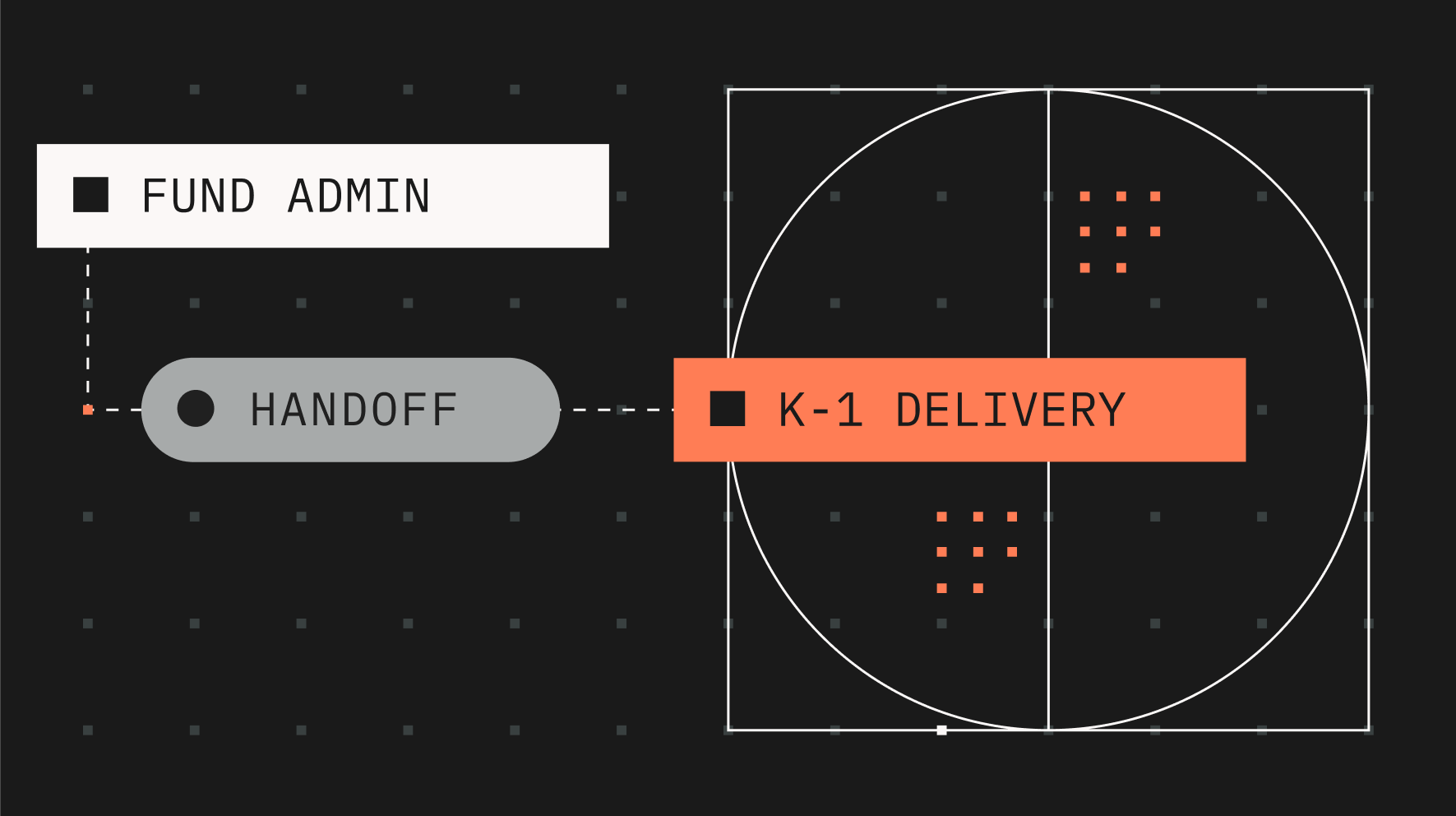
The handoff problem
Here's how the traditional year-end workflow plays out for most VC funds using separate fund administration and tax providers:
Your fund admin closes the books, typically 30 to 45 days after your fiscal year ends. Once the books are finalized, they export your fund's financial data—investment schedules, capital account statements, transaction history—and send it to your tax provider. Your tax provider receives the export, reviews it for completeness, and starts preparing your Form 1065 and the corresponding Schedule K-1s for each of your LPs.
That sounds sequential because it is. Nothing happens in parallel. The export doesn't go out until the books close. The tax provider doesn't start until they have the export. Your LPs don't receive their K-1s until both steps are complete.
In practice, this timeline stretches from January through the summer. The IRS partnership return deadline is March 15 for calendar-year funds—but the vast majority of funds with separate providers file extensions, pushing final K-1 delivery into September. That's close to nine months after the fiscal year closed.
The data translation cost
The delay problem has a root cause: Your tax provider doesn't have direct access to your fund data. They're working from an export, which means they're working from a snapshot—one that may already be slightly out of date, formatted differently than their internal systems expect, or missing line items that require a follow-up call.
Every question your tax provider has to ask you about your fund's data is a delay. Every missing document is a loop back. Every correction to the export means more reconciliation time before returns can go out.
For DataTribe, eliminating this back-and-forth was transformative. "Having Carta as our fund admin and tax service has been a really big time saver for us," says Matt Moran, CFO of DataTribe. "Because the same data powers both fund administration and tax reporting, I can work in one system throughout." The result: "Elimination of lengthy tax provider reconciliation meetings through continuous analysis."
What he's describing is the reduction of an entire category of work that most fund managers simply accept as a cost of doing business.
What your LPs are actually dealing with
Many of your LPs can’t finalize their personal tax returns until they have their K-1s. Many of them are institutional—family offices, fund of funds, endowments—with their own downstream reporting obligations that cascade from yours.
When your K-1s are delayed, many LPs file extensions, which can in turn delay their own LP reporting—even when they’re also waiting on look-through K-1s from other funds. That ripple effect can be real, and it often reflects back on you as a manager, even when the initial delay starts elsewhere in the chain.
This isn't a soft concern. Investor trust is a competitive variable. Managers who consistently deliver K-1s on time remove one more source of friction in re-ups compared with those who regularly rely on extensions. In a market where LP relationships are hard-won and long-cultivated, late tax documents are a friction point you can significantly reduce.
What changes when the systems are the same
When your fund administration and tax preparation run on a single platform, the handoff disappears. There's no export to prepare, no data translation to manage, no sequential waiting period between when the books close and when tax preparation begins.
Carta Fund Tax is built on the same underlying data as Carta Fund Administration. The tax team has direct access to your fund's general ledger, investment schedule, and capital account statements—not a copy, not an export, the actual data. That means preparation can begin earlier, questions get answered faster, and returns go out sooner.
The Tax Dashboard gives you visibility into where each return stands, across all your funds, in real time. Before this existed, fund managers had to email their tax provider to ask for a status update—a request that itself added lag to an already slow process.
The cost you stopped counting
The question most fund managers ask about their tax provider is: How much does it cost per return? That's the line item on the invoice. It's not the full cost.
The full cost includes:
Staff time managing the data transfer and following up on questions
Time spent coordinating with LPs who need status updates
Additional billable hours from your tax or accounting providers for reconciliation work and extension-related tasks
Opportunity cost of LP relationships eroded by late document delivery
Extension filing fees and the administrative overhead that comes with them
According to Carta's data, for funds between $1 million and $10 million in AUM, tax fees account for a median 12% of total fund operating expenses—higher as a percentage than larger funds, and that figure doesn't include the coordination overhead above. In our latest cohort, nearly a quarter of funds using Carta Fund Tax had estimates or K-1s out by the end of February, compared with only a low single-digit percentage of similar funds using traditional setups.
When you switch to an integrated provider, you're substantially reducing a category of work that currently lives between your fund admin and your tax provider, and currently falls on you to manage.
Getting ahead of extension season
There is no good time for K-1s to be late. But the pressure is most acute in March, as the March 15 partnership deadline approaches, and again in early April, when individual filers are working on their own returns and LP pressure is highest.
If your current provider has a structural timeline problem—rooted in how data moves between systems rather than how fast they work—adding urgency or switching to a different traditional provider won't fix it. The workflow is the issue.
The alternative is a setup where your fund data never leaves your fund admin platform to begin with—where the same team that reconciles your books is positioned to prepare your returns without waiting for a handoff that adds weeks to your calendar.
Your LPs are already planning around their own tax deadlines. The question is whether your K-1s arrive before or after those deadlines, and whether that's a variable you're content to leave outside your control.


DISCLOSURE: This communication is on behalf of eShares, Inc. dba Carta, Inc. ("Carta"). This communication is for informational purposes only, and contains general information only. Carta is not, by means of this communication, rendering accounting, business, financial, investment, legal, tax, or other professional advice or services. This publication is not a substitute for such professional advice or services nor should it be used as a basis for any decision or action that may affect your business or interests. Before making any decision or taking any action that may affect your business or interests, you should consult a qualified professional advisor. This communication is not intended as a recommendation, offer or solicitation for the purchase or sale of any security. Carta does not assume any liability for reliance on the information provided herein. ©2026 Carta. All rights reserved. Reproduction prohibited.