AI has become the dominant technology in today’s startup universe, reshaping how founders and executives are thinking about building the transformative businesses of the future in a multitude of ways.
This includes an evolution in how company leaders approach hiring and compensation. Across the startup landscape, AI is changing the way companies think about how many people they need to hire, who they need to hire, and how those hires should be compensated.
Alongside these broader shifts, a significant divide in compensation practices is emerging between those startups that are not AI-native and those that are, reflecting a wider bifurcation of the market between the companies born before and after the epochal launch of ChatGPT in November 2022.
And the tides are shifting quickly. For startups, one of the main benefits of the rise of AI has been the ability to move faster in many different respects—and compensation strategies are no exception. As compensation-related best practices continue to rapidly evolve, having access to the latest and best compensation data is more critical than ever for hiring managers and other startup executives trying to make the most informed decisions possible.
Headcount growth has slowed
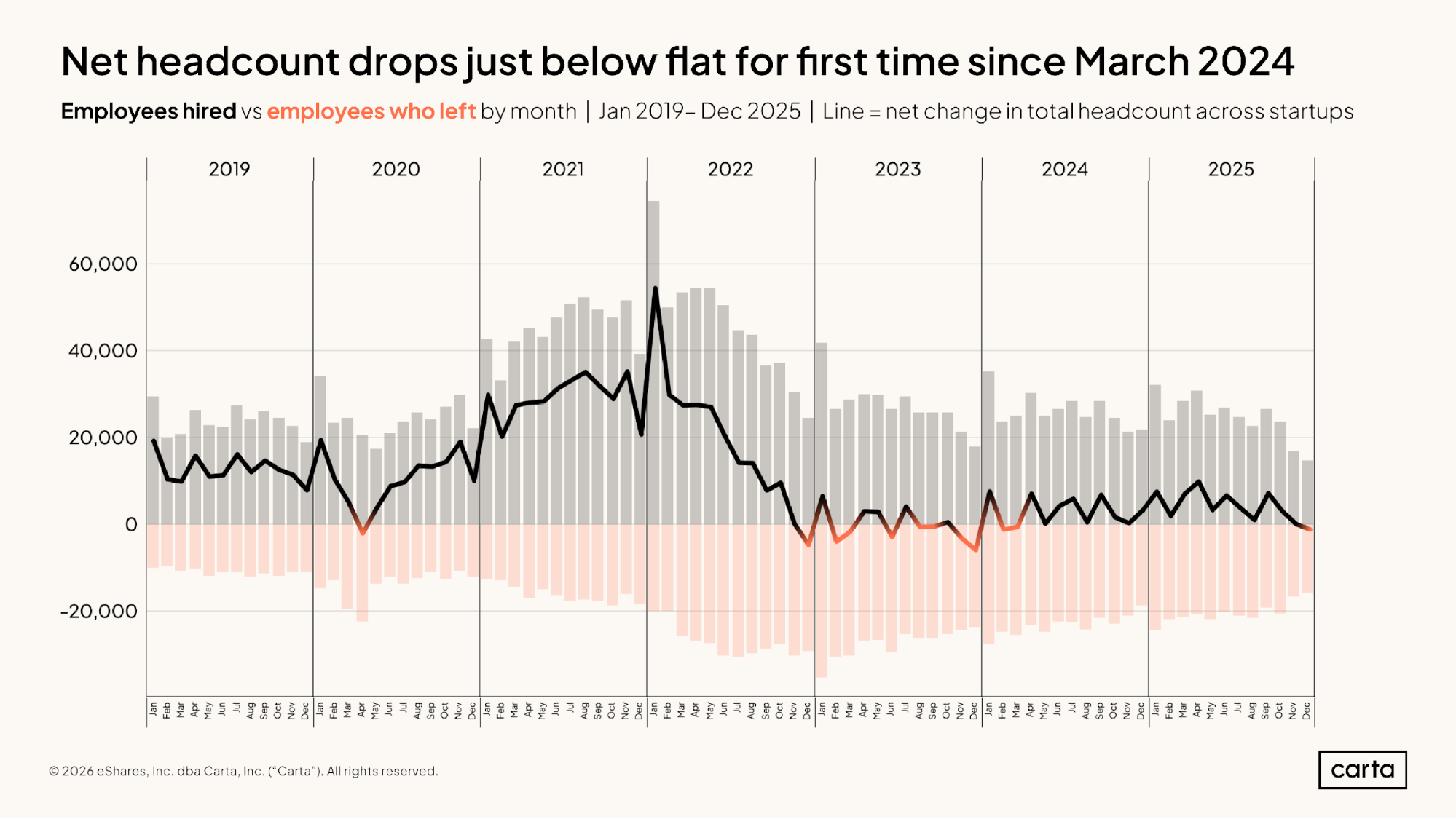
In December 2025, there were more job departures than new hires at venture-backed companies on Carta, the first time monthly headcount growth has gone negative since March 2024. Up until mid-2022, it was common for net headcount to increase by more than 10,000 people per month, peaking at monthly headcount growth of more than 50,000 in January 2022.
This December data is the latest example of a broader trend that was already underway before the launch of ChatGPT, but which in the past three years has become the new industry norm: Net headcount across the startup universe is growing much more slowly than it used to. And in some cases, it’s shrinking.
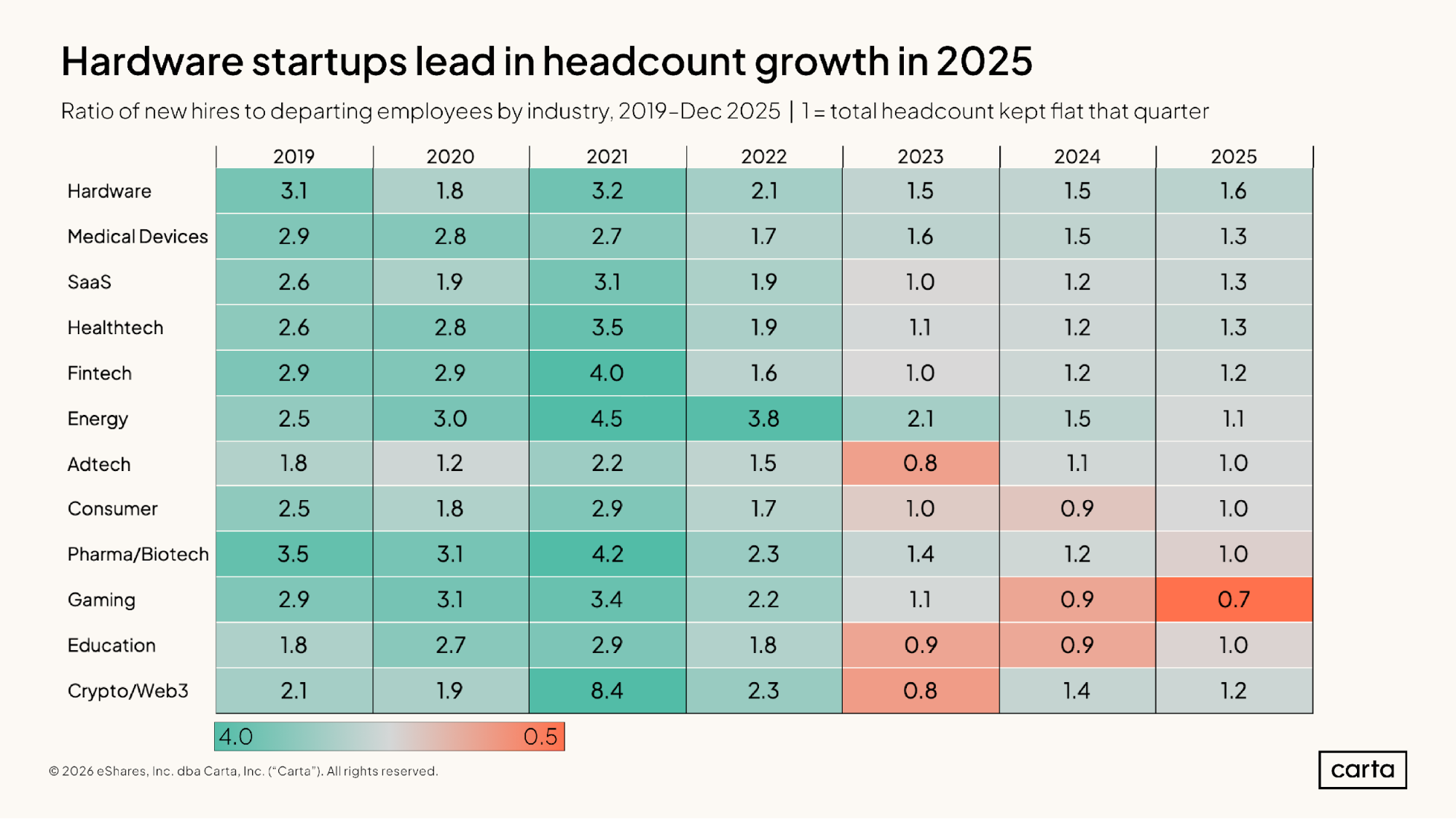
This trend applies across every major startup industry. But it’s less pronounced in some, such as hardware, than in others, such as gaming. In general, headcount growth remains a little stronger in industries that create and produce physical products, where human labor may be more difficult to replicate with AI, than in industries centered around software.
Not all of the recent downturn in headcount growth can be attributed to AI—hiring numbers were likely going to decline after the 2021 venture bull market regardless of what new technologies emerged. But AI has clearly accelerated the process. Investors increasingly want their startups to operate more leanly and to accomplish more with less. And the “less” part of that equation includes less hiring.
For hiring managers and executives, this shift may change talent acquisition timelines. It can also increase the importance of each new hire. When companies operate with smaller teams, they’re more likely to prioritize certain roles that are primed to directly impact the business, such as engineering, and to wait on other roles, like HR. In general, building with smaller teams turns each new hire into a higher-leverage proposition. If you’re bringing in just one salesperson at the earliest stages instead of three, then making the right hire becomes even more critical.
Startups are prioritizing different positions
Over the past few years, finding top talent in roles related to AI, machine learning (ML), and data science has become more important than ever. At the same time, the exact nature of the roles in those areas for which startups are hiring has undergone a shift.
Back in 2020, more than 75% of all AI/ML/data hires were for data scientist and data engineering roles. Today, that figure has dropped below 50%, and continues to fall. Now, the majority of new hires in these areas come in with titles related to AI engineering, ML, and other AI-specific responsibilities.
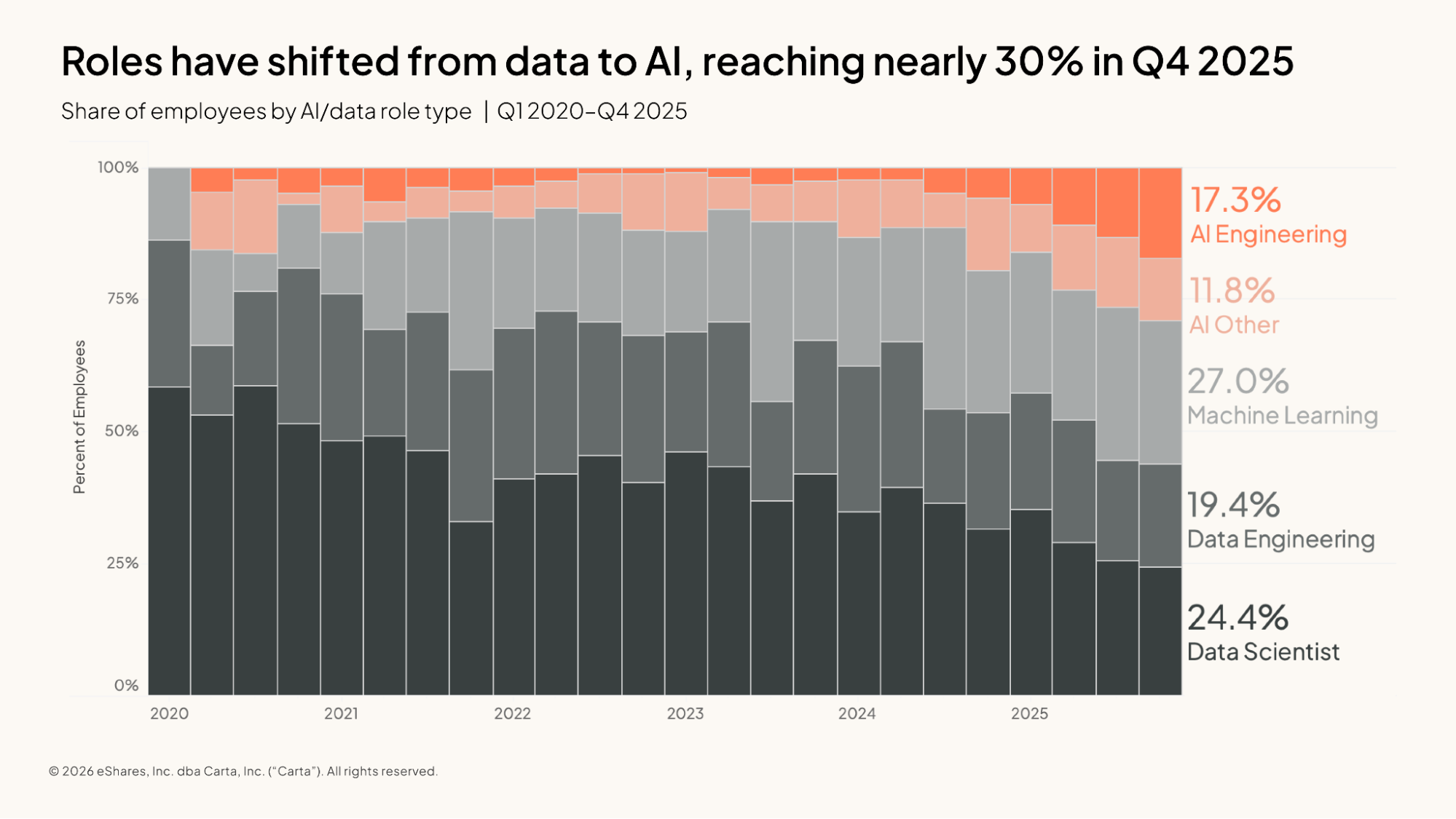
This raises an important question: Are actual job functions changing, or just the semantics of job titles? The answer might vary depending on the company. With that in mind, hiring managers should clearly define what skills they’re looking for in these roles—and closely vet applicants to make sure they meet the qualifications.
Today, nearly every software engineer uses AI in their work. But that doesn’t necessarily make them true AI engineers, a title that typically refers to those who are involved in building AI models or otherwise crafting the infrastructure of AI platforms and tools.
In the late 2010s and early 2020s, when “data scientist” was the hot job title of the time, seemingly every business analyst who could write macros in Excel started to pitch themself as a data scientist, even if they lacked some of the technical skills that position usually requires. In 2026, hiring managers should be on the lookout for candidates who may similarly try to inflate their skill sets.
Hiring managers should also be aware that demand for candidates who truly do fit the qualifications for AI engineering roles is on the rise. To stand out from the pack, some companies may need to adjust their compensation expectations.
Early-stage equity packages are ballooning
For smaller startups, the biggest adjustment so far has been a major increase in the size of equity packages granted to new hires. For startups valued between $1 million and $10 million, the median equity grant for AI/ML engineers increased by 59% from January 2024 to February 2026. For startups valued between $25 million and $50 million, median grant size increased by 30% over that same span.
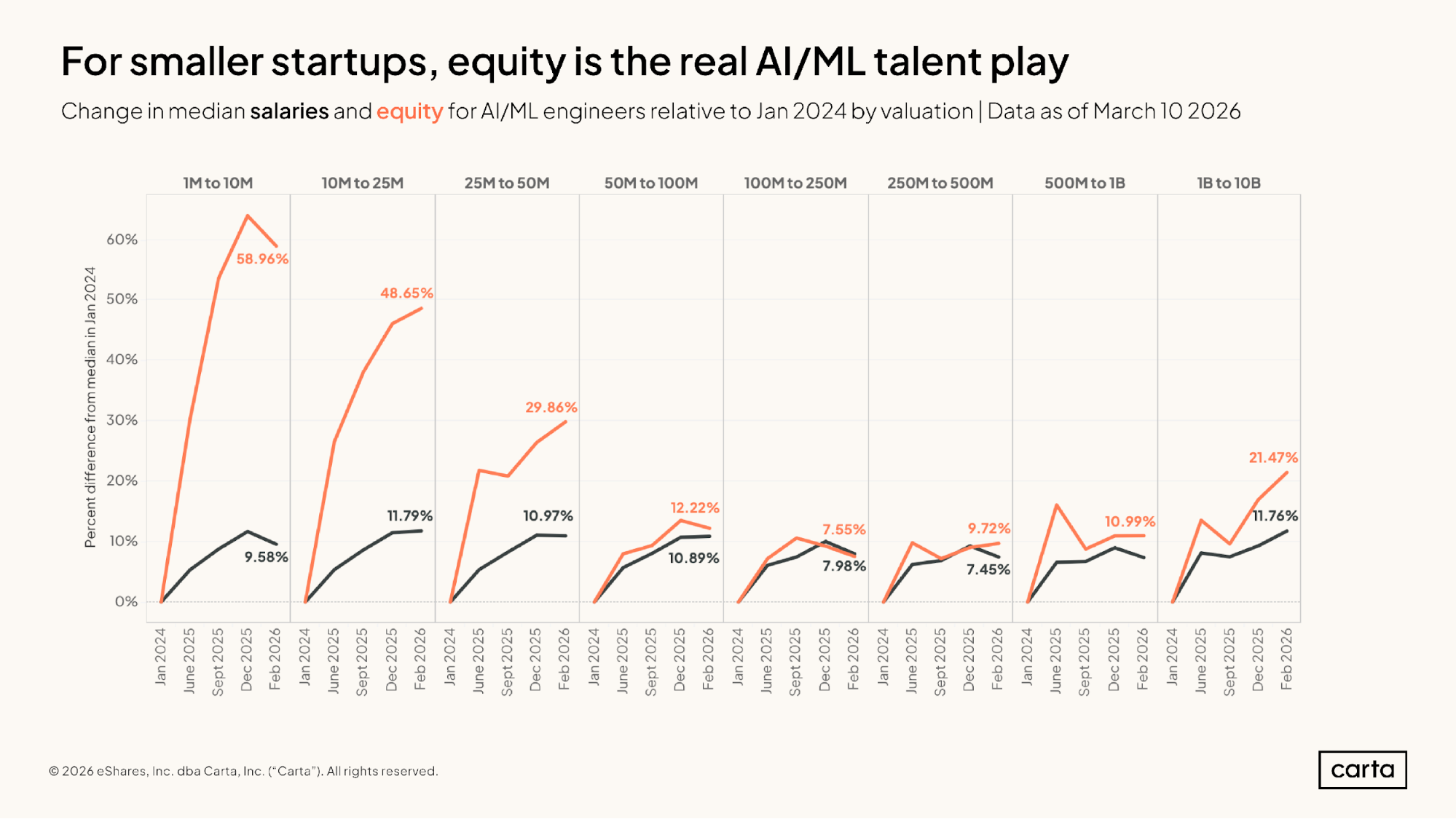
Median salaries for AI/ML engineers have also increased among smaller startups, but not to the same degree. Why has equity been more flexible?
One reason is that, from late 2022 to late 2023, the average new equity grant issued to employees across the broader startup ecosystem shrunk by nearly half, while average salaries stayed roughly the same. In this respect, the growth of equity packages for AI/ML engineers at smaller startups signals a return to the relatively recent status quo, rather than a totally new landscape.
Another reason why equity packages are growing is related to the aforementioned reductions in headcount growth. Data shows that, as typical early-stage headcounts have declined, the typical size of employee equity pools has mostly held steady. If you split the same pool of equity among fewer people, each new hire can receive more.
Thirdly, for smaller companies, increasing equity is often the best card to play when competing for top talent. A startup valued at less than $10 million, for instance, will not have nearly the same resources to pay salaries as a larger, more established AI company. For these smaller companies, equity is the best chance to compete with the industry heavyweights.
For hiring managers seeking talent in these roles, the recent data can impart multiple lessons. One is to play to your strengths as a company. Another is to remember that the compensation landscape changes quickly. If you’re working with data that’s a whole year old—or even older—you may be hopelessly out of date with what sort of compensation you’ll need to offer in order to remain competitive.
AI natives pay top dollar for top engineers
At an AI-native startup valued at more than $500 million, an AI/ML engineer compensated at the 80th to 95th percentile would earn $320,000 in annual salary and be granted 0.146% of the company’s total equity. At a startup with the same valuation that is not AI-native, those same benchmarks drop to $285,000 in salary and 0.1% of total equity.
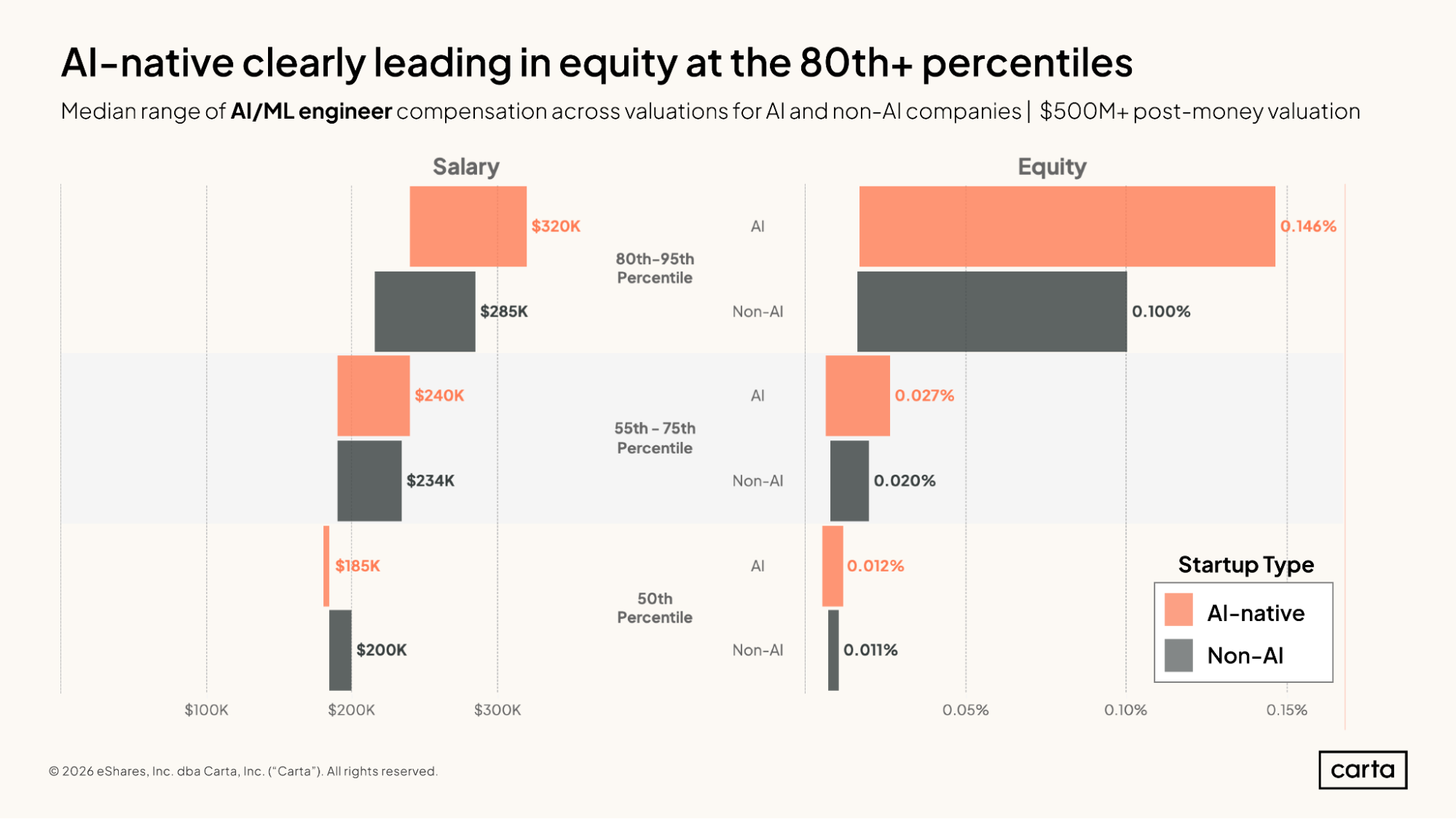
That’s the high end of the compensation range. At the median, however, non-native-AI companies pay slightly higher salaries for AI/ML engineers than their AI-native counterparts. This indicates AI-native companies are willing to pay more for top engineering talent, but also that they have a high bar, often seeking true specialists with highly technical skills. For a true difference-maker, they’re willing to shell out; for average engineering talent, not so much.
When hiring for AI/ML engineers, hiring managers should know the quality of the talent they’re pursuing, as well as what sorts of companies they’re competing against. If candidates are among the best of the best and also looking at AI-native competitors, then compensation packages may need to be commensurately more lucrative to attract their attention.
AI natives pay more for GTM roles, too
Once all those new AI/ML engineers build their cutting-edge products, someone has to take them to market. At the top end of the market, those sales and marketing professionals are receiving better compensation at AI-native companies, too.
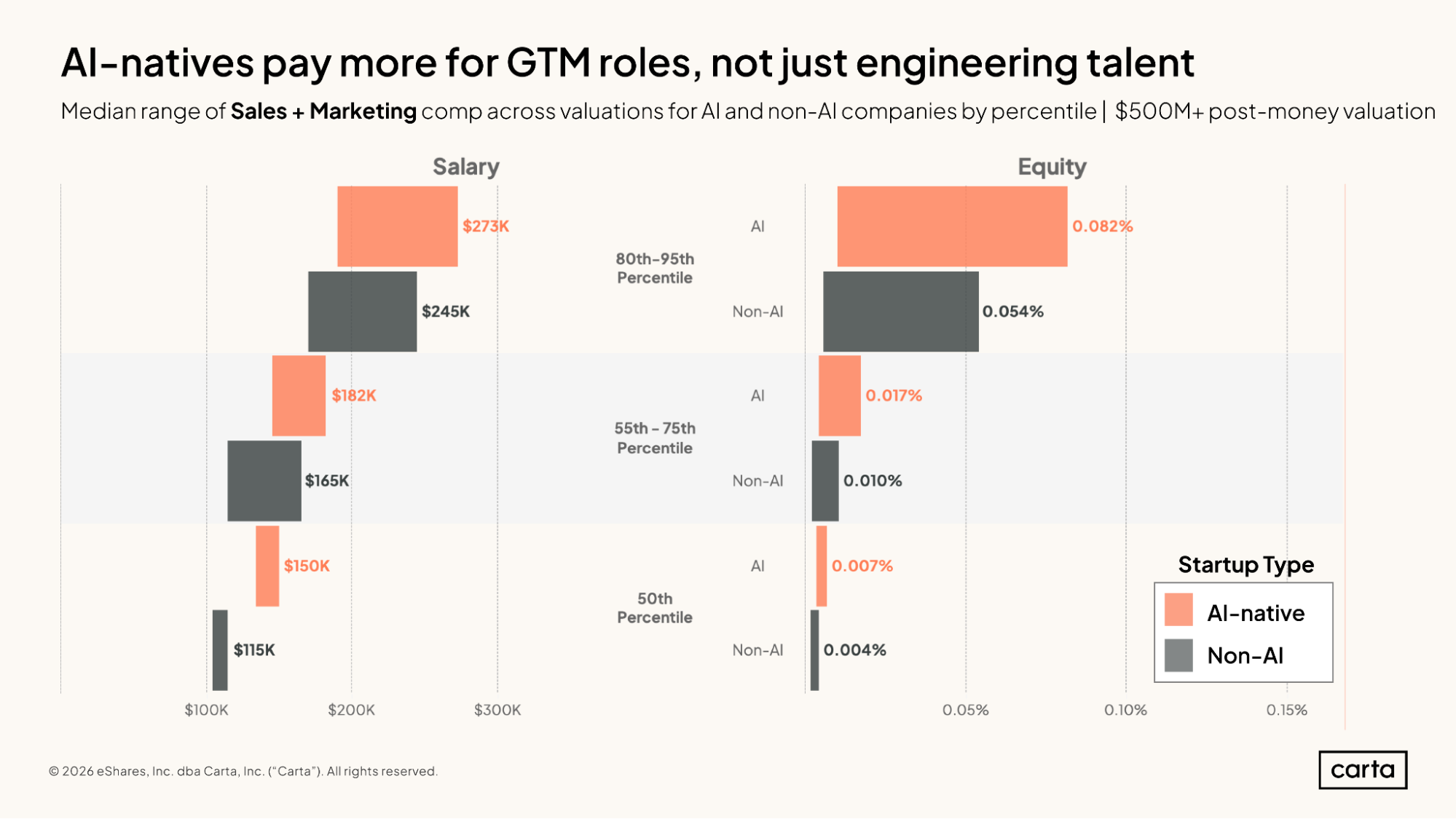
These higher wages and additional equity reflect the fact that GTM hires at AI-native companies are often asked to pitch novel, highly technical products within a nascent and rapidly changing market. Being able to do so effectively is a sought-after skill set. Unlike in AI/ML engineering, the compensation gap between AI-native and non-AI-native startups for GTM roles remains in place for all the benchmarks shown here, not just the top-end talent at the 80th to 95th percentile.
The difference in compensation between AI-native and non-AI-native companies is wider for GTM roles than for AI/ML engineering roles. However, total compensation tends to be lower in GTM, particularly in terms of equity. Because of these smaller overall compensation packages, companies looking to hire for these roles may find it easier to make up the gap between AI natives and non-AI natives in GTM positions than in AI/ML engineering.
How AI informs the data
All the compensation data included in this article is culled directly from companies. Even when it comes straight from the source, however, compensation data for private companies—particularly data on equity grants—is notoriously complex and opaque. For the past five years, Carta has been applying AI models to gather, clean, and analyze this data, making sure our clients have the best, most relevant information at their fingertips to inform their hiring decisions.
By leveraging modern foundational models and applying them to our unique proprietary datasets, Carta keeps pace with the rapidly shifting compensation market. We use AI-driven automation to match a wide range of employee data to the correct level and role, and to better understand how compensation practices differ between executive roles and non-executive roles. Carta applies these tools to estimate compensation benchmarks across various peer groups and roles—slicing and dicing data based on company valuation, capital raised, and headcount.
Today, Carta is also using AI to create new benchmarks to track emerging job titles and roles. These intelligent systems allow us to measure and analyze changes in the underlying data and our compensation benchmarks from one quarter to the next.
Given how quickly the compensation market is evolving for VC-backed companies, that quarterly cadence is critical. Just as AI is transforming the job market, it also enables Carta to accurately track that transformation in a timely manner, creating compensation benchmarks and toolkits ready to be used out of the box by any startup executives making key hiring and compensation decisions.


DISCLOSURE: This communication is on behalf of eShares, Inc. dba Carta, Inc. ("Carta"). This communication is for informational purposes only, and contains general information only. Carta is not, by means of this communication, rendering accounting, business, financial, investment, legal, tax, or other professional advice or services. This publication is not a substitute for such professional advice or services nor should it be used as a basis for any decision or action that may affect your business or interests. Before making any decision or taking any action that may affect your business or interests, you should consult a qualified professional advisor. This communication is not intended as a recommendation, offer or solicitation for the purchase or sale of any security. Carta does not assume any liability for reliance on the information provided herein. ©2026 Carta. All rights reserved. Reproduction prohibited.