- Senate Dems sound the alarm on retail exposure to alts
- Topline:
- All tricks, no treats. Shutdown stalemate continues
- Webinar replay: The power of broad-based ownership in private equity
- Senate Democrats raise alarm on 401(k) access to private markets
- Carta Policy in Boston + NYC
- Quick hits
- Sign up below to receive Carta's Policy Weekly Brief
Topline:
Shutdown stalemate continues
EE ownership webinar
Senate Democrats raise alarm on 401(k) access to private markets
Carta Policy is coming to Boston + NYC
Quick hits
All tricks, no treats. Shutdown stalemate continues
The federal government has now been shut down for a month, putting it on track to become the longest shutdown in U.S. history. The Senate left town this week no closer to a deal than it was 31 days ago, while the House remains on recess. Democrats want commitments to address expiring health care subsidies; Republicans remain adamant there will be no movement until the government reopens.
Why it matters: While policymakers are no closer to a solution, the economic and operational impacts are being felt across the country—in paychecks, airports, and grocery stores alike.
More than 1million federal employees have missed paychecks, including essential personnel still reporting for duty without pay.
SNAP and other food-aid programs are nearly depleted, with states warning benefits could lapse if a deal is not reached soon.
Air-traffic control shortages are prompting flight delays and raising safety concerns as unpaid controllers call in sick.
The Congressional Budget Office estimates the shutdown could cost the economy $7-$14 billion—roughly a 1-2% hit to GDP in Q4 if it continues.
Policy paralysis: Federal agencies have ceased most day-to-day operations, delaying government contract awards, freezing research grants, and disrupting small business lending. The SEC is operating with minimal resources, meaning staff are unavailable to review filings, provide comments, or declare registration statements effective, which has led to delays in IPOs and other market activity (though the SEC has provided guidance to enable IPO registration statements to automatically go effective during the shutdown). Rulemaking efforts have also halted across agencies, stalling progress on policy initiatives to expand access to capital and investment opportunities. Even once funding is restored, agencies will face a costly restart process and significant backlogs that could stretch into next year. Meanwhile, Congress faces a narrowing legislative window. With a limited number of working days before the midterm elections take center stage, the opportunity to advance capital formation legislation is shrinking.
How does it end: Next week could mark an inflection point as the shutdown impacts continue to mount and 2026 open enrollment begins on the ACA marketplaces, where significant premium spikes will
appear without the subsidies. While there is optimism these pressures could push negotiations forward, key sticking points around healthcare subsidies and the length of a government funding deal will need to be addressed to reach 60 votes in the Senate.
Webinar replay: The power of broad-based ownership in private equity
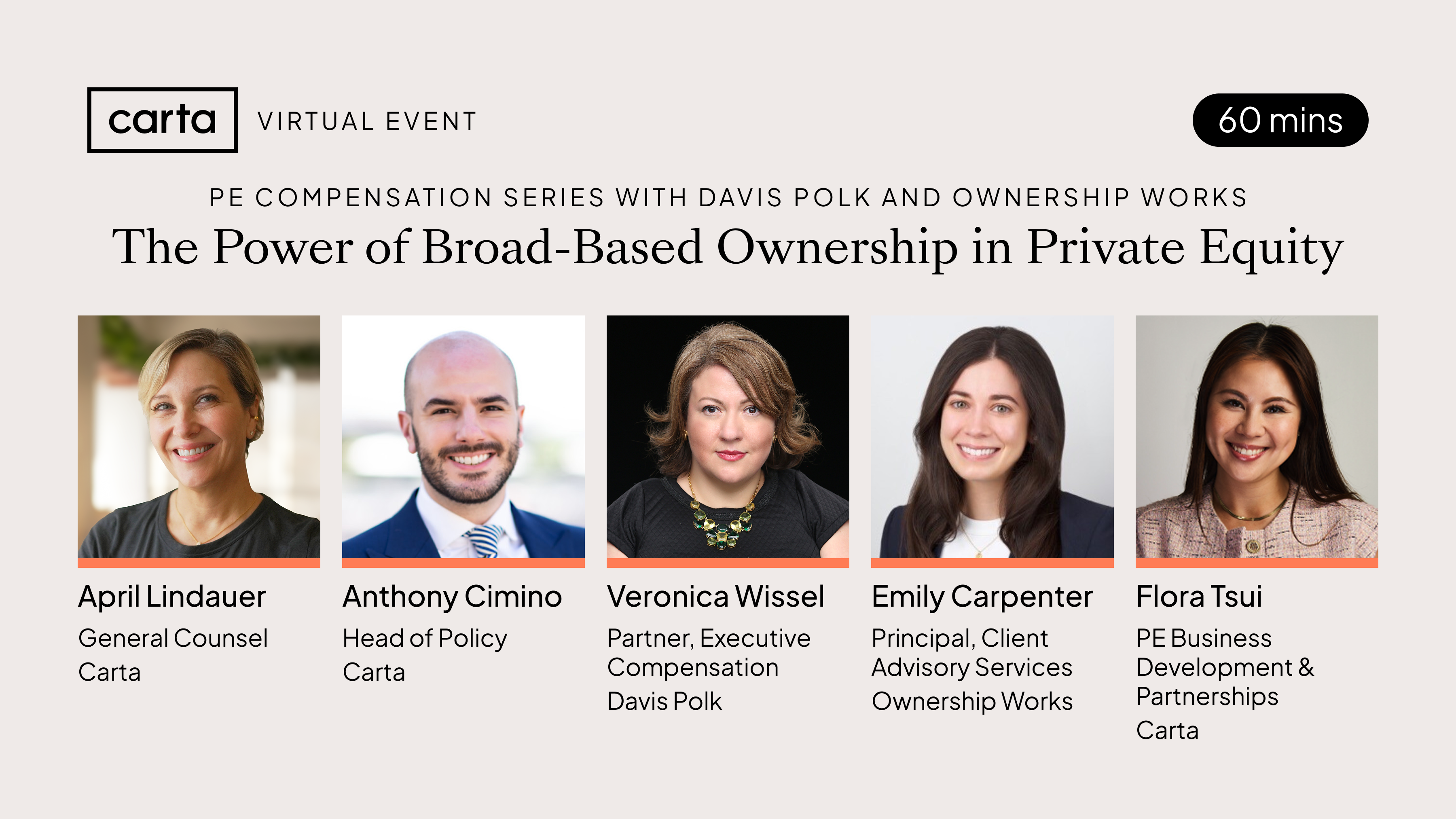
In our latest PE compensation webinar with Davis Polk and Ownership Works, Carta explores how Broad-Based Ownership Programs (BBOPs) are reshaping value creation in private equity. Expanding equity to all employees is driving stronger alignment, retention, and long-term success—while offering a compelling response to rising policy and investor focus on inclusive ownership.
Watch the replay here.
Senate Democrats raise alarm on 401(k) access to private markets
Sen. Elizabeth Warren, joined by Sen. Bernie Sanders and other senior Democratic senators, sent a letter to the U.S. Department of Labor (DOL) and SEC raising alarms about the administration’s directive to expand 401(k) exposure to alternative assets, including private funds. The senators cautioned that private market investments lack standardized valuation practices, carry higher fees, and create opportunities for conflicts and preferential treatment. Without stronger safeguards, they warned retail investors and retirement plans could serve as a “dumping ground” for unwanted assets—concerns that are magnified by the illiquid nature of private fund investments. The senators also questioned whether private equity had outperformed public markets once adjusted for fees, liquidity, and risk.
Why it matters: Make no mistake, the Trump administration is committed to expanding access to private markets. The SEC has already taken steps in this direction and is working closely with the DOL to implement pathways to open retirement plan exposure to alternative assets. But dissenting voices will only grow louder, and the concerns they raise around transparency, fees, and liquidity will need to be addressed if regulators—and plan sponsors—are to broaden access in a meaningful and sustainable way.
SEC Chairman Paul Atkins has acknowledged that expanding retail access requires corresponding guardrails. Atkins has highlighted valuations, liquidity, and transparency around fees and side letters as areas that need to be addressed, stressing the SEC must ensure “ground rules” are in place to prevent lower-quality assets from being pushed onto retail and retirement accounts. As the lines between public and private markets continue to blur, so will the regulatory expectations: greater access will bring greater accountability and scrutiny.
Engagement matters: This is a moment to lead. It will be incumbent on the industry to coalesce around best practices and standards that build trust and demonstrate readiness for broader retail participation. Engagement with the DOL and SEC will be critical to shaping a framework that is not only workable but can also endure political shifts to enable long-term retail participation in private markets.
Carta Policy in Boston + NYC
Speaking of engagement, the Carta Policy Team will be in Boston and New York City the week of November 17. If you're in the area and would like to catch up, please let us know!
Quick hits
What to know about Trump’s trade deal with China’s Xi. After a summit between the two leaders in South Korea, the U.S. confirmed it will cut its average tariff on Chinese imports from about 57% to roughly 47% after China committed to crack down on fentanyl chemical exports and resume U.S. agricultural purchases.
US judge blocks consumer agency’s ‘open banking’ rules for now. In a win for the banking industry, a federal judge temporarily blocked the CFPB’s open-banking rule, which requires banks and fintechs to give consumers the ability to securely share account and transaction data with third-party providers to increase greater data portability in financial services.
Exxon Mobil sues California over looming climate disclosure rules. Exxon Mobil sued to block California’s new climate-disclosure laws, arguing the state is forcing companies to align with its views on climate change. The rules—S.B. 253 and S.B. 261—would require large private and public companies to report emissions across their supply chains and disclose climate-related financial risks beginning in 2026. The California Air Resources Board is expected to finalize the regulations in early 2026.
Sign up below to receive Carta's Policy Weekly Brief
DISCLOSURE: This communication is on behalf of eShares, Inc. dba Carta, Inc. ("Carta"). This communication is for informational purposes only, and contains general information only. Carta is not, by means of this communication, rendering accounting, business, financial, investment, legal, tax, or other professional advice or services. This publication is not a substitute for such professional advice or services nor should it be used as a basis for any decision or action that may affect your business or interests. Before making any decision or taking any action that may affect your business or interests, you should consult a qualified professional advisor. This communication is not intended as a recommendation, offer or solicitation for the purchase or sale of any security. Carta does not assume any liability for reliance on the information provided herein. ©2026 Carta. All rights reserved. Reproduction prohibited.