Since its introduction by Y Combinator in 2013 as a way to streamline the fundraising process for very young startups, the SAFE has emerged as the dominant fundraising structure in the pre-seed market.
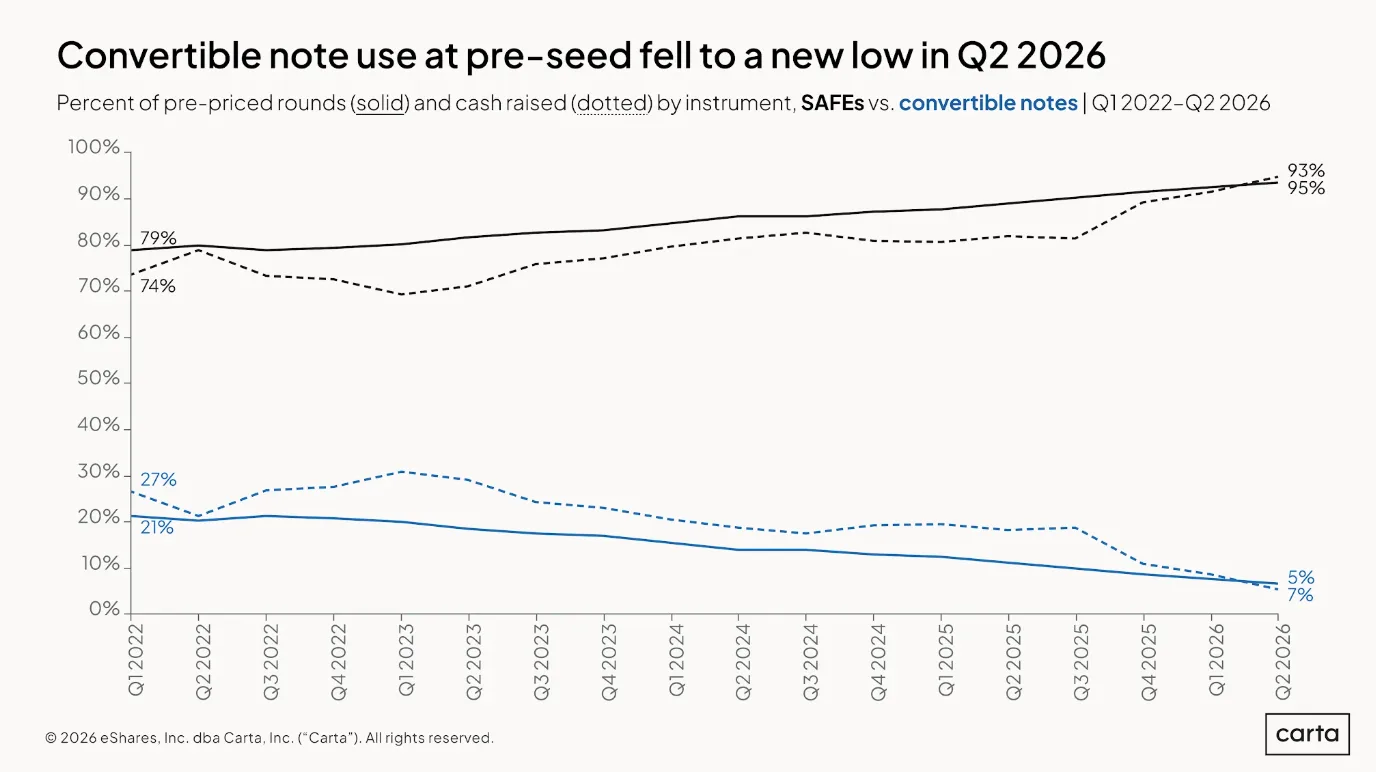
Today, it’s grown so dominant that it has little ground left to conquer. In the second quarter of 2026, 93% of all pre-seed rounds were structured as SAFEs, according to Carta’s latest State of Pre-Seed report. Measured by capital raised, that figure climbs to 95%. Convertible notes now account for a small fraction of pre-seed activity, and that fraction continues to shrink.
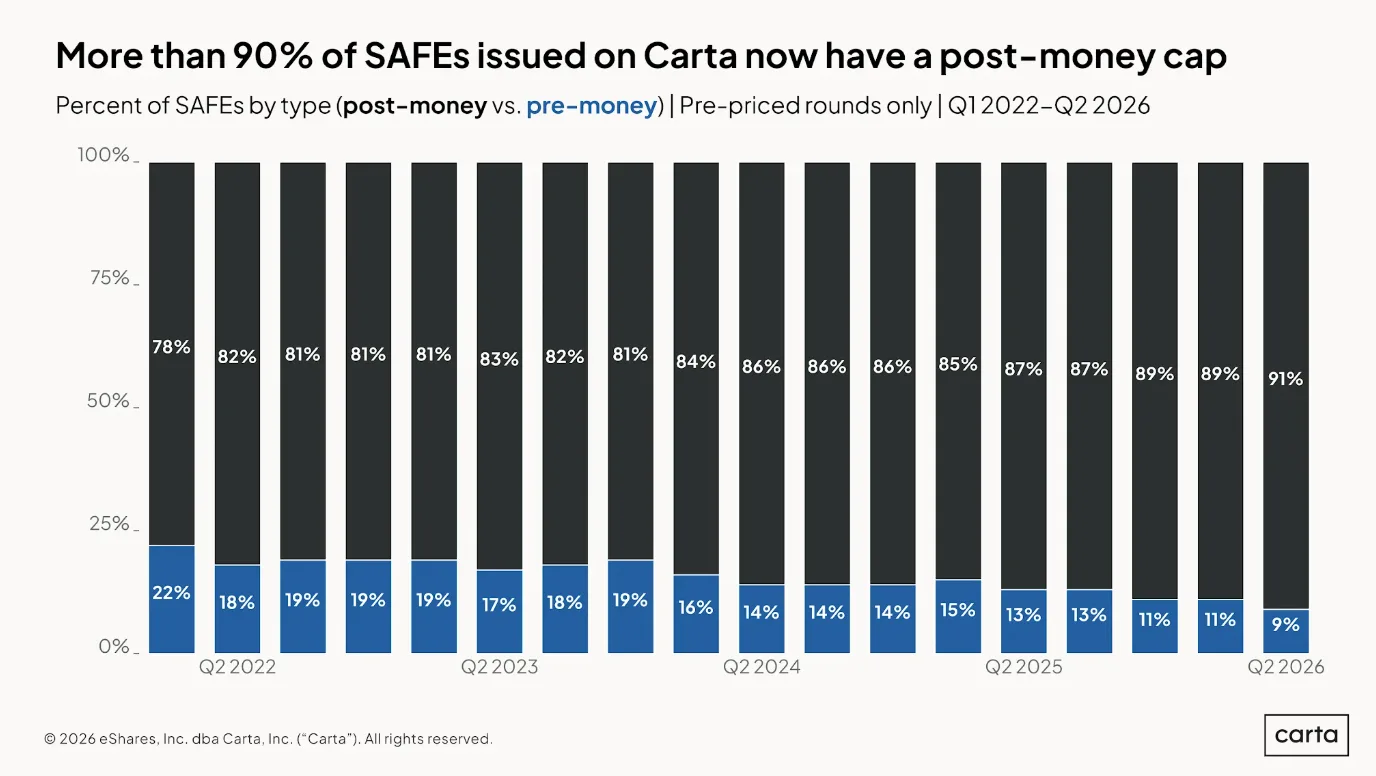
As SAFEs have come to monopolize the pre-seed market, a certain type of SAFE has grown more popular, too. In Q2 2026, some 91% of SAFEs on Carta were post-money SAFEs, rather than pre-money.
In a post-money structure, the investor’s eventual ownership percentage when the SAFE converts into equity is locked in at the time of signing. This provides more transparency than a pre-money SAFE, when ownership might be diluted by other SAFEs signed in the future.
So, almost every pre-seed funding round these days is structured as a SAFE, and almost every SAFE is post-money. We can go another level deeper: Among those post-money SAFEs, almost every one has a valuation cap.
In the first half of 2026, the proportion of post-money SAFEs with a valuation cap sat at 94%. In 73% of cases, a valuation cap was the only price-adjustment mechanism included in the SAFE, while another 21% included both a valuation cap and a discount rate.
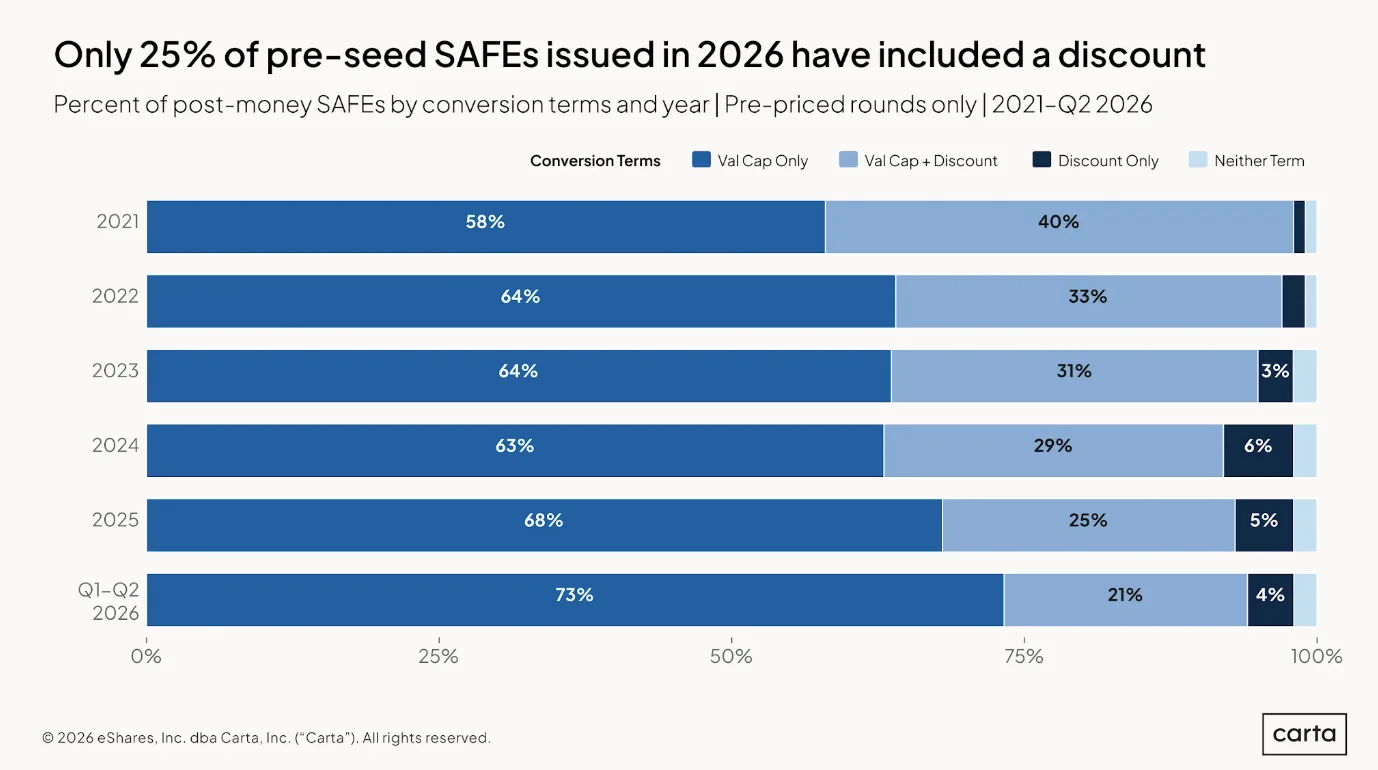
A valuation cap is a deal term that essentially sets a ceiling for the valuation at which an investor’s shares will convert when the company eventually raises a priced round. This ensures the investor will receive a minimum percentage of the company’s shares, no matter how high the company’s valuation might climb.
For example, say a VC fund invests $1 million in a startup through a SAFE with a $10 million valuation cap. When the startup goes on to raise a priced round, the VC fund is guaranteed to receive at least 10% of the startup’s shares, because the size of its investment is 10% of the valuation cap. Even if the round values the company at $100 million, the fund still gets a 10% stake based solely on its initial $1 million investment.
If the priced valuation is lower than the valuation cap, on the other hand, the valuation cap becomes moot, and the SAFE converts at a rate equal to the size of the initial investment divided by the valuation of the priced round. In these cases, the fund receives more than its minimum stake. If the startup in our example is valued at $5 million, for instance, that $1 million SAFE converts to 20% ownership.
Lower valuation caps are typically seen as more investor-friendly, because they guarantee a minimum ownership stake. Higher valuation caps offer more flexibility to founders, reducing the risk of higher-than-expected dilution.
Every deal is different, of course, but valuation caps are typically set at a relatively small premium to what investors and company management believe to be the company’s current value. In general, the valuation cap is a number both sides expect the company to be able to surpass when it eventually raises a priced round.
So it’s a meaningful development that, over the past year, median valuation caps have been rising across SAFEs of every size, reflecting at least some level of confidence among investors that the latest crop of pre-seed companies will be able to grow into lofty valuations:
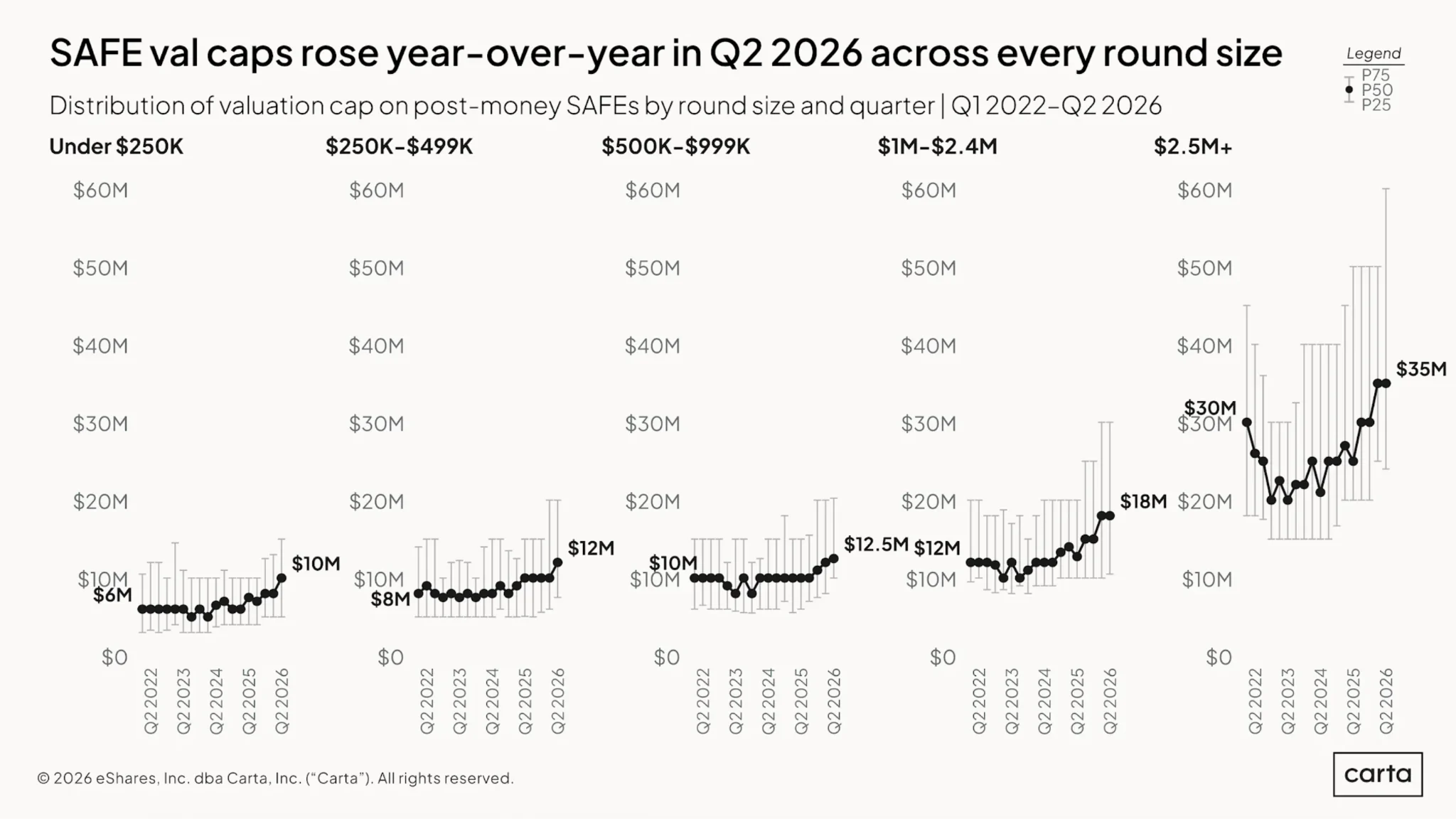
For instance, on SAFEs larger than $2.5 million, the median valuation cap was $35 million in Q2 2026, up 40% year over year. The 75th percentile for valuation caps on these largest SAFEs has skyrocketed even further, approaching $60 million in Q2.
The willingness among investors to sign on for these higher valuation caps is likely influenced by rising valuations at later stages of VC fundraising. At every stage from seed through Series C, median valuations on Carta increased between Q1 2025 and Q1 2026.
This recent valuation growth is particularly stark at the top end of the market. Valuations at the 90th percentile have soared to previously unseen heights, in some cases doubling in the span of a year. At the seed stage, the 90th percentile valuation in Q1 2026 was nearly 4x higher than the median valuation. At Series A, top-decile valuations were nearly 5x higher than the median.
The dynamic is similar, if less extreme, among valuation caps for post-money SAFEs. Across the past six quarters combined, 90th percentile valuation caps have been between 2.5x and 3.5x higher than medians, depending on the size of the SAFE.
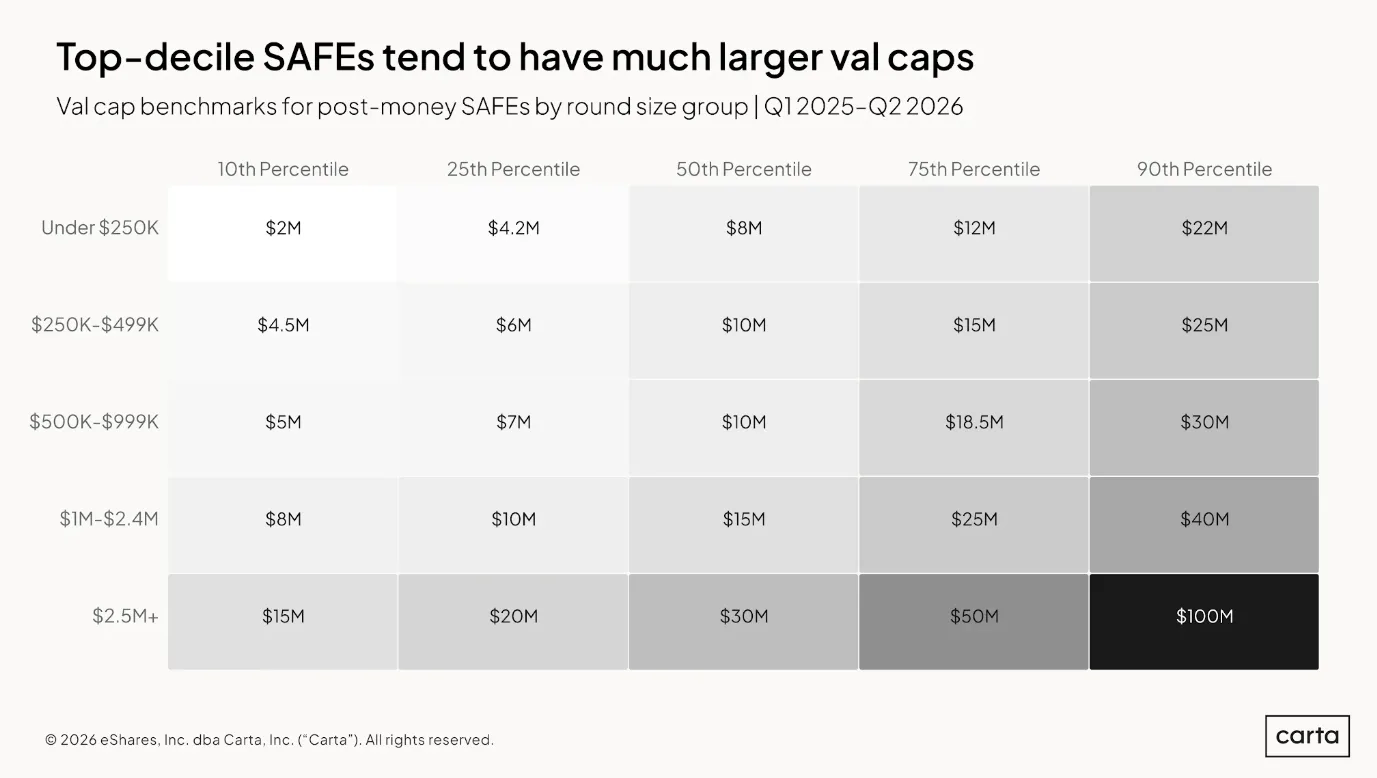
That’s a lot of charts in quick succession. Together, however, they paint a clear picture of a significant systemic shift that’s unfolded in the pre-seed market in recent years.
Nearly every pre-seed round today is a SAFE, and most of them are post-money SAFEs. Nearly all those post-money SAFEs have valuation caps. And those valuation caps are rising higher and higher, particularly at the top of the market. Investors are optimistic that the best of the best from the current crop of AI-powered early-stage startups will eventually produce standout returns, even at higher price points.
Subscribe to the Data Minute newsletter

DISCLOSURE: This communication is on behalf of eShares, Inc. dba Carta, Inc. ("Carta"). This communication is for informational purposes only, and contains general information only. Carta is not, by means of this communication, rendering accounting, business, financial, investment, legal, tax, or other professional advice or services. This publication is not a substitute for such professional advice or services nor should it be used as a basis for any decision or action that may affect your business or interests. Before making any decision or taking any action that may affect your business or interests, you should consult a qualified professional advisor. This communication is not intended as a recommendation, offer or solicitation for the purchase or sale of any security. Carta does not assume any liability for reliance on the information provided herein. © 2026 Carta. All rights reserved. Reproduction prohibited.