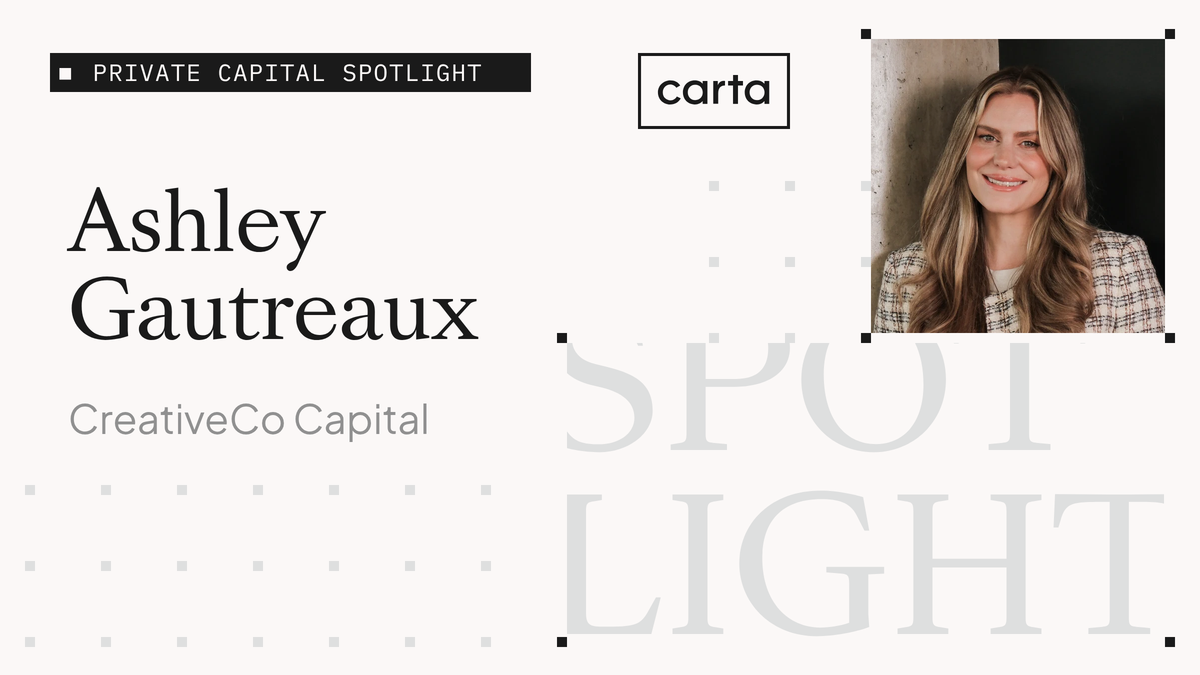
Ashley Gautreaux is a Partner at CreativeCo Capital, a Charlotte-based investment firm that backs bootstrap-minded founders building across AI and automation in essential industries such as govtech, manufacturing, infrastructure, and vertical industries. Its portfolio includes companies like Madison AI (an AI platform for local governments), Proline (AI and SaaS for roofing contractors), Debtbook (treasury for local governments) and Aiwyn (AI Platform for accounting firms.)
Before CreativeCo, Gautreaux spent seven years in operations at Tesla, where she held a series of roles, including launching Tesla into more than 20 countries and managing M&A and integrations globally.
Gautreaux also co-founded gWen (Growing Women Entrepreneurs Network), a Southeast-focused community for female founders, and co-produces Seed the South, an annual capital summit in Charlotte that brings together founders, investors, and ecosystem partners from across the region.
We sat down with Ashley to talk about going from Tesla to venture capital, what it means to back “bootstrap-minded” founders, and why “boring businesses” excite her.
CARTA: You joined Tesla back in 2012. What drew you there, and what did that experience teach you?
ASHLEY GAUTREAUX: When I joined, it was early. There was no factory, and we basically just had the roadster and R&D battery technology. We had around 1,000 employees. By the time I left, we had over 100,000 employees globally.
What really drew me in was the mission—it was big and bold and I wanted to be a part of it. There was a lot of opportunity to really build at Tesla, which excited me.
Being at Tesla in those early days was the best career bootcamp I could have asked for. I helped scale a lot of different organizations from the ground up, building out teams across the Model S, Model X, and Model 3 launches. Later on, I helped launch Tesla into 20 different countries, standing up sales and service centers, and managing mergers and acquisitions globally.
Tesla was a very merit-based company, so you just kept getting more responsibility as you grew. I really appreciated that and it’s something that I’ve carried through to my work at CreativeCo.
I also learned a lot about identifying great people. In the early days, Elon would interview every single person. So if I was putting a candidate in front of him, I needed to be fully confident that I could point to at least three things about them that were exceptional, not just on a resume, but things about their character, their ability to go the distance, their innovative thinking. I still carry that framework when we're evaluating founders at CreativeCo. And the M&A work gave me the same lens for evaluating businesses, how to quickly assess what's defensible and whether the fundamentals hold up.
You then moved to Charlotte and started at CreativeCo. What led to that move?
I moved to Charlotte for my family. My husband had lived there, and through him, I was introduced to my now CreativeCo partners, Travis Parsons and Christian Czenye, who were in the early stages of starting a fund. What excited me was the chance to take everything I had learned about building and scaling at Tesla and apply it: both to building CreativeCo as a company and to helping founders do the same.
I had spent years in the trenches, whether launching markets or integrating companies or building teams, and I knew that’s exactly the kind of support founders need in the early days. So we launched CreativeCo with the clear mission to build a company that founders would actually want to partner with, not just for capital, but for the operational support behind it.
CreativeCo has a few teams. Can you tell us a bit about how they work together?
CreativeCo operates with three different pieces working together. There's investment funds, where we provide growth capital. And as many founders know in early days, scaling talent is hard, so we have our studio, for product design and engineering that we can bring to the portfolio as needed. And then there's our go-to-market advisory, where our team and a network of advisors roll up their sleeves on strategy, positioning, and execution alongside the founders.
This means we have a unique level of engagement with our founders. We don’t just write a check and then check in quarterly. We have weekly touchpoints with our founders. We may interview some of the candidates they're bringing onto their teams. We really want to be building alongside our founders.
On the go-to-market side specifically: Because we're investing in vertical AI companies in essential businesses, there's a lot of commonality in what works across the portfolio. So one approach that's worked really well is leveraging top go-to-market leaders from one portfolio company to advise others to share what's working, because there are real similarities across those businesses.
CreativeCo invests in what you describe as "bootstrap-minded" founders. What does that mean, and why is it a key part of your thesis?
Yes, it’s a major part of our philosophy. Bootstrap-minded founders are builders who can create value with the resources efficiently. We come in after these companies have $1 million to $3 million in ARR. These founders have already built something. They have customers, they've tested their product, they have product-market fit, and they're scaling very fast and borderline break-even or profitable. So the capital we're providing is growth capital, not survival capital.
What we've found with bootstrap founders is that they're disciplined. They know how to try things and be mindful of where they're putting every dollar to work. That's a fundamentally different dynamic, because we're de-risking a lot upfront. Our philosophy is: VC returns without VC risk. The bootstrap-minded founders have already de-risked the hardest part - getting the product to customers who love it. We want to provide them with the capital that helps them get to the next level which is usually to hire more engineers and invest in sales and marketing so they can grow.
A lot of your portfolio is in what some might call unglamorous industries: roofing, waste management, self-storage. Is that intentional?
Very much so. Some might call them boring industries, but I think that's exactly where the opportunity is right now.
We’re in the middle of one of the biggest technology shifts in a generation, and AI is finally making it possible to rebuild these essential industries from the ground up. AI and automation in sectors like construction, property operations, and government has always been our focus. Now the timing is catching up to the thesis.
We have companies like Trashlab, an operating system for waste haulers, Proline, AI for roofing contractors; UrbanSDK, geospatial ai for infrastructure, Swivl, does AI automation for self-storage operators; and Madison AI, which is an AI platform for local governments. The list goes on.
You founded gWen—the Growing Women Entrepreneurs Network—and co-produce the Seed the South conference. What gap were you trying to fill?
When I moved to Charlotte, I noticed a real opportunity to bring female founders and investors together. So I cofounded gWen with Jenny Farias, it’s grown into a genuine community of high growth female founders, focused on connection, mentorship, and making introductions.
Through gWen, we also co-host Seed the South, a summit in Charlotte. What I love about it is that people in the southeast genuinely care about helping and supporting each other. They go out of their way to open doors. There’s a different kind of energy. It can be so important to a founder's journey to have those resources available.
Outside of Silicon Valley it can be a challenge to access capital. So you do need to be intentional about building out the networks and the relationships so you do have opportunities.
But on the other hand, there are real advantages to living outside of the Bay Area. And while there may be a smaller founder community, there may also be more domain industry experts in your region. So there is a different sort of institutional knowledge to be gained and why we look to invest across the United States
It can also be a plus to have some space, and to not get caught up in the hype of whatever is hot in the Bay Area today. Founders outside that bubble are focused on building their businesses. It could be a good thing that they're not distracted by all the noise.
At the end of the day, these boring industries are the bread and butter for our economy, and newer, sophisticated operators are looking for AI solutions to scale institutional knowledge with intelligent systems.