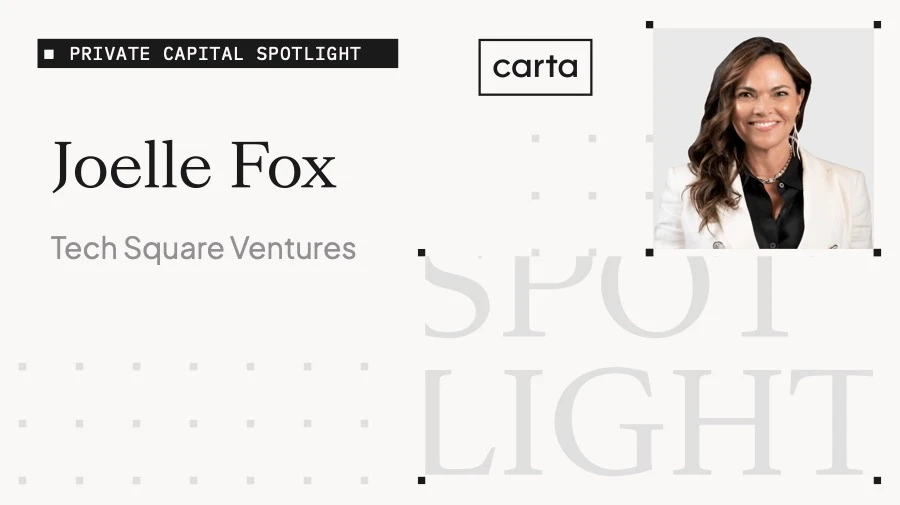
Joelle Fox is the CFO and operating partner at Tech Square Ventures, an Atlanta-based early-stage venture capital firm that invests primarily at the Seed and Series A stage in enterprise technology companies. The firm also runs Engage, a corporate innovation and startup accelerator program connecting entrepreneurs with global enterprises (including Coca-Cola, Chick-fil-A, Delta, and Invesco), Georgia Tech and Invest Georgia. In her role, Joelle manages operations, investor relations, treasury, fund administration and accounting; and supports the investment process.
Joelle spoke with Carta about switching her major to accounting on the advice of a college advisor, what eight years at PwC taught her that no MBA could, and how a reunion with a founder she'd met during a due diligence process two decades earlier brought her to venture capital.
CARTA: Walk us through your career path. What led you to accounting?
JOELLE FOX: I started out a finance major in college, but I had an advisor who noticed I was taking a lot of accounting classes. I was doing well in them and I enjoyed them, so at some point he asked, "Why are you still in finance instead of accounting?" He laid it out: With the number of accounting courses I'd already taken, I could easily switch my major. It would make me more marketable and differentiate me from other finance candidates while also keeping an accounting career as an option.
My hesitation was the stereotype. I thought accounting would be boring, a more introverted field. But then I went and shadowed people in public accounting in Atlanta. They said: No, it's not like that at all. You're immediately with other people your age. In Big Four, you’ll have an audit cohort of about 40 peers that you come up with. And day-to-day in the work you're on teams and interacting with clients.
And the clients at PwC were exciting—I ended up working on accounts like The Great American Cookie Company, Caterpillar and Ted Turner's film library out in LA. That was very different from what I'd imagined. So I switched majors, and I'm so glad I did. It was a very people-oriented career.
You spent eight years at PwC. Were there mentors in your early career who shaped your path?
Definitely. PwC had a strong training culture. The managers and partners really took an interest in helping develop junior talent. You received a review after every client engagement, so you were constantly getting feedback.
I like to say that when you go to work at a Big Four firm, or another large institution in consulting or investment banking, it's like an MBA, except you're getting paid for it. You have a robust training program, constant feedback, and real stakes. For people working in these sorts of intense environments with long hours, I say look at it as getting paid to learn as quickly and as much as you possibly can.
One mentor who stands out from that period is Patrick Boyer, a manager who eventually made partner and has since retired. We spent a lot of time together in LA working on the Ted Turner MGM Film Library account. When you travel with someone like that, you really get to know each other, and can learn a lot. But honestly, the whole environment at PwC was a good mentoring culture, there are so many people who helped shape my career.
What made you leave PwC after eight years, and what came next?
By that point, I knew the partner track wasn’t for me. I'd done some transaction support work—M&A, buy-side, and sell-side—that I found genuinely compelling. I'd also worked on the Atlanta Olympics forecast, where we helped advise the City of Atlanta on all their revenue and expense streams so the Games didn't leave the city with a lot of debt. That project felt less like an audit and more like running a business, more like FP&A. I loved it
So I started putting the word out. iXL was a PwC client—a technology company that was gearing up to make a lot of acquisitions. Some friends who worked on that account said it would be a perfect fit. I interviewed and joined early on.
What was your experience like there?
Busy. In just under two years we did 40 acquisitions and an IPO. iXL grew to over $400 million in revenue. I had wanted to work on an IPO from the inside—that was part of what drew me there. But the acquisitions were where something unexpected happened: I learned I loved working with founders. On every deal I was doing due diligence and working closely with the people building these companies. They were so passionate; so pragmatic and operational. Meeting all of them really inspired me to work more with startups.
Was the pace at iXL a shock after PwC?
The biggest difference was the pivot from a very structured environment to one with no bureaucracy. At PwC, everything was compliance-heavy, deliberate, and structured. Then I walked into a world where we completed 40 acquisitions and an IPO in under two years. Nothing moves that fast inside a public accounting firm.
For that sort of speed, you need to be agile and make decisions fast. If you need to later, you can course-correct. But you need to move quickly and decisively.
How did you eventually get to Tech Square Ventures?
After iXL I joined Velocity Medical Solutions, a software startup that commercialized technology developed at Emory University. Unlike iXL, which was very well-funded when I joined, this was a bootstrapped company. We had to grow from our own revenue and get creative. We grew to around 30 people and were eventually acquired by a strategic partner, a public company out of Silicon Valley. I stayed through the integration, but then I found myself pulled back into that public company culture. It just wasn't fun anymore. I missed that startup pace.
So I left, and around that time I went to what I'd describe as an iXL reunion—there are about ten of us who met during those acquisition years and have stayed close ever since. We sort of function as each other's informal boards of directors, giving each other advice and guidance as we work through career decisions. I was there telling people I'd left my company and was looking for something challenging again. And Blake Patton—who'd been one of the very first founders whose company we acquired back at iXL, which I did diligence on—was there saying he'd started a venture firm and needed help on the financial side.
Someone said: The two of you need to talk.
So it came full circle.
Completely. And I think that's a lesson worth naming: You really don't realize how the people you come into contact with throughout your career come back around. Blake and I had a relationship that started on a due diligence process during the iXL years, two plus decades ago. Keep all your options open and invest in those relationships.
As you started that conversation with Blake, what excited you about Tech Square Ventures?
Joining Tech Square allowed me to weave together the skills and experience I’d gained throughout my career in a unique way. Tech Square manages an early-stage venture fund and also runs Engage, the corporate innovation program. It was a great fit. I knew how to do financial reporting that would make sense to the Fortune 500 partners; I could speak that language. But I also had such an empathy for the founder experience and love of the excitement of early-stage startups. The one piece I really had to learn was fund accounting and the mechanics of venture—but that was exciting, not daunting. It felt like the best of all three worlds.
And I believed in Blake. That mattered.
What does your day-to-day look like at Tech Square?
It varies enormously, which I love. Some days I'm listening to our team facilitate conversations with Fortune 500 corporate partners: hearing what's on their strategic roadmap, what they're looking to explore next. Other days I'm hearing pitches from founders or Georgia Tech students. We partner with Georgia Tech and local universities, and we have student interns and recent graduates on the team. They bring a lot of great energy and are so bright and fun to be around.
One day might be focused on portfolio strategy. Another might be a big Engage reception where startups are pitching directly to corporate partners. And another might be me picking out furniture for the new office, designing a space that really fits our culture. When you're running a firm at this stage, it really is its own kind of startup. You're building something. I’m really proud of what we’re building here in the Southeast.
With over 150 investments, six funds and multiple SPVs, Tech Square describes itself as the most active venture firm in the "Super South"—from Texas to D.C. What are the advantages of being outside the coastal hubs, and what are the challenges?
The advantages are real. Atlanta has one of the highest concentrations of Fortune 500 companies in the U.S: companies like Delta, Home Depot, and Coca-Cola. This is a diverse set of companies; there's not a lot of sector overlap, which can foster collaboration without competition. These corporations can sit next to each other and talk about shared challenges like supply chain or energy resilience without feeling like they're giving something away to a competitor. There's a genuine commitment from those companies to help build a stronger startup ecosystem here. They want to see more startups succeed in Atlanta, and they're collaborating to make it happen.
Then there's Georgia Tech. They’re ranked third in the country for undergraduate engineering, according to U.S. News & World Report. And they've been among the top feeders to Y Combinator recently. The talent pipeline is real, even if it's not always appreciated from the outside. One of the common objections we hear to building outside of Silicon Valley is a concern about being able to find the talent, but what we’ve seen from local universities like Emory, Georgia Tech, Georgia State and others is that the talent is here.
The challenge companies really face here is capital. Our ecosystem is maturing, but it is not Silicon Valley—where you have repeat founders, deep liquidity, and so much venture capital access. We've had meaningful exits and the flywheel is starting to take effect, but there's still a gap. That's part of what we're working to close.
You've talked before about your competitive nature. Where does that come from, and how does it show up in your work?
My father played minor league baseball and then went into finance, so competition has always been part of how I was raised. For me it mostly manifests as competing against myself—looking at a hard challenge and thinking: I can beat this. Instead of getting frustrated, I try to step back and ask what resources I need, how I prepare, how I power through.
One thing I've learned over time is the difference between acting with urgency and acting in a panic. As a CFO, especially at a VC firm, one of the most valuable things you can do is stay calm under pressure. When other people panic, it tends to escalate quickly—it almost pulls you in. I've tried to train myself to recognize that and stay clear-headed, because I'm much more useful that way.
Some of that knowledge came from sports, especially my experience boxing. I train with a boxing coach, and it teaches you to stay present and composed. When I work out, I'm not overthinking work—I'm just listening to the coach, learning a new skill, getting out of my head, and pushing myself physically. I think it's just as important to challenge your body as it is to challenge your mind.
What advice would you give someone early in their career who wants to find their way into venture or private markets?
First: Learn to take critical feedback. I've talked to a lot of people who felt singled out when they received criticism, or found it hard to absorb. My advice is to lean into it. That being said, there's a real difference between criticism and something abusive. Criticism typically means someone believes you have potential—they're investing time in giving you specific feedback because they think you can absorb it and improve. If that’s what someone is doing for you, don't shy away from hard truths. Try not to take it personally. Instead, use it to grow.
And one more thing worth emphasizing: The relationships you build throughout your career have a way of coming back around. Keep all your options open and invest in those connections—you really don't realize how the people you come into contact with early on may become important to your path later on.

DISCLOSURE: This communication is on behalf of eShares, Inc. dba Carta, Inc. ("Carta"). This communication is for informational purposes only, and contains general information only. Carta is not, by means of this communication, rendering accounting, business, financial, investment, legal, tax, or other professional advice or services. This publication is not a substitute for such professional advice or services nor should it be used as a basis for any decision or action that may affect your business or interests. Before making any decision or taking any action that may affect your business or interests, you should consult a qualified professional advisor. This communication is not intended as a recommendation, offer or solicitation for the purchase or sale of any security. Carta does not assume any liability for reliance on the information provided herein. ©2026 Carta. All rights reserved. Reproduction prohibited.