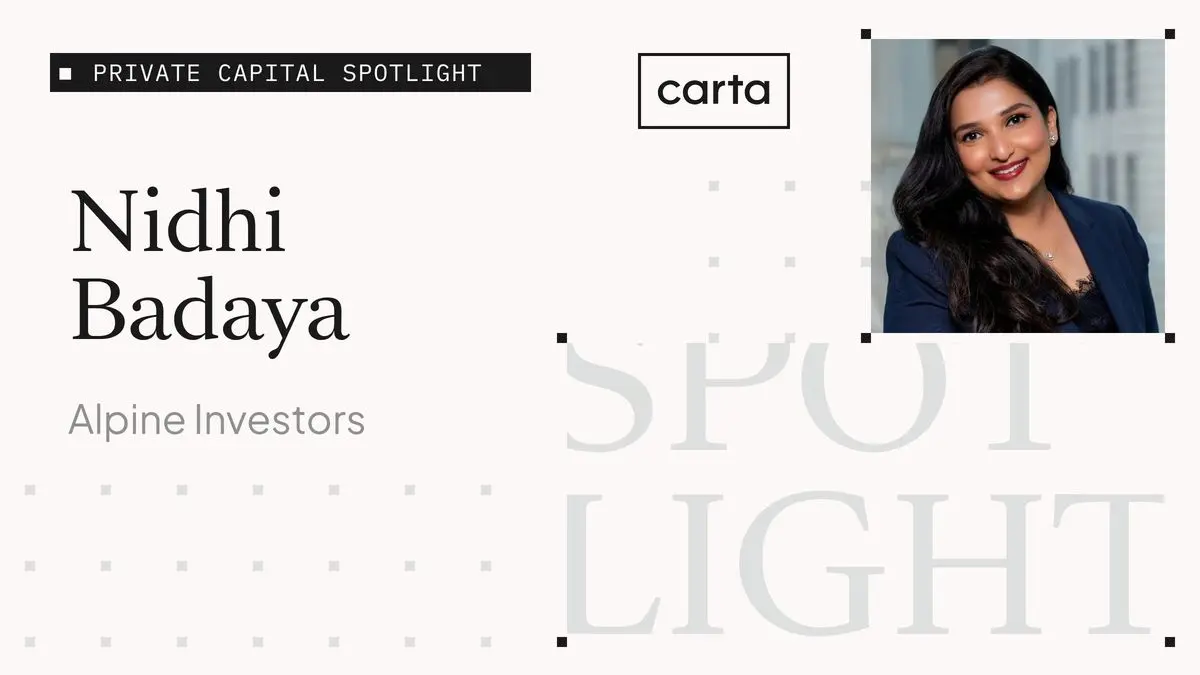
Nidhi Badaya is an operating partner at Alpine Investors, a San Francisco-based private equity firm with over $18.9 billion in assets under management that focuses on software and services businesses. Before joining Alpine, Badaya spent several years at Sterling Check Corp., a Goldman Sachs-backed background screening company, where she co-led the company's IPO. She holds an MBA from the MIT Sloan School of Management and an MPA from the Harvard Kennedy School. Her path wound through management consulting at Ernst & Young in London, enterprise sales and a chief of staff role at Microsoft, and a pricing leadership role at WeWork. Nidhi currently lives in Chicago with her husband and they are expecting their first baby in a few weeks!
Carta sat down with Nidhi to talk about what it means to be an operating partner, how to prepare a company for a public exit, and the career advice she finds herself giving over and over again.
CARTA: Tell us about your career path. What guided you early in your career?
NIDHI BADAYA: I started my career in management consulting at Ernst & Young in London. It's a great job for a 22-year-old—you're traveling around Europe, you're coming up to speed on a new problem statement every few months. It teaches you how to think strategically and critically about very different topics, and how to build relationships quickly
Then I moved to the U.S. for graduate school, and after business school I was one of the few people in my graduating class who pursued sales. I had interned at Microsoft during school and realized that one skill I didn't have was actually selling.
I'd gotten this piece of advice early in my career: To truly understand any company, you need to be close to the product or close to the money. I wasn't an engineer, so I chose to get close to the money. The way you get close to the money is by ringing the cash register.
Microsoft was one of the best places to learn that, and at the time, they had a sales-focused MBA recruiting program. I joined their enterprise sales program and loved it. I genuinely think everyone should have a stint in sales, because until you've carried the briefcase and asked for the check, you're still fairly removed from what a business is meant to do.
What came next?
I was picked to be Chief of Staff of Microsoft's Northeast region, which took me back to my strategy and operations background.
Then I got the opportunity to build the pricing team at WeWork, which came completely out of left field—I had no prior expertise in pricing. But I loved the chance to build something from scratch, and WeWork at the time was one of the hottest startups in New York. Within less than nine months, I'd helped build the entire pricing and revenue management function from the ground up, hired over 30 people, built a dynamic pricing tool, and rolled it out globally.
Then WeWork was going to IPO and then didn't—I think everyone saw that public implosion. I was on a work visa at the time, which added an additional constraint, so I started looking at other roles. That led me to Sterling Check Corp., which was owned by Goldman Sachs. I came on to support the CFO and CEO in running an enterprise transformation. That was my first real exposure to what a private equity-owned organizational setup looks like—and to what it means to take a company through a transaction.
By four months into that job, I was running large parts of the finance function: FP&A, pricing, data, and business intelligence. And very soon after that, we decided to take the company public. So I built out a public-company ready-finance function from scratch.
I co-led the IPO, and we also completed three or four acquisitions along the way. From roughly 2020 to 2024, we grew from around $500 million in revenue to north of $800 million. We took the company public and then it was ultimately acquired by our largest competitor, Silver Lake-backed company.
Because I had established myself as an operator in that space, I started getting interest from private equity firms. When Alpine Operations Group approached me for the SVP, Monetization role within their value creation team, Atlas, it felt like the right time to do something different. I was looking for a change of pace, but I still wanted to do intellectually rigorous work—and that's exactly what I got.
A lot of people who think about careers in private equity picture the investment team. Can you explain to those who are unfamiliar what an operating partner does?
There are many variations of this role across the industry. What's common is that you have to have actually operated something to land in this sort of role and you should be able to speak the language of the investing team. You have to have sold things, built things, built a team, experienced some leadership failures and successes of your own, before you can credibly advise the CEOs you'll be working with.
In general, you can think of yourself as a thought partner to the CEO, CFO, or Chief Revenue Officer of a portfolio company—or a set of companies your fund has invested in. Your job is to be a coach when needed, be ready to jump into the field when needed, and connect the dots between the board, the investment team, and the operating leadership of the company. You're asking: What does this team need? Where are they excelling? Where are the gaps? And you always have a lens toward talent: Are the right people in the right roles?
The role itself can be a generalist position where you're working with one company on their entire strategy, or it can be functional. You can be, for example, an Office of the CFO expert, working closely with CFOs on systems, process, budgeting. Both variations exist. But the most common thing every operating partner has to do is multidisciplinary stakeholder management. You're the nexus between the investment fund and the operating teams, making sure everyone is speaking the same language and working toward the same goals.
I don't recommend this path for anyone coming straight out of college or business school—you need that operating experience first. But it's an incredibly interesting role once you get there.
How do you think about value creation when you're working with a portfolio company?
At Alpine Investors, we believe exceptional people are at the heart of exceptional investment outcomes. My team aims to operationalize this belief across our portfolio companies. Alpine's operating philosophy is rooted in long-term value creation. Our mandate isn't about creative financial engineering; it's about building better, longer-lasting businesses. My own view on it is: You buy good businesses at fair prices, and then you bring a level of operational sophistication those organizations may not have had the resources to invest in before.
When I'm working with a portfolio company, my lens is never that the business needs to be transformed entirely. The whole point is that it was a good business to begin with—that's why we bought it. The question is: How do you take it from five or six to ten? What are the incremental changes that can dramatically improve results while also improving the customer experience, the employee experience, and building a better business in the process?
I think about value creation in two or three pillars. The first is go-to-market: everything from how you improve lead generation at the top of the funnel, to better sales forecasting, to understanding your customer acquisition costs and whether your pricing and packaging is right. The second is finance and systems: Do you have the right financial leadership, a strong FP&A team, a good reporting cadence, and systems in place to actually trust the numbers you're reporting? And then there's always the people angle: Do you have the best people in place in these roles who make the business work every day?
I strongly believe that value creation shouldn’t be a blue-sky strategy workshop. It’s about getting things done in partnership with the management team. You get very good at doing one or two things across a lot of companies, and you get results relatively quickly. You find the most important operational levers, for e.g. quick and effective pricing tweaks and you pull them quickly and consistently, helping the management teams minimize execution risk and churn risk.
You co-led an IPO at Sterling. What should management teams be thinking about when they're preparing for a public exit?
Any transaction is really a large-scale, intense project management experience. A public transaction just adds the complexity of the additional legal and compliance layers on top.
I think about the preparation in four buckets. The first is financial statements. You have to get your company through a PCAOB audit—that means the last several years of financials have to meet public company accounting standards. And within that, your forward-looking projections have to be defensible. You need a strong FP&A team and a model you can stand behind, without any surprises during the process. Equally important is the data infrastructure: External parties will want access to your data room, and you need systems that can actually support that cleanly.
The second bucket is the narrative. The right metrics have to be communicated with the right story of the business: What's the growth trajectory? What are the risks investors need to understand? What investments have been made? The CEO, CFO, and whoever will be on the investor roadshows need to do a lot of preparation to get that story right and then be completely consistent about it. Analysts who will model your business are trying to understand it very quickly; consistency is everything.
Third is SEC, legal, and compliance. This process can be prolonged, tedious–you need the CFO's office and your compliance team working very closely together. That's something you just have to do a really clean job with, because it determines whether you can transact at all.
The fourth thing—and people underestimate this—is that the business doesn't stop running while all of this is happening. It needs to be clear—who on your leadership team is focused on the transaction and who is making sure the business doesn't take a setback in the meantime. That parallel operating cadence is critical.
What are the most common mistakes you've seen in the lead-up to a transaction?
Timing is everything. There's a reason people say past results are not indicative of future performance—but in transactions, recent results are still something investors are going to be looking very carefully at. Investors want to see a sustained trajectory of growth they can believe in before they'll credit your forward projections. Timing your transaction when the results support the story and drive confidence in the future of the business is a skill, and I think it's underappreciated.
The second thing is getting your advisor team right. Every transaction involves a large cast—lawyers, bankers, accountants, consultants, compliance firms. Any weakness in that team shows up in the process, either as delays or as friction that didn't need to be there. You need to know exactly where you need help and what kind, and you need providers you can trust.
And the third is data quality. I've seen data rooms that are a mess—analysts working around the clock for weeks just trying to get the numbers straight. If you can invest in automating your reporting procedures, having clean, reliable data infrastructure before you ever begin a process, that work pays off enormously. Don't wait until you're in the middle of a transaction to find out your systems can't support the questions you're going to be asked.
You've served on both corporate and nonprofit boards. How do you navigate these rooms and make sure your perspective is heard?
It's a balancing act. It begins with knowing what you stand for and what your perspective is, and then you earn the right to be heard by demonstrating genuine expertise. For me tactically, I lean into what I know best, which is the P&L. I'm trained in finance, so it's natural for me to look at a set of numbers and ask hard questions about a cost line or a trend. That's my way in. It doesn't mean I don't have perspectives on sales, marketing, or other parts of the business—but starting from a clear place of expertise gives you credibility that you can then use to expand into other areas.
The second thing is genuine curiosity. Asking great questions is a critical skill—and not just as a tactic, but because you really do learn from the people in the room, especially when they come from different backgrounds than you. A lot of the time, listening first actually helps me shape my own thinking better.
A lot of what I learned about this came from sales training at Microsoft. They used a methodology where it all starts with asking great questions to understand your customer, then you bring something of value, and then you can guide the conversation. It only works when you've laid that foundation of real curiosity first. My sales experience helps a lot. I think most conversations, when you strip them down, are some form of persuasion—whether it's a CEO selling a budget to a board or anyone advocating for a perspective. Genuine curiosity and thoughtful questions create the foundation for all of it.
One thing Alpine does that I've adopted more broadly: In meetings, we start with the most junior person in the room sharing their perspective first. That gives them a safe space, and it signals that their opinion is as valuable as the most senior Partner in the room. I try to do that whether it's my own team, a board I'm part of, or any organization I'm working with. Making newcomers feel genuinely welcome isn't just nice—it makes the room smarter.
If you could go back to your first year at MIT Sloan or the Harvard Kennedy School and give yourself advice about navigating a career—in private markets or otherwise—what would it be?
I always say, if you truly know what you want to do with your life—then just go do that. Don’t edit your dreams and if you feel you have a clear passion, then pursue it with all you’ve got.
But in the absence of that——the alternative is having a really honest understanding of what you're good at and what you simply haven't had exposure to yet. Practicing journaling and honest reflection can be very helpful here
I had no idea whether I could be a good salesperson before I tried it. Nobody came to recruit for sales roles at business school the way they did for consulting or investment banking. But I recognized it was a critical skill I didn't have, and I kept an open mind. That muscle—reflecting on skills, identifying gaps, staying curious about the unfamiliar—is a toolkit you can carry from role to role for your entire career.
The other piece is learning to assess people—not in terms of who you like and who you don't, but who do you want to learn from and work with? That applies to the jobs you take and to the teams you build. Some of my greatest professional satisfaction has come from hiring people and watching them grow into roles and succeed and similarly, some of my biggest learnings have come from my previous bosses. I have been extremely fortunate in having bosses who have been incredible mentors. I've also turned down jobs when I didn't feel that potential in the person who would be managing me. Take bets on people—just as much as you hope they're taking bets on you.
If you don't have a North Star yet, have a compass. Know what you want to learn and who you want to learn it from and don’t hesitate to bet on people.
These are the lessons that have helped me build a career across continents, across functions, starting from zero multiple times and moving between sales, strategy, pricing, finance, and private equity. As I look into the evolution of both my personal and professional lives, these will continue to be my guiding forces.

DISCLOSURE: This communication is on behalf of eShares, Inc. dba Carta, Inc. ("Carta"). This communication is for informational purposes only, and contains general information only. Carta is not, by means of this communication, rendering accounting, business, financial, investment, legal, tax, or other professional advice or services. This publication is not a substitute for such professional advice or services nor should it be used as a basis for any decision or action that may affect your business or interests. Before making any decision or taking any action that may affect your business or interests, you should consult a qualified professional advisor. This communication is not intended as a recommendation, offer or solicitation for the purchase or sale of any security. Carta does not assume any liability for reliance on the information provided herein. ©2026 Carta. All rights reserved. Reproduction prohibited.