
- The alternative minimum tax (AMT), explained
- What is the alternative minimum tax?
- Who needs to pay the alternative minimum tax?
- History of the alternative minimum tax
- How is AMT calculated?
- 2026 AMT exemption amounts
- 2026 AMT exemption phaseout thresholds
- Free AMT calculator
- What deductions are still allowed under AMT?
- What does AMT have to do with exercising stock options?
- The bargain element explained
- What is an AMT credit?
- How can you minimize AMT related to your equity award?
- Frequently asked questions about AMT
What is the alternative minimum tax?
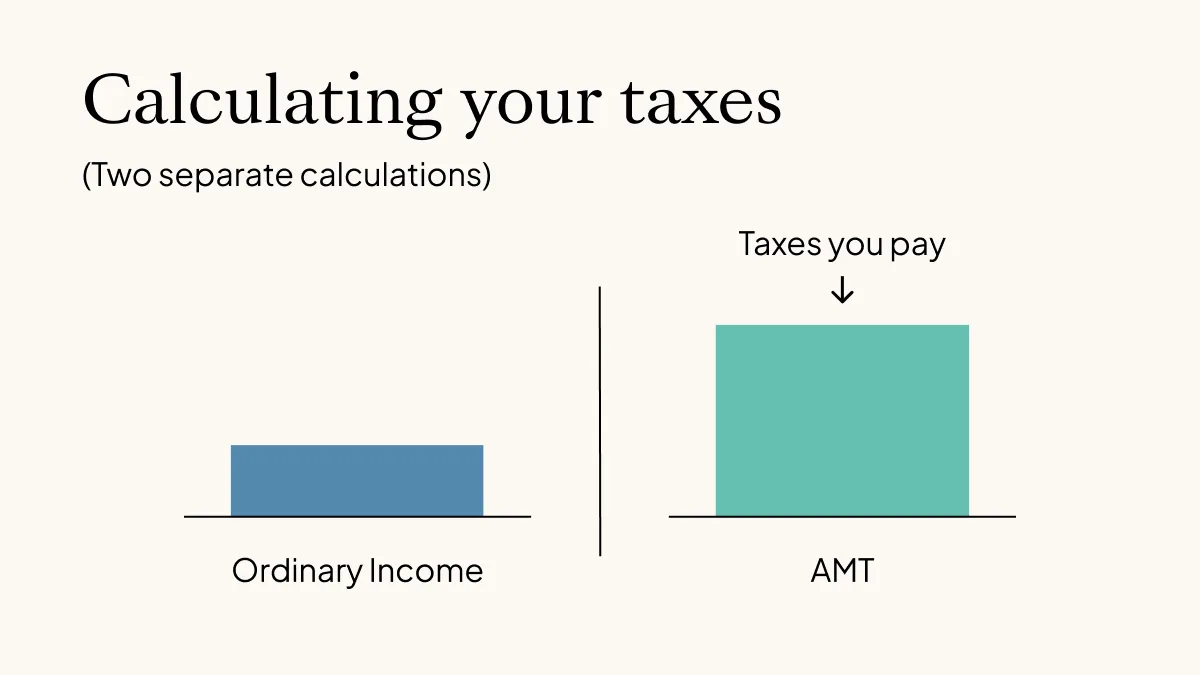
The alternative minimum tax (AMT) is a parallel tax system that requires all taxpayers to calculate their taxes twice—once under the regular tax system and once under the AMT rules—and pay the higher of the two. Originally designed to target high-income earners, the AMT calculation limits certain tax breaks, deductions, and credits available under the standard system. Taxable income under AMT is typically higher, effectively setting a tax floor that prevents wealthy taxpayers from using preferential treatment to eliminate their tax bill entirely.
Common deductions and exclusions that are limited or disallowed under AMT may include:
State and local tax deductions: Fully disallowed
Miscellaneous itemized deductions: Generally not allowed
Depreciation adjustments: Slower depreciation schedule for assets
Incentive stock options (ISO): The difference between the strike price and fair market value (FMV) counts as AMT income
Tax-exempt interest: Interest from some municipal bonds is taxable under AMT
Passive activities: Passive activity losses may be recalculated under AMT rules, which can reduce deductions otherwise allowed under regular income tax
Who needs to pay the alternative minimum tax?
The AMT applies to taxpayers whose income and deduction profile pushes their alternative minimum taxable income above the exemption threshold. What triggers the alternative minimum tax varies by situation, but it often catches people who claim large itemized deductions, exercise ISOs, or recognize significant preference income.
Despite its original intent, the AMT may affect a much broader range of people than many expect. For startup employees in particular, exercising incentive stock options can trigger a significant tax bill even if your cash income is modest, because the spread between your strike price and the stock's fair market value counts as income under AMT rules the moment you exercise, even if you haven't sold a single share.
You may be more likely to pay AMT if you:
Have a high income
Are married (or are married but file separately)
Live in a state with a high income tax
Recently exercised ISOs and didn't sell them
If you think you may be subject to the AMT, you can refer to the instructions for Form 1040 (Schedule 2) and Form 1040-SR or work with a tax preparation specialist. To calculate whether you owe AMT, you will use Form 6251, also known as the Alternative Minimum Tax form.
History of the alternative minimum tax
The AMT was introduced in 1969 to prevent wealthy taxpayers from using excessive deductions and credits to pay little or no taxes. While initially targeting the wealthy, the AMT eventually began affecting middle-income earners due to inflation, cuts in ordinary income tax rates, and tax bracket creep.
In recent years, Congress has made several adjustments to reduce the number of taxpayers who are subject to the AMT. In 2012, AMT exemption amounts were adjusted under the American Taxpayer Relief Act, which also made future exemption amounts indexed for inflation. The 2017 Tax Cuts and Jobs Act (TCJA) increased AMT exemption amounts through 2025, at which point they were set to expire.
The 2017 AMT exemption increases were permanently extended under H.R. 1, One Big Beautiful Bill Act (OBBBA), which was enacted on July 4, 2025. However, the OBBBA reverts the AMT exemption phaseouts to 2018 levels ($500,000 for single filers and $1 million for married couples filing jointly) and increases the phase-out rate (50 cents vs. 25 cents) for every dollar AMTI exceeds the phaseout threshold. As a result, more higher-income taxpayers could be subject to the AMT.
How is AMT calculated?
To manually calculate your AMT, start by figuring out your alternative minimum taxable income (AMTI). This includes:
Your adjusted gross income (AGI)
Certain deductions and exclusions that reduce your regular taxable income, such as the standard deduction or the deduction for state and local taxes
Preference items, like the spread between the price you paid to exercise your ISOs and their market value when you exercised
Calculating your AMTI can get complicated, so we recommend using tax software or talking to a tax professional. You can calculate your AMTI using IRS Form 6251.
While the standard deduction isn't allowed under the AMT system, the AMT provides its own exemption amount that you can subtract from your AMTI before calculating what you owe.
2026 AMT exemption amounts
Filing status | Exemption amount |
Single filers | $90,100 |
Married couples filing jointly | $140,200 |
Source: Internal Revenue Services (IRS)
However, these exemptions start to phase out once your AMTI hits a certain threshold:
2026 AMT exemption phaseout thresholds
Filing status | Threshold |
Single filers | $500,000 |
Married filing jointly | $1,000,000 |
Source: IRS
AMT exemptions phase out at 50 cents per dollar earned once AMTI reaches $500,000 for single filers and $1,000,000 for married taxpayers filing jointly. For every $1 above the threshold, your exemption is reduced by $0.50.
Once you reach your final AMTI, you can calculate your AMT liability.
26% AMT tax rate | 28% AMT tax rate | |
Married filing separately | AMTI up to $122,250 | AMTI above $122,250 |
All other filers | AMTI up to $244,500 | AMTI above $244,500 |
Source: Tax Foundation
If this amount is higher than what you'd have to pay doing your taxes the usual way, you have to pay AMT.
Free AMT calculator
Calculating AMT can be complicated, but you may want to get an estimate before you exercise, as it could be a significant amount of money.
To help, Carta created a free AMT calculator you can use to estimate your potential tax bill. To use this calculator, all you need is the following information:
Your income
Filing status
Strike price
Current FMV of your shares
The number of options you exercised or plan to exercise
What deductions are still allowed under AMT?
While AMT disallows many of the deductions you can claim under the regular income tax system, several deductions still count toward reducing your AMTI. Knowing which ones qualify matters, especially if you're timing an ISO exercise or a large charitable gift.
Deductions that remain available under AMT:
Charitable contributions: Donations to qualified nonprofits are deductible under AMT, the same as under regular income tax rules.
Home mortgage interest on acquisition debt: Interest paid on a mortgage used to buy, build, or substantially improve your primary residence (or a second home) is deductible under AMT. Home equity loan interest used for other purposes does not qualify.
Investment interest expense: You can deduct interest on debt used to buy taxable investments, but only to the extent of your net investment income.
Medical expenses: You can deduct unreimbursed medical expenses under AMT, but they must exceed 10% of your AGI.
The IRS provides additional detail on AMT adjustments and allowable deductions in Topic no. 556 and the instructions for Form 6251.
What does AMT have to do with exercising stock options?
For startup employees, the AMT most commonly comes into play when you exercise incentive stock options. Under the regular tax system, no income is recognized at exercise, but the AMT treats the spread between your strike price and the stock's fair market value as taxable income. If you exercise your ISOs and don't sell in the same year, that paper gain gets added to your AMTI even though you haven't seen a dollar of actual cash.
For example, if you exercise 1,000 shares at $1 each when they're worth $5 each, you need to add back $4,000 to your income when calculating AMT. You can report your spread on IRS Form 6251.
If you exercise your shares and sell them in the same year, the spread doesn't count as income for AMT purposes and instead counts as regular income.
The bargain element explained
The main trigger for the AMT when you exercise ISOs is something called the bargain element. The bargain element is the difference between the stock's fair market value on the day you exercise and the lower strike price you paid for it.
While this bargain element is not considered income under the regular tax system when you exercise, it is counted as income when calculating the AMT. This is the phantom income that can lead to a tax liability. The larger the bargain element, the more likely it is that you will be affected by the AMT.
What is an AMT credit?
If you pay the AMT, you may earn an AMT tax credit that you can use to reduce your tax bill in future years. When you pay AMT because of exercising ISOs, the IRS gives you a credit for that amount, which is calculated and tracked using Form 8801. You can then use what the IRS calls a special minimum tax credit in future years to lower your regular tax bill. Typically, you can apply this credit in the year you eventually sell the stock and realize the actual cash gain. This helps offset the capital gains tax you owe at that time, effectively returning the AMT you paid in a prior year.
One important caveat: You can only use this credit in years when you're not subject to AMT, so if you trigger AMT again the following year, the credit has to wait. The good news is the credit carries forward indefinitely until you're able to use it.
If you paid taxes to a foreign government, you may also be able to claim an AMT foreign tax credit to offset a portion of your AMT liability, separate from the minimum tax credit discussed above.
How can you minimize AMT related to your equity award?
Tax planning is your best defense against an unexpected AMT bill. Talk to a tax professional before you exercise your options. They can tell you how many ISOs you can exercise without triggering AMT and advise you on whether to exercise or sell and when.
If you sell your shares (that used to be ISOs) in the same year you exercise, you won't have to include the spread in your AMTI. But you won't qualify for ISOs’ favorable tax treatment, since you need to hold them for at least a year after exercising to qualify for long-term capital gains tax benefits.
If your company allows early exercising, you could consider exercising your ISOs right when you're granted them and filing an 83(b) election within 30 days. This allows you to be taxed on the day you exercise instead of waiting for your shares to vest. If you exercise your ISOs as soon as they're granted, there usually won't be a spread you need to add to your AMTI. However, you're paying cash now for shares that may lose value in the future.
Other strategies to minimize your AMT obligation include lowering your adjusted gross income. Your tax advisor may suggest maxing out contributions to your retirement accounts and increasing charitable contributions to nonprofits. However, the effectiveness of any strategy depends on your overall tax picture, so work through the numbers with a professional before acting.
Carta Equity Advisory helps the employees of Carta’s customer companies make informed decisions about equity ownership and taxes.

Frequently asked questions about AMT
The rules around the AMT and stock options can be confusing, but a few common questions come up frequently.
What happens if I sell my shares in the same year I exercise?
If you sell your shares in the same year you exercise your ISOs your profit from the exercise will be generally taxed as ordinary income, but you will not have an AMT adjustment related to that exercise.
What is Form 3921?
Form 3921 is a tax document your employer provides after you exercise ISOs. It reports the key details you need to calculate your taxes, and companies on Carta can automate its delivery to employees.
Do I still get QSBS benefits if I pay AMT?
Yes, paying AMT on your ISO exercise does not prevent your shares from qualifying for qualified small business stock (QSBS) tax benefits later, as these are two separate tax rules that apply at different times.
What is the difference between the AMT and capital gains tax?
The AMT can be triggered by the exercise of ISOs based on the paper gain of the bargain element. Capital gains tax, on the other hand, is triggered by the sale of your shares and is based on the actual cash profit you make.
How do you avoid alternative minimum tax?
One common way to reduce AMT exposure is to carefully time your ISO exercises, working with a tax advisor to model how many options you can exercise in a given year without triggering AMT. Because AMT resets each tax year, you can plan around it by spreading exercises across multiple years to stay below the threshold. Beyond ISOs, you can also minimize other preference items by avoiding private activity bonds and being strategic about the timing of large capital gains and itemized deductions.
How do I know if I need to pay AMT?
The IRS provides a worksheet in the instructions for Form 6251 that walks you through the calculation. If your tentative minimum tax exceeds your regular tax, you owe AMT. Tax software and most tax professionals can run this check automatically when you file.

DISCLOSURE: This communication is on behalf of eShares, Inc. dba Carta, Inc. ("Carta"). This communication is for informational purposes only, and contains general information only. Carta is not, by means of this communication, rendering accounting, business, financial, investment, legal, tax, or other professional advice or services. This publication is not a substitute for such professional advice or services nor should it be used as a basis for any decision or action that may affect your business or interests. Before making any decision or taking any action that may affect your business or interests, you should consult a qualified professional advisor. This communication is not intended as a recommendation, offer or solicitation for the purchase or sale of any security. Carta does not assume any liability for reliance on the information provided herein. This post contains links to articles or other information that may be contained on third-party websites. The inclusion of any hyperlink is not and does not imply any endorsement, approval, investigation, or verification by Carta, and Carta does not endorse or accept responsibility for the content, or the use, of such third-party websites. Carta assumes no liability for any inaccuracies, errors or omissions in or from any data or other information provided on such third-party websites. © 2026 eShares, Inc. dba Carta, Inc. All rights reserved. Reproduction prohibited.