Executive summary
The startup job market in the Asia-Pacific, Middle East, and Africa (APAC & MEA) shows signs of improvement after a few years of pulling back. The hire-to-departure ratio has recovered, with two and a half employees being hired for every departure in the first half of 2026. That’s nearly double the recent minimum of 1.26 hires per departure back in 2024.
Equity grants are a growing and important part of the compensation story. Although early employee equity grants issued by companies in APAC & MEA tend to be smaller than those issued by their U.S. counterparts, initial grant sizes are now rising. The median initial equity grant size declined from 2022 to 2024, but as of the first half of 2026, it was cumulatively up 39% from 2022.
Employee confidence in equity is also returning, as evidenced by a recovery to a 43% exercise rate of in-the-money vested options in H1 2026, up from a low point of 27.4% in 2024. The H1 2026 rate is approaching the recent high of 49.1% set back in 2022.
This report analyzes employee headcount, hiring trends, equity grant sizes, option exercise rates, and vesting structures across private companies headquartered in APAC & MEA on Carta, with comparisons to the U.S. where applicable. Some analyses are broken out into four subregions: Australia and New Zealand (ANZ), East and Southeast Asia (ESEA), Middle East, North Africa, and South Asia (MENASA), and Sub-Saharan Africa (SSA).
Key takeaways
APAC & MEA companies have larger teams at every stage: From the seed stage onward, APAC & MEA companies typically have more employees than comparable U.S. companies. At Series C and beyond, the gap is striking: The median APAC & MEA company at these later stages has 119.5 employees, versus 43 in the U.S.
The region’s equity discount on early hires is real: The median first hire at an APAC & MEA startup receives an initial grant comprising 0.505% of the company’s equity, compared to 0.731% in the U.S. For the second hire, the gap widens: 0.218% versus 0.400%.
There are notable geographical nuances: The subregions within APAC & MEA are diverse and have their own market dynamics. While in-the-money option exercise rates are improving, there is significant variation. ANZ leads at 37.1%, followed by ESEA (36.7%), MENASA (29.1%) and SSA (19.5%).
Employee headcount and movement
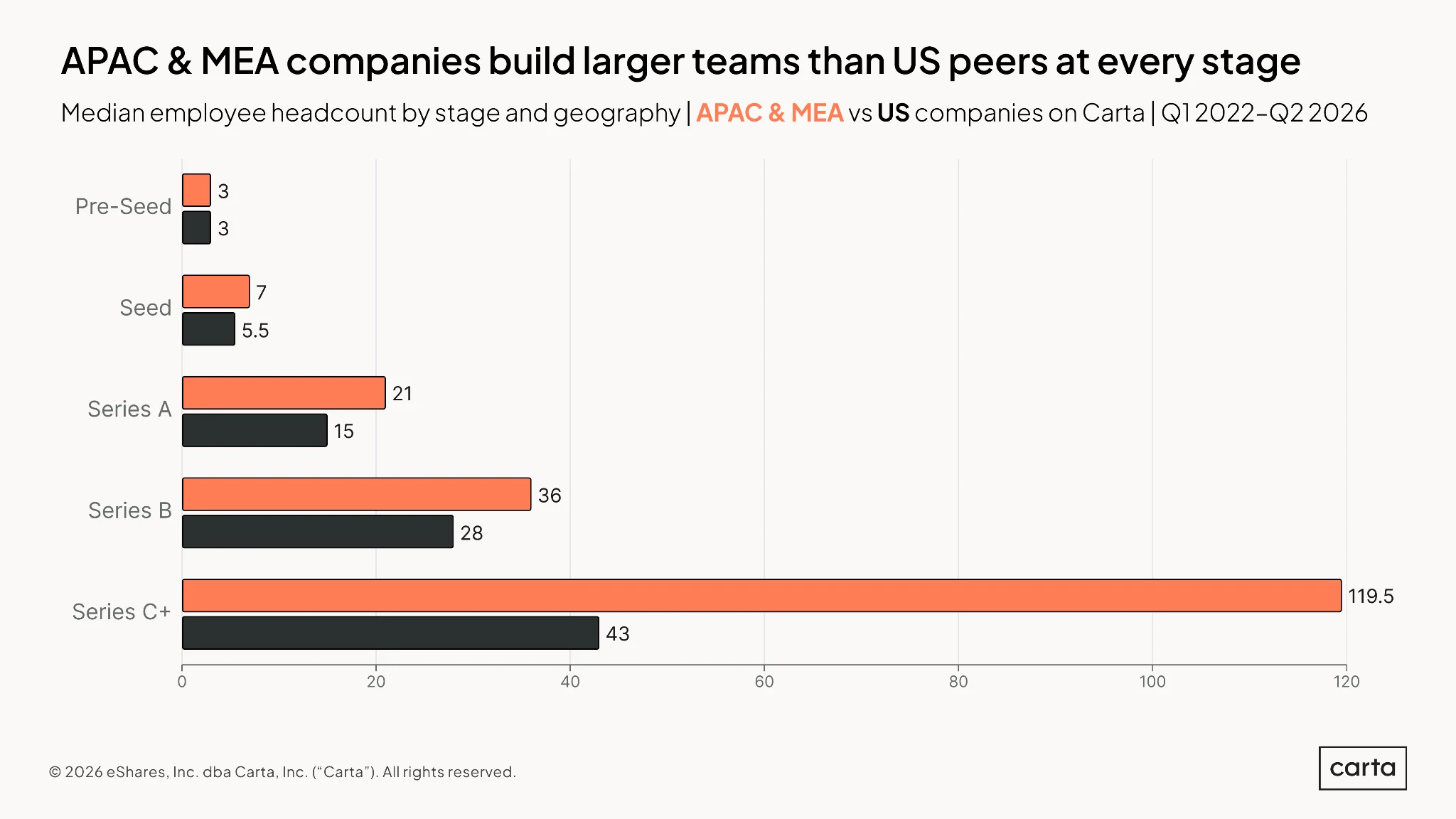
APAC & MEA startups tend to have more employees than their counterparts in the U.S., especially at later stages.
The gap holds at every stage from seed onward and is consistent enough across this dataset to be treated as a durable regional characteristic. By Series C+, the scale difference between APAC & MEA and U.S. companies is noteworthy. The median APAC & MEA company at these later stages has 119.5 employees. The median U.S. company has 43.
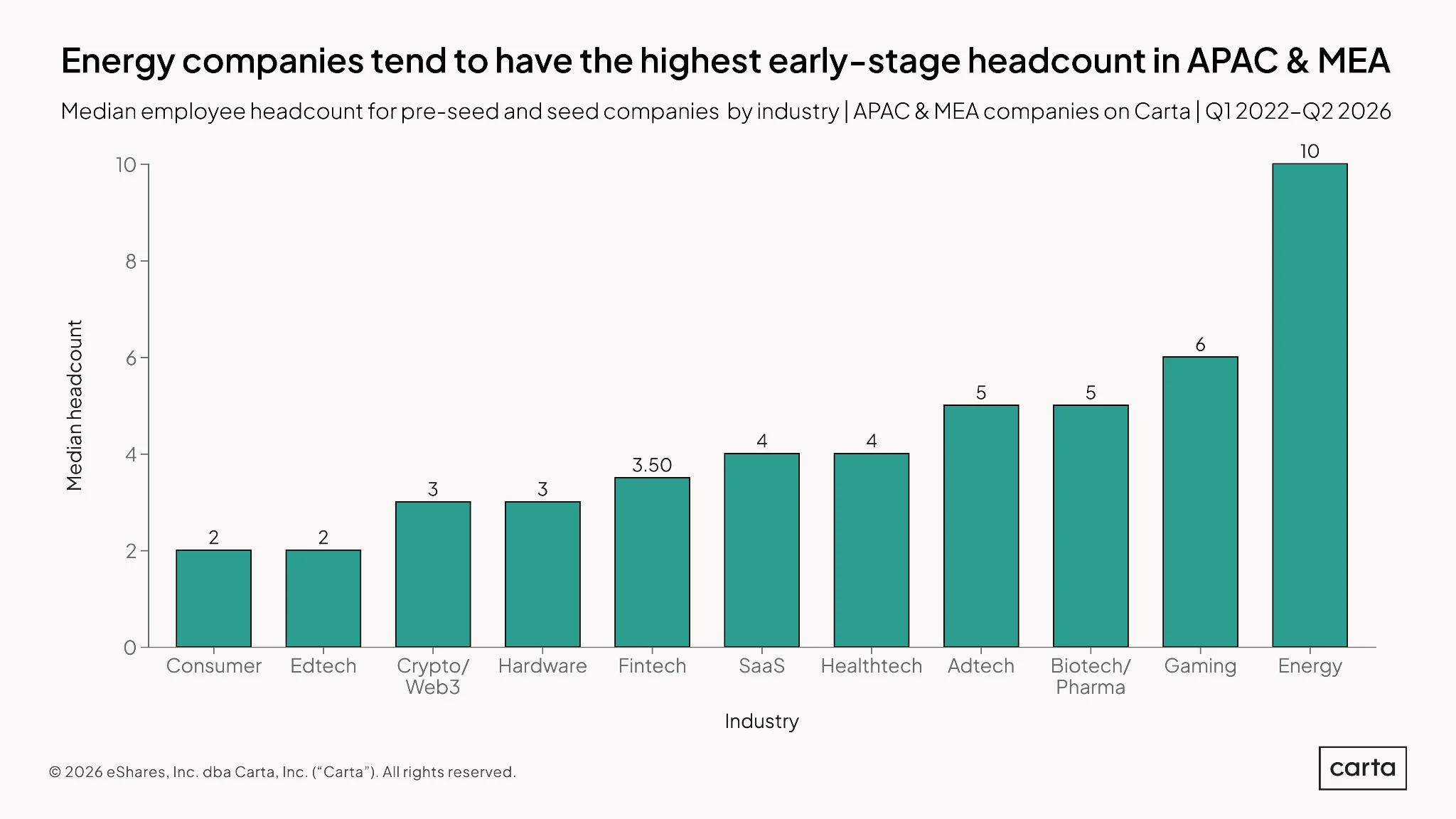
Startup headcount varies greatly by industry, even at the same stage. Considering early-stage companies at the pre-seed or seed stage, the median headcount in APAC & MEA ranges from two to 10 across industries. Energy startups have a median employee count at these stages of 10, the highest of any sector, driven by the higher operational and compliance demands they often must meet before shipping a product.
Read the full report
Submit the form below to access the full report and receive a copy in your inbox.



DISCLOSURE: This communication is on behalf of eShares, Inc. dba Carta, Inc. ("Carta"). This communication is for informational purposes only, and contains general information only. Carta is not, by means of this communication, rendering accounting, business, financial, investment, legal, tax, or other professional advice or services. This publication is not a substitute for such professional advice or services nor should it be used as a basis for any decision or action that may affect your business or interests. Before making any decision or taking any action that may affect your business or interests, you should consult a qualified professional advisor. This communication is not intended as a recommendation, offer or solicitation for the purchase or sale of any security. Carta does not assume any liability for reliance on the information provided herein. ©2026 Carta. All rights reserved. Reproduction prohibited.